Terra-cotta Army

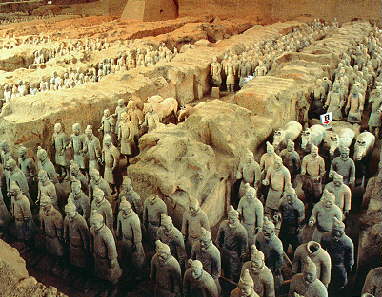
The eight wonder of the world...This picture shows the Terra-cotta army that was buried along with the First Emperor Qin Shihuang(259-210 B.C.)
They were found in 1974 while a well was being dug 20 miles east of Xi'an, at the foot of Lishan Mountain. So far more than 2,000 warriors have been unearthed, and investigations suggest that up to 6,000 more lie beneath. According to historic surveys, a splendid necropolis apparently depicting the whole of China in miniature is located in the center of the mound, 154ft. deep.
According to old records, the ceiling is said to be studded with jewels depicting the sky, and mercury was pumped in mechanically to create images of flowing rivers. Trial digs have shown high contents of mercury in the soil but the official entrance to the tomb has yet to be found.
Several hundred thousand workers spent 36 years building the tomb, which Shihuang ordered built at the age of 13. It is said that workers and supervisors involved in its design and construction were buried alive within the tomb. Also by the order of Hu Hai, son and the second Emperor of the Qin, all the concubines and palace maids who were without children were buried alive to accompany the dead monarch when he was entombed. Some speculations say that the Emperor was so superstitious and fearful that he had the necropolis built as a decoy and was, in fact, buried somewhere else.
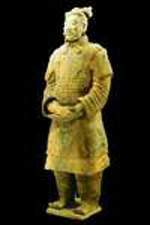
A General
These warriors, horses and chariots are arranged in battle array and gives us a miniature picture of the army of the Qin Dynasty. Each soldier is unique, having distinct features and differing from each other in height and built. It is speculated that each statue was based off a real person. They were all dressed and ready for battle. They carried spears and various other combat weapons. Each warrior is wearing an army uniform which distinguishes the soldier's rank. The soldier's uniforms were painted either red or green. They also wore either brown or black armor.
Ravages of floods, fire, and time have erased most of the original paint from statues. Ancient pigments made from minerals were mixed with a binder such as animal blood or egg white to color the statues. Charcoal may have once tinted the hair.
The figures are the earliest life-size clay sculptures in China.
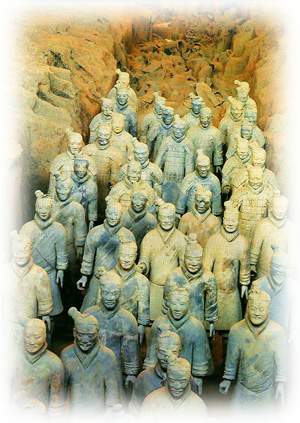
The emperor
Emperor Shihuang was the first emperor of China and was the founder of China's first multinational and centralized feudal empire-"Qin". He was born during the "Warring States Period" in Chinese history when seven separate feudal kingdoms were constantly at war with each other. He gained the throne as the king of the State of Qin at age 13. During his reign, he fought for ten years (230-221 B.C.) to unify China, finally putting an end to the situation in which China had been divided for over 5000 years. After the unification of China Shihuang ordered that the Legal codes, currencies, written languages, and weights and measures be standardized. He proclaimed himself the"First Emperor" in the hope that his descendants would carry on the hereditary system.
Back to the Wonders page