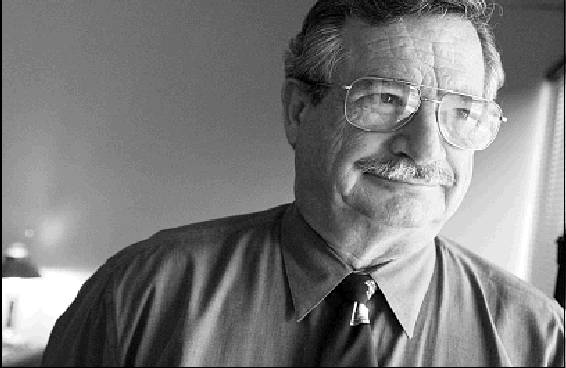
 Kenneth C. Ravenna, vice president of LandSea Systems, said that since his company was founded in 1992, it has sold about 10,500 satellite systems all over the globe, about 3 percent of the market. (Photo by Genevieve Ross)
BEACH COMPANY'S PHONE BROUGHT IRAQ WAR HOME
Published: April 28, 2003
Section: BUSINESS, page D1
Source: DEBORAH MARKHAM THE VIRGINIAN-PILOT
© 2003- Landmark Communications Inc.
VIRGINIA BEACH — News junkies saw and heard more of Operation Iraqi Freedom than any previous war, thanks to media coverage transmitted by satellite phones.
Some of that coverage likely was handled with phones sold by a Virginia Beach company, LandSea Systems Inc., whose clients include The New York Times and Los Angeles Times. With about 25 employees and an undisclosed number of clients, the company expects revenues of $13 million this year, an 8.3 percent increase over last year’s $12 million in revenue. 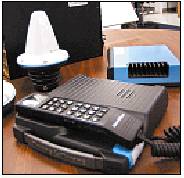
Since its basement start-up in 1992, LandSea Systems has sold about 10,500 satellite systems used worldwide, which is 3 percent of the world market, said Kenneth C. Ravenna, LandSea Systems’ vice president.
Clients of LandSea Systems include the military, the Department of State, White House communications, various embassies and private industries.
LandSea Systems sells mobile satellite communications systems manufactured by Thrane & Thrane,a Danish firm that markets its product globally through more than 100 distributors.
As one of five global Thrane & Thrane ‘‘Certified Service Centers,’’ LandSea Systems can repair satellite units on-site rather than send it back to the manufacturer. 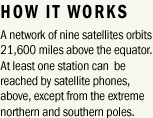
‘‘Usually it’s not the phone that is broken,’’ said Cooper. ‘‘It’s they don’t understand how to use it.’’ To help clients learn how to use the phones, LandSea Systems offers free individual and group training, including an annual three-day course at the Oceanfront. If LandSea Systems clients have any problems with their units in the field, they can call the company’s technical support phone number, which can be found on the bottom of each system. Customer service is available 24 hours a day, seven days a week.
As an Inmarsat partner and service provider, LandSea Systems’ equipment connects clients through Inmarsat’s global area network of satellites.
The network consists of nine satellites orbiting 21,600 miles above the earth’s equator. The satellites are positioned to allow at least one station to always be reached, except from the extreme northern and southern poles.
Inmarsat typically keeps four satellites active for high-data rate services. The company broughta fifth satellite online in mid-March to handle demand for services, particularly in the Middle East.
The high-speed service can cost $7 a minute. The low-speed service, mostly used for voice calls, can cost $2 a minute.
E-mail and other documents can be transmitted through an ‘‘always on’’ packet data service, which can cost about $4.50 per megabit of data sent or received.
LandSea Systems’ best-selling land unit that incorporates all three services is the Capsat Messenger, also known as the ‘‘M4.’’ The other best-selling land unit is the Capsat Mobile Telephone, also known as the ‘‘mini-M.’’ The mini-M transmits voice and data at 2,400 bits per second. It sells for about $2,500. The M4 transmits voice, fax, video and other high-speed data at 64 kilobits per second and sells for about $7,200.
The price may seem high for cellphone-carrying laymen, but officials in the news business say the technology is worth every cent.
Gary Stokes, news director for WAVY-TV 10 and Fox 43, said the station’s satellite phone system is a great addition to its broadcast technologies, which includes microwave and satellite trucks. The portability of the units allows reporters to cover action where a truck can’t drive or might be compromised.
However, mobile satellite phone video transmissions look shaky. Most people notice how the voice follows the speaker’s lip movement by a beat.
‘‘It’s a new technology that allows us to get footage from anywhere in the world,’’ he said. ‘‘But, it’sa new technology that is constantly evolving.’’ Although the conflict in Iraq fueled purchases of satellite phones, LandSeas Systems sales remained steady.
‘‘We’re on track to making our goal this year,’’ said Barbara Cooper, founder and president of LandSea Systems.
Stratos, a competing satellite communications firm in Bethesda, Md., made $95.7 million the first quarter of this year, a 21 percent increase in revenue from the first quarter of last year. It was the company’s best quarter.
‘‘There has been increased demand for land satellite services due to the war,’’ said Al Black, spokesman for the company. ‘‘The biggest users responsible for the increase this quarter are the military and media.’’ Satellite phone carriers Globalstar Telecommunications, based in San Jose, Calif.; Iridium, based in Arlington, Va.; and Inmarsat, headquartered in London, also experienced more business from journalists, the military and other organizations during the conflict in Iraq. Some carriers got a boost in early April when a rival, Thuraya Satellite Telecommunications Co., saw its units banned from Iraq by the United States.
Thuraya’s phones included global positioning system capabilities that might have allowed the Iraqis to zero in on American positions.
The ban left many journalists scrambling to replace their phones.
Apparently, there was no stampede toward LandSea Systems.
‘‘We really haven’t had any increase because of the war,’’ said Tara Bair, a spokeswoman for LandSea Systems. ‘‘Something like 80 percent of our business is with the government so it isn’t anything new.’’
Reach Deborah Markham at 446-2033 or dmarkham(AT)pilotonline.com
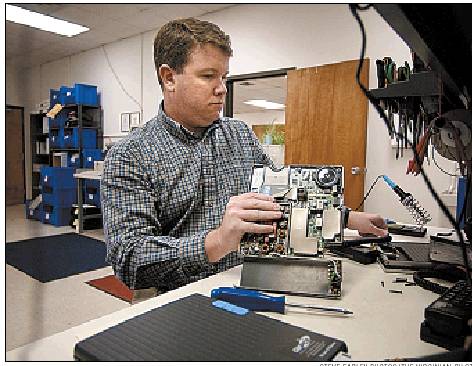
John Roomsburg services a satellite phone at LandSea Systems in Virginia Beach. The company
has sold satellite phones to media companies covering the war in Iraq. (Photo by Steve Earley)
Description
of illustration(s):
Color photo: STEVE EARLEY/THE VIRGINIAN-PILOT
GENEVIEVE ROSS/THE VIRGINIAN-PILOT