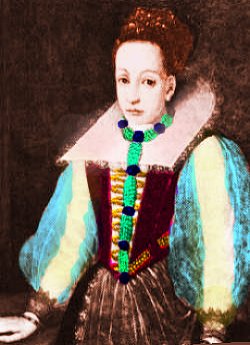
| Countess Elizabeth Bathory (1560-1614), often referred to by her Hungarian name, Erzsebet, was a Hungarian noblewoman, born to one of Hungary's wealthiest and most influential families. As with most European aristocratic dynasties, the Bathory clan was fraught with mental illness resulting from a long tradition of inbreeding. King Stephan of Poland ranks as one of Elizabeth's more memorable relatives; the less savory included a bisexual, sadistic aunt and a schizophrenic uncle. Small wonder, then, that Elizabeth began suffering from epileptic fits at the age of four or five. The young Countess was a spoiled child, raised by a string of governesses employed to cater to her every need. Though her erratic fits and stand-offish personality were bothersome, she was generally regarded as an intelligent and capable young woman. |
At
the age of eleven (or fifteen, by some accounts) Elizabeth became engaged to
twenty-six-year-old Count Fernencz Nadasdy, a renowned war hero whose sadistic
flair would ultimately earn him fame as "The Black Hero of Hungary."
As was not uncommon in aristocratic circles, the marriage was a purely political
union engineered by Elizabeth's opportunistic mother. The Nadasdy clan also
climbed a few rungs on the social ladder - the Bathorys were a more powerful
family with greater seniority. Though much speculation has been published with
regard to the Countess' marriage, Fernencz's frequent absences were a hard fact.
The first few years of their marriage produced few children, and it was during
these long periods of solitude that Elizabeth's sadistic nature took rein.
Before we explore any further, I must mention an incident from the Countess'
childhood that clearly influenced her brutal actions as an adult. At a young
age, Elizabeth witnessed the execution of a traitorous gypsy; the accused was
stuffed in the dissected belly of a live horse and sewn inside. The gypsy's
death was presented as a public spectacle (one particularly titillating for
the nobles who attended); no sympathy was shown for the man's death nor was
any remorse present on the faces of his executioners. This incident convinced
young Elizabeth - in whom the seeds of cruelty had been sown at birth - that
commoners could be killed with impunity and without fear of retribution.
In her early twenties, Elizabeth, perhaps in a fit of boredom, discovered that torturing servants "tickled her fancy," if you will. No clear reasons have yet been given as to why the Countess took such exquisite pleasure in the pain of others, but overwhelming evidence proves that she did. Unfortunately for the teenage females in the servant population, Elizabeth's choice targets were adolescent girls. She began by ripping their bodies apart with red-hot pincers, setting them on fire, and torturing them with "star-kicking," which entailed oiled bits of paper being placed inbetween the servants' toes; the paper would be lit on fire while the Countess delighted in the spectacle of the girls attempting to kick away the flames. (How utterly delightful.) She was known to rip girls' heads apart - literally - by pulling their mouths open until they tore at the edges and the neck snapped. On her better days, she delighted in humiliating girls by forcing them to strip naked and perform their household duties in full view of men.
When Fernencz returned home from war, he often indulged in the torture spectacles with his wife, though most accounts note that his capacity for administering agony was vastly exceeded by his wife's - Ferencz would storm off in disgust while Elizabeth squealed in delight. In her late twenties, the Countess bore two daughters and a son, all of whom were promptly relinquished to the care of wet nurses and governesses shortly after birth. Though the Countess ignored her children, she did not include them in her tortures.
As the Countess grew steadily older, her thirst for innocent girls' flesh heightened. She invented new forms of torture, such as "honey torture," in which a girl was covered with honey and left outside to be devoured by insects and predators, and "water torture," in which a girl was stripped naked, taken out into sub-zero temperatures, and showered with cold water until she froze to death. Following the death of her husband (which some attribute to the Countess herself, though no strong evidence exists), she became ever more concerned with her fading beauty and began the regular blood-baths which earned her notoriety.
When an unfortunate servant girl pulled the Countess' hair while styling it,
Elizabeth slapped the girl so hard that blood splashed on her hand. As she went
to wipe it off, she believed that the skin touched by the blood had regained
the smooth, creamy complexion for which it had once been famous. She consulted
her accomplices - witches known as Darvulia, Helena Jo, and Dorka-who assured
her that the blood of virgins was indeed the proverbial fountain of youth for
those who bathed in it.
Elizabeth ordered the maid's throat slashed and her blood drained into a large
vat; she bathed lavishly in the blood while it was still warm. Thus began a
horrific ritual; hundreds of girls were kidnapped, brought to the castle, and
drained of their blood. Often she bit their necks and breasts herself, drinking
the blood and eating the flesh from their open wounds. Elizabeth ordered torture
devices from German clockmakers and blacksmiths; soon Csjethe Castle, where
she lived out much of her adult life, had a full-scale torture chamber in the
basement. Aside from the notorious vat and a kitschy iron maiden, there were
spiked cages and a spike-filled metal orb hanging from the ceiling. Girls were
placed in the cylindrical spiked cages and prodded with red-hot iron pokers
until they impaled themselves on the spikes; others were placed in the spiked
orb, which was rocked back and forth like a pendulum until the girl's flesh
had been shredded. The cages were fitted with drains at the bottom so that the
Countess could stand beneath them for a "blood shower."
Elizabeth's reign of terror continued for years. The casualty list grew into the triple-digits; this was later verified by the roster of victims the Countess kept in her writing desk. Bodies of dead girls were burned, buried beneath the castle floors, or left in the wilderness to be devoured by scavengers. Shockwaves of terror penetrated the surrounding countryside from which most of Elizabeth's victims had been abducted, but few dared speak out for fear of the Countess' infamous wrath. Even the clergy - supposedly responsible for protecting peace and justice - remained silent.
But even a powerful aristocrat cannot commit 600+ unavenged murders. Towards
the end of her murderous marathon, the Countess became sloppy, ordering dead
girls tossed over the castle walls to be devoured by passing wolves and asking
clergymen to perform burial services for mutilated girls. However, no direct
action was taken until the Countess, having exhausted her supply of adolescent
girls in the area, began preying on noblewomen of lesser rank. She established
a sham "school" for teenage girls of noble birth, inviting them to
Csjethe Castle with the promise of education, only to torture them to death
for months at a time.
A
clergyman finally notified King Matthias of Hungary, who commissioned Elizabeth's
cousin, Count Thurzo, to conduct an investigation of the Countess' activities.
A raid on the castle proved ghastlier.than Thurzo and his men had prepared themselves
for: one dead girl in the main hallway, another, still alive, whose entire body
had been pierced with holes, and several more hung from the rafters of the basement
ceiling like gutted deer, their blood emptying into Elizabeth's now-legendary
vat. Fifty bodies were exhumed from the basement of the castle; the roster,
discovered in Elizabeth's desk, listed the names of 650 girls who had been murdered.
The Countess' accomplicies - Dorka, Ficzko, and Thorko, among others - were
taken into custody, while the Countess herself was placed under house arrest
in her castle.
In 1610, the Countess and her accomplices were placed on trial. Dorka, Helena
Jo, and Ficzko confessed after lengthy torture sessions, though their attempts
to diminish their roles in the terror were blatant; "life in prison with
the possibility of parole" was not an option in seventeenth-century Hungary.
All placed the majority of blame on Anna Darvulia, a witch consort of Elizabeth's
who passed away several years prior to the trial. Over 200 witnesses were called,
many of whom had little more than hearsay to offer; nonetheless, confessions
of those close to the Countess' court, as well as the grisly evidence uncovered
at Thurzo's raid, provided ample testimony to her guilt. Elizabeth herself never
physically appeared in court or admitted to any crime.
Here I must briefly digress. Elizabeth's failure to appear in court was not
by her own choosing; in fact, she pleaded constantly with her captors to publicly
present her own side of the story. Unfortunately for her, King Matthias was
not privy to her demands, having engineered her trial as a public spectacle
to check the unruly nobility. Although there exists ample evidence proving Elizabeth's
guilt, it is important to note that she was not permitted to testify at her
own trial.
Her accomplices, however, were shown no mercy. Dorka and Helena Jo, whose hands
had "spilled Christian blood," had their fingers torn out with red-hot
pincers before being thrown into a fire; the others were beheaded and burned
at the stake. Another cohort, Erszi Majorova, was later beheaded when evidence
surfaced linking her to the Countess' sadistic activities.
By law, Elizabeth's noble birth prevented her from sharing the fate of her accomplices,
but her cousin Thurzo sentenced her to "perpetual imprisonment in [her]
own castle" in 1611. (Legend holds that he pronounced this judgement upon
raiding the Countess' torture chamber, but we have no evidence that this ever
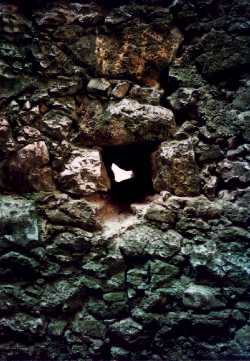
happened.) Elizabeth was walled into a small chamber in her castle, with only
a small hole left open for air and food. The tower still stands today in the
modern Slovak Republic. A full transcript of the trial was produced and remains
today in the Hungarian State Archive in Budapest.
Countess Elizabeth Bathory never confessed to her crimes, nor did she utter
a word of repentence or remorse. After refusing the services of a battalion
of priests, she was found dead in her prison in 1614, three years after her
initial imprisonment. She was fifty-four years old. Folklore has attributed
her death to deprivation of virgins' blood, but old age was the most likely
culprit.
A complete transcript of Elizabeth's trial was compiled during the proceedings
but spent the next few centuries locked away in the Hungarian State Archive
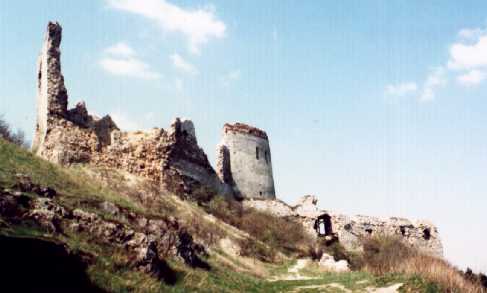
in Budapest. Csjethe Castle fell into ruins, which can be seen today in the
modern Slovak Republic. (For pictures of what remains of the castle, please
see the "images" page.) Elizabeth was interred in the Bathory family
tomb, and the act of speaking her name was declared a criminal act by the Hungarian
Parliament. Only after the demise of Communism was the Archive opened and the
trial transcript released. The prior lack of evidence, though, did not stop
Hollywood from turning out a handful of cheap horror flicks based on the Countess'
story. The 1970's film Countess Dracula was the first to deal explicitly with
the Bathory story, though the villainess is named "Mathory." Movie
insiders say that a newer version of the Bathory story (starring (gulp) Linda
Blair, which offers some insight into its predicted quality) is in the works
right now.
 |
 |
 |
"THE
RUINS OF THE CASTLE" |
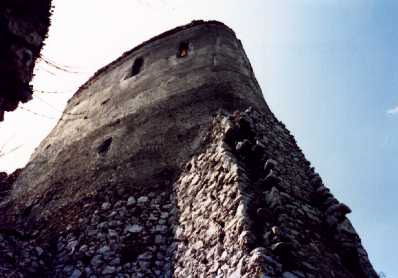
"A
VIEW OF THE TORTURE CHAMBER FROM BELOW" |
"THE
ONLY HOLE SHE HAD IN HER OWN CHAMBER" |