Legend has it that sharks' preferred time of attack is at dawn and sunset. The legend is said particularly to apply to the Great White. Is there any truth in this old rumour and, if there is, why should it be so?
The other thing about White Sharks' attacks is that they prefer to launch themselves at their victim from beneath. Is there any reason to do with the physics of their environment why they should do so?
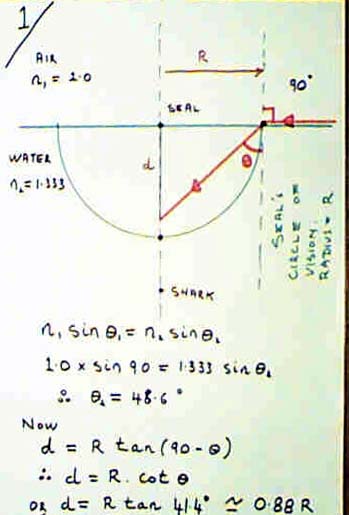
Consider the angle of Total Internal Reflection (TIR). Water is denser than air, as everybody knows, and Snell's Law applies. There will be a Critical Angle where light emanating from a source beneath the waves will be refracted parallel to the water's surface. But the Law is symmetrical. Light emanating from a point source on the horizon will find a path along the Critical Angle. That means light from a setting or rising sun can only penetrate a certain distance "d" beneath the surface with respect to a line vertical from the surface to an observer (shark) below the surface.
How deep is "d"? How does this affect the shark? And how does it affect the shark's prey, the seal?
A seal is floating peacefully on the surface, let's say. Let's say it can see, in a hemisphere underwater, a distance "R". Distance "R" is, of course, determined by the turbidity of the water. Deep below, deeper than distance "R", a shark lurks. It can see the seal, silhouetted by the backdrop of the sunlit surface, but the seal can not see it. While it stays outside the seal's vision limit of "R", it remains unseen. But it needs a meal : it could rush at the seal but, as soon as it comes within distance "R", its victim will see it and may escape.
If you're a shark, if you're a predator of any sort, you stalk your prey. You try to get as close as possible without being seen before you attack. The element of surprise is all important. But, ultimately, there comes a point where you have to break cover and rush at your victim. The closer you can get before that fatal moment, the better. Miscalculate and you go hungry. Obviously, the essence of successful stalking and ambush is to insinuate yourself inside the victim's normal radius vector of detection. Even a slight advantage in that regard might be crucial.
Consideration of the geometry of refracted rays near the
angle of TIR leads us to see that a shark cruising below a quiescent
seal is able to approach 12 % closer than he normally could to his victim
before he is illuminated by the sun's light. But this only
happens when the sun's rays are roughly horizontal with respect to the
water's surface. In other words, at dusk and at dawn.
|
|
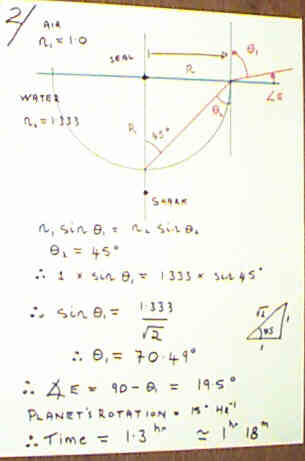
As the sun rises, the refracted beam is deflected ever deeper into the water. When does the refracted ray intersect the seal's hemisphere of vision? When is the shark illuminated by this ray? In fig #2, we see that the angle of deflection must be 45 degrees in this case. It follows that sin (theta) = 1.333/sqrt(2) or theta = 70.49 degrees. The angle of the sun's elevation at this point is, of course, the complement of this angle, 19.5 degrees.
As our planet rotates 15 degrees every hour, the moment of concurrence of the sun's refracted rays with the seal's vision limit will occur 1 hr 18 min after the sun rises above the horizon. This figure would apply only at the equator, I guess and maybe only on the equinoxes at other latitudes. The sun's position and length of day naturally depends on both latitude and season. Have to think about that some more.
Of course, this is the classic "ideal case". Wave action will randomly reflect light from bodies illuminated underwater, blurring the boundary of the seal's hemisphere. Small particles in sea water will scatter ambient light, further obscuring the fundamental issue. Nevertheless, considerations of the physics involved should grant us some insight into the exigencies of the shark's attack strategy.
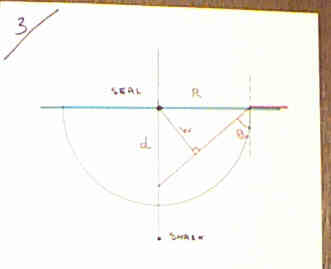 Fig
#3 : there's the question of the line from the seal normal to the refracted
ray. This distance, "h", is obviously less than the vertical distance "d",
the limit of vertical visibility. Inspection of the geometry shows that
h = d.cos(90-theta). Fo the critical angle, h=0.75d approx, but since d=0.882R
then h=0.662R
Fig
#3 : there's the question of the line from the seal normal to the refracted
ray. This distance, "h", is obviously less than the vertical distance "d",
the limit of vertical visibility. Inspection of the geometry shows that
h = d.cos(90-theta). Fo the critical angle, h=0.75d approx, but since d=0.882R
then h=0.662R
A contraction of visibility of that order would give the shark a BIG advantage. The question is, "Do sharks tend to attack at dusk within a cone having an angle of 2 x 48.6 degrees?"
Whatever, the physics suggests that the old tale about the extreme foolhardiness of taking a swim in the sea at dusk may have some truth to it.
An Experiment :
You can't do physics without experimenting! Take a fish
tank, mask of three sides with cardboard to block outside light. Add about
1 ml of milk to render the water slightly turbid so you can see light rays.
Take a light source, probably one of those lensed lights you use with a
microscope, support it with clamp and boss head so the light shines just
above the horizontal from one end of the tank. Maybe put a bit of
cardboard with a pencil hole over the lens so as to collimate the beam.
Then see whether any of the above maths "holds water", so to speak. Maybe
ruffle the surface with an electric fan to see what effect wave action
has on refracted light from a shark's point of view. Measure angles of
elevation and refraction. You're not doing physics if your experiment doesn't
generate a set of numbers!
Copyright &
Disclaimers
Copyright (c) 2001 to Ian Hynes.
All rights reserved.