No changes in behaviour or technology can save us unless we can achieve control over the size of the human population. The birth rate must be brought into balance with the death rate or mankind will breed itself into oblivion. We can no longer afford merely to treat the symptoms of the cancer of population growth; the cancer itself must be cut out.1
Critics and fans of SF frequently feel the need to divide SF into
categories and subsets. There is military SF such as that published by Baen; Del
Rey specialises in alternate histories such as Harry Turtledove’s novel Guns
Of The South (1992) or the Worldwar
in the Balance series. Much of this is done as an advertising ploy for the
benefit of book sellers and is generally not worthy of note. However, some
categorisation can be useful. For example, Make Room! Make Room! falls
into at least four categories of SF: the alternate world or alternate history,
the dystopia, “a politically nasty place to live,”2 sociological SF,
and the kind of SF which charts what Kingsley Amiss has called, “New Maps of
Hell.”3 When the book was
written in 1966, ecological concerns had replaced fear of the nuclear bomb as
the stock SF theme. Brian Aldiss states, ”In the sixties, this groundswell [of
SF themes] was to move towards environmental topics.”4 Make Room! Make Room! shows the city
of New York as it would be in the year 1999 if then current population trends
continued. Harrison got the inspiration for the book when he, and his wife and
small child Todd, moved from New York to Mexico in the 1956. Harrison states:
Before anyone heard of
overpopulation I had been living in Mexico and I watched it develop there. We
came back about 15 years after living there: the population had doubled. Why?
Death control and no birth control. Malaria had been endemic, kept the
population level. The new regime in its wisdom used arial spray, killed all the
mosquitoes in the swamps and wiped out malaria. Doubled the population in 15
years. You must have birth control. You can’t have one without the other.5
Harrison did a great deal of research to produce a work of
density of thought and ideas, as shown in the novel’s “suggestions for further
reading” which lists forty-one books and periodicals. This “detailed research”
approach to the novel categorises it as one of the “New Map” SF stories. Writer
and editor Judith Merrill states, “New Map” stories are those that offer a
detailed, sometimes highly technical, often very knowledgeable, explication of
some as-yet unfilled-in area in a territory recently explored by the “concept”
and “research” people, but open now to settlement and building-up by the
“engineering” and “applications men.”6.
Make
Room! Make Room! clearly meets these requirements. Harrison states,
“Through scientific journals I became more and more aware of the threat of
overpopulation on the entire world. I researched population growth curves, oil
depletion, food growth etc. in the British Museum and came up with the figures
I used in the book.”7 In Hell’s Cartographers, he elaborates
further:
I had a major book I
wanted to do [Make Room! Make Room!].
I had been working on it for some time, a total of five years of
preparation in fact, just digging out
the material to make an intelligent estimate of what life would be like in the
year 2000AD. At this time there were no popular non-fiction books on the
dangers of overpopulation, overconsumption, pollution and allied problems. But
there was a great deal of talk and speculation in the scientific journals that
interested me greatly. Overpopulation had been a recurrent theme in sf for
years, but the overpopulated future had always been the far future and was
about as relevant to life today as E.E. Smith’s Lensman.
My basic idea was a simple one: set a novel in the year 2000
just a few decades away, when the reader, and certainly the reader’s children,
would be around to see what the world would be like. But in setting a novel so
close in time I had to extrapolate every detail of our lives and see that I got
it as right as possible. I also attempted to write a more realistic novel than
I had ever attempted before. I went to the specialists, the demographers and
the petrologists and agronomists, and read a great number of very thick books.
It took a great deal of time to write the novel, which was the longest I had
ever done, since, in addition to getting my facts right, I had to write the
realistic story of life in that world.7
Writer and anthropologist
Leon Stover points out some inconsistencies in Harrison’s research however. In
his biography of the author he quotes figures from the Census Bureau which seem
to suggest that, when the novel was written, New York’s population was
shrinking. He feels that the novel, or, more specifically, the film of the novel,
Soylent Green, could have been set in Southern California where the
population really has dramatically increased.8 Stover has missed the point of the novel
however. It is not really prediction, more of a warning of what life could be
like if damaging trends in population growth continued. It was set in New York
and not, say, in Calcutta, because the writer wanted to bring home to his
American audience the immediacy of the population problem. Paul R. Ehrlich
recognises this in the novel’s introduction when he states:
Projection of even the
mid-range future of urban areas presents near insuperable problems [and] the
results of such projections, while instructive, are also preposterous. We know
things won’t work out that way as far as the numbers living in cities are
concerned. [However] Make Room! Make
Room! presents a gripping scenario of where current trends may be leading.
Such scenarios are important tools in thinking about the future, and in
bringing home to people the possible consequences of our collective behavior.9
This is known as “sociological” science fiction writing, the definition of which, critic David Ketterer has given as, “A writer [who] may extrapolate the future consequences of present circumstance.”10 When researching the novel, Harrison must have come up with some sobering statistics from which he could envision his dystopian future society. For example, by 1968, 900,000 people were on Welfare in New York, a ratio of one person on Welfare to every three employed in private industry. Two thirds of central Los Angeles was concreted over for streets, freeways, parking lots, and garages, and, by 1970, nearly 70 per cent of the American population lived in or near cities.11
Make
Room! Make Room! uses what are, by now, familiar Harrison themes, in
particular his use of the detective story. This is not unusual in SF writing.
For example, Philip K. Dick wrote a character named Rick Deckard, a bounty
hunter/detective in his 1968 novel Do Androids Dream of Electric Sheep?.
SF stories frequently begin with a mystery which the reader is asked to solve.
In New Maps of Hell, Kingsley
Amis comments, “Detective fiction and science fiction are akin. There is a
closely similar exaltation of idea or plot over characterisation, and some
modern science fiction, like most detective fiction…invites the reader to solve
a puzzle.”12 He expands on this later in the book:
science fiction appears to
be on the point of taking over some of the functions of the traditional
detective story…for the science fiction deduction problem, while to some tastes
inferior to the detective story in its weaker connections to the world we know,
is superior to that tiny motive-means-opportunity system in its range of both problems set and kinds of answer
proposed.13
There is a fine SF literary
tradition therefore behind Harrison’s character Andrew Rusch. However, Harrison
has another reason for using this particular plot line namely, “having a hunt
for a killer the main narrative thread which allows the author to show us a good
deal of his pretty unpleasant future world along the way.”14 In a polarised society such as that of New
York in the year 1999, a device must be found to give the reader access to all
levels of society. Detective Rusch is this device. He has to investigate the
murder of a rich man who lives in an expensive apartment by a poor, teenage
Taiwanese immigrant who lives on an abandoned Liberty ship. In the course of
his investigations, we see how both ends of the social spectrum live as well as
that of Rusch who can only be described as
“middle class,” in that he has a job, and lives in a relatively spacious
apartment when many people are reduced to living in the abandoned subway or in
rusting cars which no longer run due to the scarcity of petrol.
The
murdered man is “Big” Mike O’Brien, an ex con who acts as a link between
organised crime and prominent legal figures such as the corrupt Judge Santini.
O’Brien lives with a beautiful young mistress, Shirley Greene in an exclusive,
guarded apartment complex called Chelsea Park complete with “crenelated
battlements”, towers and a drawbridge.15 O’Brien is murdered in the
course of an attempted robbery by Billy Chung, an immigrant from Formosa which,
in this alternate world, has invaded mainland China and in turn been
counter-invaded, leading to a flood of immigrants to the USA. Billy is a member
of the underclass that is, the criminal poor who make up the majority of the
populace of New York in 1999. In this world the people have reverted to a
Hobbsian state of nature where life tends to be “nasty, brutish and short.”16
Chung had been drawn back to the apartment after catching a glimpse of
the naked Shirl. He intends to commit a robbery but also fantasises about the
woman, hoping to find her in the apartment when he breaks in. In this respect,
Shirl connects all the major characters in the novel. She is the reason for
Chung’s return to the apartment. She is O’Brien’s girlfriend and later Rusch’s.
She befriends Sol and Tab Fielding, her black bodyguard. She has a seemingly
bewitching influence on them all.
Because O’Brien has connections in high places his murder warrants a
closer investigation than most. Rusch is resentful of this since murder is
commonplace. He comments, “The City of New York averaged seven murders a day,
and ten on good days.”17 Rusch spends most of his time working on
the case despite being bruised and tired from riot control duties. Despite, or
perhaps because of this, he develops a romantic relationship with Shirl. When
O’Brien’s harpy-like sister takes ownership of the apartment, Shirl moves in
with Rusch and his room-mate Soloman Kahn. Sol is seventy-five years old and
can remember the relative good times before food shortages and depletion of
natural resources. In this respect, he is the reader’s link with the world they
know. However, he is also a very believable character, perhaps because he was
modelled on the author! In an interview with Paul Tomlinson, Harrison was asked
about the similarities: “I am not Soloman Kahn in the novel. But Kahn is my
mother’s family name on one side so I used this to suggest a parallel, since I
gave Kahn my birthday and military record. This is to tie him in to the present
day readers, so they can identify.”18
Truly
well-rounded and believable characters are hard to find in SF writing. For
example, critic Scott Sanders states, “Science Fiction is a home for invisible
men and women. One is hard put to name half a dozen memorable characters in all
the annals of the genre, to recall any science fiction protagonist who hangs in
the mind.”19 The reason for this, apart from the many bad writers,
is that ideas and concepts come to the fore in SF writing. Kingsley Amis
explains the concept in SF of “idea as
hero” rather than character: “concentration upon idea…occupies the position
given in ordinary fiction to matters of human situation or character; in this
sense it is the hero of the story. Idea
as hero is the basis of a great deal of science fiction corresponding to…the
plot as hero type of detective
story.”20
Leon Stover and Harrison both agree on “the didactism of the genre,” that SF is a, “content-orientated literature with message-as-content.” This leads to characters more “flat” than “round.” However, Harrison stresses that this “should never become an excuse for bad writing.“21
In
many cases, however, the author really only wants to lecture the reader, but to
keep one’s interest, a plot must be devised and characters created. A prime
example of this is in the stories published by Hugo Gernsback, the almost
legendary figure from SF’s “Golden Age.” Writer and critic Brian Aldiss
comments:
Gernsback laid great
emphasis on the need for scientific accuracy in his stories…Although this
dictat was more honoured in the breach than the observance, it did have the
effect of introducing a deadening literalism into the fiction. As long as the
stories were built like diagrams, and made clear like diagrams, and stripped of
atmosphere and sensibility then it did not seem to matter how silly the
`science’ or the psychology was.22
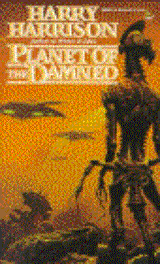 Harrison can
write believable and memorable characters. In this novel, proper thought is
given to the actions and motivations of the protagonists because the author
wants to paint as realistic as possible a picture of a dystopian world. In
other novels, however, such as Sense of Obligation (1962) (renamed Planet
of the Damned), Harrison is less concerned with characterisation. Sense
of Obligation is a product of Harrison’s days in pulp and magazine writing.
His hero, Brion Brandd, is a muscular hero similar in stature to Arnold
Schwarzeneger. The plot is fast-paced and exciting, and not without Harrison’s
trademark humanism.23 However, the characters are not as rounded as
they would be in his later work.
Harrison can
write believable and memorable characters. In this novel, proper thought is
given to the actions and motivations of the protagonists because the author
wants to paint as realistic as possible a picture of a dystopian world. In
other novels, however, such as Sense of Obligation (1962) (renamed Planet
of the Damned), Harrison is less concerned with characterisation. Sense
of Obligation is a product of Harrison’s days in pulp and magazine writing.
His hero, Brion Brandd, is a muscular hero similar in stature to Arnold
Schwarzeneger. The plot is fast-paced and exciting, and not without Harrison’s
trademark humanism.23 However, the characters are not as rounded as
they would be in his later work.
In Make
Room! Make Room!, it is clear that many of Sol’s views echo those of the
author. For example, in part two of the novel, Harrison voices his views on
birth control through Sol’s conversation with Shirl. This passage is virtually
a lecture, and Shirl is there not as a counterfoil to Sol’s arguments but
simply as a prompt to enable Sol to expand on what he has previously said. For
the film Soylent Green however, Harrison told veteran actor Edward G
Robinson, who had asked Director Richard Fleischer for direction on his
character, “Very simply, you are me
in this story.”24
Harrison has used a writing technique called “background as foreground”;
he explains:
of course, the background is
what it’s all about – the background is the foreground. In the book, which
appears at first just to be an adventure story, I didn’t draw attention to the
setting – I just let it sink in slowly. When the reader is about two-thirds into it he suddenly becomes aware
of the horrible reality of this terrible New York of the future and then it
becomes obvious as to what the book is really about.25
In the author’s essay A Cannibalized Novel
Becomes Soylent Green Harrison states:
The film, like the book,
shows what the world will be like if we continue in our insane manner to
pollute and overpopulate Spaceship Earth. This is the “message” of film and
book. Both of them deliver this message in a manner unique to science fiction:
The technique of background-as-foreground. This means simply that the story
played out by the characters is not the major story. It is the means to capture
the reader/viewer’s attention, to reveal a greater truth in the setting where
the foreground takes place.26
In the novel, Harrison demonstrates this
technique in a subtle way. We know from the beginning that the murder occurred
as part of a robbery. Rusch is told to investigate further but the reader knows
the outcome of the investigation already. The plot therefore becomes a manhunt
which is resolved when Rusch accidentally kills Billy Chung in the process of
arresting him. In terms of an adventure story, this resolution is a let-down.
In many stories like this a relationship develops between the characters. For
example, in Joseph Conrad’s short story Heart Of Darkness (1899), there
is a type of father-son relationship between the hunter Marlow and the hunted
Kurtz. In the 1982 SF movie Bladerunner, the film version of Dick’s Do
Androids Dream of Electric Sheep?,
an almost brotherly bond develops between Deckard and the hunted Roy Baty. This
does not happen in Make Room! Make Room! because Harrison purposely does
not let it. Furthermore, we discover that the mobsters who were pushing the
investigation are no longer interested in its outcome. In return for the work
Rusch has put in to the case he is demoted from detective to uniformed
patrolman, Shirl leaves him, an obnoxiously large family is forcefully moved
into his apartment and he is left friendless
when his roommate Sol dies of pneumonia after receiving a broken hip in a
protest march. There is no happy ending therefore as Rusch loses everything. If
this were simply an action-adventure novel, the reader would probably feel
cheated.
However, as the author has intended, the plot unfolds to its
unsatisfactory conclusion but, in the process, the reader becomes aware of the changes which have taken place between
the world of today and the world of the novel. In this scenario, all aspects of everyday life have becomes a struggle, especially
for those on Welfare. There is still a democratic society and elections. This
is important as Harrison wants to keep America recognisable; the value of his
warnings about the future would be lost if the story were set in totally
unfamiliar surroundings. For example, it may be too much of a leap of faith to
ask readers to suspend their disbelief and accept the America of Robert
Heinlein’s Revolt in 2100 (1953) where America is governed by a corrupt,
religious despot. However, in Harrison’s world the problems seem more down to
earth and immediate. They are not political problems because the system seems
to be working as it always had. The political parties continue to squabble over
the abortion bill, for example, despite there being an immediate need for
radical thinking and action. In the novel’s prologue Harrison states:
In December, 1959, The
President of the United States, Dwight D. Eisenhower, said: “This
government…will not…as long as I am here, have a positive political doctrine in
its program that has to do with this problem of birth control. That is not our
business.” It has not been the problem of any American government since that
time.27
Harrison clearly feels it
should be. However, he also makes it clear in the Prologue that the novel is set
in a familiar United States of the near future. The main tenets of society such
as the political system, must be there. In any event, the problem is not
political ideologies but scarcity of resources:
By the end of the century,
should our population continue to increase at the same rate, this country will
need more than 100 per cent of the planet’s resources to maintain our current
living standards. This is a mathematical impossibility-aside from the fact that
there will be about seven billion people on the earth at that time
and-perhaps-they would like to have some of the raw materials too.
In which case, what will the world be like?28
So, the people of this future are more concerned with immediate
problems, many of which may seem vaguely familiar to the reader. Drinking water
is short and has to be extracted from shared public taps. Oil supplies have
been depleted and, whatever vehicles there are run on low quality, probably
vegetable based, fuels. There is no public transportation: however, those with
enough money can hire a pedal driven “pedicab.” Food is rationed and tasteless.
Much of America’s farmland has been reduced to Depression era dustbowls due to
water shortages. Farmers are resentful of so much of this scarce resource being
used by the city and have taken, on occasion, to blowing up aqueducts. In
another throwback to the Depression, “tent cities” have formed to house the
poor. Prison work-gangs are used to break up concrete parkways to provide more
land for farming. The staple diet is sea food made from plankton and seaweed. A
treat would be Soylent Green, made from Soya beans and lentils. Only this
society’s privileged elite can afford meat from the meat-leggers’ shops which
are protected by armed guards. Margerine is made from motor and chlorella oil.
As in many poor countries today, the children of 1999 New York go to school for
only three hours a day. Razors are in short supply: Rusch complains about his
dull, chipped blade and thinks that he must get a new one. “Maybe in the fall”
he thinks.29
Electricity is in short supply. As with much of the information listed
above, we are not told this directly: Harrison is a believer in the maxim,
“Don’t tell ‘em, show ‘em!”30 so the author shows Sol pedalling
furiously on a cycle-driven generator to create electricity. Similarly,
batteries are in short supply so Harrison shows his characters using “squeeze”
flashlights. Sol uses the heat of the sun to heat water to wash in. Alcohol and
cigars are luxury items. “Third World” diseases are commonplace; people suffer
from dysentery and malaria, and children get “quash”, a vitamin deficiency
affliction related to beriberi. Even the “hero” of the story, Andy Rusch is
balding, has pale skin, protruding ribs and a pot-belly due to a diet of too much
starch. All aspects of the environment have been despoiled. This is a world
where whales have been hunted to near extinction. Hundreds of species such as
passenger pigeons and whooping cranes are extinct and there is no mention of
pets such as birds, cats, dogs etc.
There are riots over food and water and the senior citizens, the
“Eldsters”, demonstrate for better treatment and the right to work.
The
rest of the world fares little better:
All of England is just one big
city and I saw on TV where the last Tory got shot defending the last grouse
woods when they came to plow it up. Or you want to go to Russia maybe? Or
China? They have been having a border war for fifteen years now, which is one
way of keeping the population down…Denmark maybe. Life is great there if you
can get in…but they got a concrete wall right across Jutland and beach guards
who shoot on sight because so many starving people keep trying to break into
the promised land.31
This is ironic in that Denmark has
traditionally been a haven for the world’s refugees. The author shows how bad
the situation is when the liberal Danes feel the need to build a “Berlin” style
wall to protect their borders. Harrison has stated, “I’m a great believer in
small countries…I lived in Denmark for seven years. I love what they do there.
They care about people you know. The motto of the country is “Few have too much
and none have too little.” They’re caring people! I believe in small languages
and small countries.”32
A
life such as this would be intolerable to us. However, for the people in this
world it is all they have known. Shirl comments, “Everyone must be unthinking
and selfish;” but Sol replies, “No-I think better of the human race. They’ve
just never been told.”33 Only the older generation, people such as
Sol, have any idea of what the world used to be like. He is from a different,
more civil age but he may as well be from another world. He hates the ersatz
food because he knows what real food tastes like. No-one else notices. He uses
slang that no-one can relate to. When he takes a stand on abortion no-one
understands why. In this world apathy reigns.
The
cause of all this is the continuing growth in population beyond its ability to
sustain itself. The problem is exacerbated by the concentration of population
in urban areas. Harrison talks in the Prologue of a projected population of
seven billion. This has not yet come to pass. However, according to United
Nations’ figures, in 1900 the world population stood at 1.6 billion. By 1950 it
had reached 2.5 billion. The population in 1998 was 5,925,729,000, nearly six
billion. The projected population for the year 2050, if present trends
continue, is an incredible 11.2 billion. Most of this growth has taken place in
developing countries. In 1950, 80 per cent of population growth took place in
developing countries compared to 98 per cent today. The main reasons for this
population explosion were public health programs and rising food production.
Today, the number of births per minute is twice that of the number of deaths, a
ratio of 261 to 101.34 This is despite the increasingly easy
availability of contraception and the loosening grip of anti-abortion stalwarts
such as the Catholic Church.
In
America the issues of contraception and abortion are still not resolved.
Historian Carl Degler points out that these arguments are old ones:
Prior to 1820…so few were
the abortions…there were no laws against them. By the 1860s , abortions had
become so common that many states were enacting laws against them, usually at
the behest of medical doctors who saw them as contrary to nature and socially
wicked. By the end of the nineteenth century, virtually every state in the
union had passed laws forbidding abortion.”35
However, the liberal
attitudes of the 1960s were reflected in the Warren Court. In 1965 the Supreme
Court case Griswold v Connecticut ruled that a Connecticut law which
banned the sale of contraceptives was illegal since the Bill of Rights created
a right of personal privacy. The 1973 case Roe v Wade confirmed this
right of privacy in the area of abortion, effectively legalising it but giving
individual States the right to regulate abortions in the later stages of
pregnancy.
So,
in 1966 when the novel was published, Harrison was arguing for the right to have access to, and information
about, contraception and abortion. He wanted to see positive intervention by
the state in the form of education and provision, if asked for, of the means of
contraception. What he was not advocating was enforced contraception as this
would be contrary to his liberal views: “There should have been free
discussion, tons of money for fertility research, world-wide family planning,
educational programs on the importance of population control-and, most
important of all, free speech for free opinion.”36 Leon Stover is,
therefore, incorrect in stating, “For Harrison to play on the horrors of
overpopulation at the same time he elsewhere places emphasis on freedom from
religion and received ethical standards is contradictory.”37
In
the novel, Harrison methodically rejects the arguments of the
anti-abortionists. Shirl argues that the Emergency Bill, contemptuously
re-named the “Baby-killer Bill” by its opponents, is about “killing babies”, a
violation of “natural law”, and, prophetically when one considers Roe v Wade,
“an intrusion of privacy.”38 In return, Harrison attacks the
hypocrisy of organised religion as he sees it, particularly that of the
Catholic Church, and argues for advances in technology such as the
contraceptive Loop, water de-salination plants and nuclear power.39
Much of what he has argued for has now come to pass. However, when asked if he
stills feels strongly about the issue today, Harrison replies:
Oh yeah, absolutely.
Everything has gone completely wrong. Everything I predicted is exactly how I
predicted only worse! I mean the world is full
of problems. All the problems are overpopulation…Now we’ve got rid of atomic war
we’ve got overpopulation. Where is the CO2 coming from? People running cars.
Where is the sulphur dioxide coming from? People crapping too much. Why are we
still destroying forests?…Overpopulation is taking us apart still and
it’s…madness…American reactionaries like Reagan stopped any American aid where
they mentioned the word abortion. Christ! Abortion is only one of many varied
choices…I feel just as strongly about it now as I did then. Or more so as
there’s no-one doing anything about it.40
Make Room! Make Room! is described by author Stan Nicholls
as, “a chilling portrayal of over-population,”41 by David Pringle
as, “[Harrison’s] most sombre and admonitory work,”42 and by Brian
Aldiss as, “a highly credible portrait of an overcrowded New York.”43 However, the novel did not sell well when
first published. Harrison states:
I wanted to rush the book
into print before the growing interest in these problems faded. As it was, Make Room! Make Room! came out too early
and vanished with a dull whiffling sound. But it was the only novel on these topics
and when the world at large became aware of these problems it was bought for
movie adaptation and turned into the film Soylent
Green -which, at times, bears a slight resemblance to the book.44
 The novel stands
on its own as a fine piece of fiction however. Harrison’s prose has seldom been
better. For example, note the author’s description of Billy Chung’s encounter
with the dispatcher at Western Union: “`What do you want, kid?’ the dispatcher
said, finally looking up, speaking through tight, pursed lips, reluctant to
give anything away anything, even words. A man in his fifties, tired and hot,
angry at a world that had promised him more,”45 and there is more
than a touch of John Steinbeck in the angry crowd scenes: “By nine o’clock
there was a different feeling in the air, a tension that had not been there
before. The crowd seemed to have a louder voice, and to be stirring faster,
like water about to
The novel stands
on its own as a fine piece of fiction however. Harrison’s prose has seldom been
better. For example, note the author’s description of Billy Chung’s encounter
with the dispatcher at Western Union: “`What do you want, kid?’ the dispatcher
said, finally looking up, speaking through tight, pursed lips, reluctant to
give anything away anything, even words. A man in his fifties, tired and hot,
angry at a world that had promised him more,”45 and there is more
than a touch of John Steinbeck in the angry crowd scenes: “By nine o’clock
there was a different feeling in the air, a tension that had not been there
before. The crowd seemed to have a louder voice, and to be stirring faster,
like water about to
boil.”46 Harrison’s prose is, at
times, reminiscent of that of Ernest Hemingway. Certainly they developed their
art in similar circumstances; Hemingway learned to write clearly and concisely
in the newspaper industry whereas Harrison learnt his trade in magazine editing
and the pulps.
In Make Room! Make Room! Harrison
has written the seminal piece of fiction on the overpopulation problem. It is a
problem which we cannot ignore much longer: according to figures supplied by
the United Nations Population Fund (UNFPA), “In 2050 the world population could
be anything between 7.7 billion and 11.1 billion: the UN’s best estimate is 9.4
billion.”47 Harrison would see this as a vindication of his work. He
states:
I was correct right down the line--because all of my predictions on population and over-consumption were taken from specialist studies. The powers fighting birth control are still fighting--and killing--in the name of saving life. Birth rates are falling in the west, not because of morality, but because of selfishness. Instead of a new baby, people prefer a bigger TV and better holidays. This started first in Germany, and now many countries have hit zero population growth or lower. Selfishness also means that we are almost totally indifferent to zooming third world population growth, followed by land destruction and famine. The little wars only exacerbate the existing situation. When plagues start reaching us from Africa we might take some notice.48
As with Harrison’s short stories on
overpopulation, “Roommates” and “A Criminal Act,” Make Room! Make Room!
is an angry warning of the dangers of complacency and ignorance. He cautions:
Before the clock strikes we are going to have to decide if we want to live in a world at peace-or watch the entire thing go down the drain. We are all going to have to forget nationalism, remember that we are all passengers on spaceship Earth-and act accordingly. The alternative is unthinkable.
The time to act is now.49
Notes
1 Paul R
Ehrlich, prologue, The Population Bomb, by
Paul R Ehrlich (London:
Ballantine, 1972).
2 David Pringle, The
Ultimate Encyclopedia of Science Fiction: the definitive illustrated guide (Dubai:
Carlton, 1997) 296.
3 Kingsley Amis, New
Maps of Hell: A Survey of Science Fiction,
(London: The Science Fiction
Book Club, 1962)
4 Brian
Aldiss, Trillion Year Spree, (London:
Paladin Grafton, 1988) 309.
5 Harry
Harrison, interview, “Instead of Having a Rotten Job: The World
According to Harry Harrison,” albedo
1 science fiction fantasy horror, issue 11, trans. Robert Neilson (Dublin: Tachyon Productions, 1996)
19.
6 Judith
Merril, “What do you mean: Science?
Fiction?” SF: The Other Side of
Realism: Essays on Modern Fantasy and Science Fiction, ed. Thomas D. Clareson (Bowling Green, Ohio: Bowling Green
University Popular Press, 1971) 74-5.
7 Harry
Harrison, interview, “Harry Harrison on
Soylent Green,” Make Room! The Harry
Harrison Appreciation Society,
September 1985, ed. Paul Tomlinson: 6
8 Leon
Stover, Harry Harrison, Twayne’s United States Author Ser. 560 (Boston:
Twayne, 1990) 74.
9 Harry
Harrison, “The Beginning of the
Affair,” Hells Cartographers, eds. Brian W. Aldiss & Harry
Harrison, (London: Futura,
1976) 92.
10 David
Ketterer, “The Apocalyptic Imagination,
Science Fiction, and American Literature,”
Science Fiction: A Collection Of
Critical Essays, ed.
Mark Rose (New Jersey: Prentice-Hall, 1976) 148. Another
example of this by Harrison is his collection of stories, One Step from
Earth (1970), which examines the effect on society should matter
transmission become a reality. Far fetched and highly improbable though this
may seem, in December 1997 experiments at the University of Innsbruck, Austria
seem to have succeeded in teleporting two photon particles two metres across a
laboratory. For details see Paul Parson,
“Lets all beam over,” Focus March 1998
(London: Alex Stitt, Gruner
& Jahr, 1998) 108. In any event, Harrison was not
interested in prediction, more of the effects of a new technology on society. In the introduction to One Step from
Earth he states “I do not pretend that any of the things I predict will
happen….But what is the effect on man and his institutions.”
11 Samuel Eliot Morison, Henry
Steele Commager, William E.
Leuchtenburg, A Concise History of the American Republic 2nd ed. (Oxford: Oxford
University Press, 1983) 706.
12 Kingsley Amis, New
Maps of Hell: A Survey of Science Fiction,
(London: The Science Fiction
Book Club, 1962) 34.
13 Kingsley Amis, New
Maps of Hell: A Survey of Science Fiction,
(London: The Science Fiction
Book Club, 1962) 141-2.
14 Chris
Charles, rev. of Make Room! Make
Room, by Harry Harrison, Starburst, (London: n.p.
1982: 47.
15 Harry
Harrison, Make Room! Make Room! (New York:
Berkley, 1973) 51.
16 From Thomas
Hobbes Leviathan (1861). Harrison has used this phrase before in Deathworld
3 (London: Sphere,
1981) 32.
17 Harry
Harrison, Make Room! Make Room! (New York:
Berkley, 1973) 51.
18 Harry Harrison, interview,
“Harry Harrison on Soylent
Green” Make Room! The Harry Harrison Appreciation Society, September 1985, ed. Paul Tomlinson: 8.
19 Scott
Sanders, “Characterisation in science
fiction: Two approaches,” Science
Fiction: A Critical Guide, ed. Patrick Parrinder (London: Longman,
1979) 131
20 Kingsley Amis, New
Maps of Hell: A Survey of Science Fiction,
(London: The Science Fiction
Book Club, 1962) 137.
21 Leon
Stover, Harry Harrison, Twayne’s United States Author Ser. 560 (Boston:
Twayne, 1990) 35-6.
22 Brian
Aldiss, Trillion Year Spree, (London:
Paladin Grafton, 1988) 254
23 Harrison’s
character, Jim DiGriz, from the best-selling Stainless Steel Rat series,
is sometimes compared to Ian Fleming’s superspy, James Bond. Unlike Bond,
however, DiGriz values human life and never kills if it can be avoided. In that
ten book series, Harrison’s character has killed only one man, a hired
assassin, and that was in self defence.
24 Harry Harrison, “Boom Two
(1970-73),” Future Tense, ed. John Brosnan (New York: St. Martin’s Press, 1978)
206.
25 Harry Harrison, “Boom Two
(1970-73),” Future Tense, ed. John Brosnan (New York: St. Martin’s Press, 1978)
204.
26 Harry
Harrison, “A Cannibalized Novel Becomes
Soylent Green,” Omni’s Screen
Flights-Screen Fantasies: The Future According to SF Cinema, ed.
Danny Peary (N.p.:
Doubleday, 1984) 146.
27 Harry
Harrison, Make Room! Make Room! (New York:
Berkley, 1973) 5.
28 Harry
Harrison, Make Room! Make Room! (New York:
Berkley, 1973) 5.
29 Harry
Harrison, Make Room! Make Room! (New York:
Berkley, 1973) 12.
30 Leon
Stover, Harry Harrison, Twayne’s United States Author Ser. 560 (Boston:
Twayne, 1990) 36.
31 Harry
Harrison, Make Room! Make Room! (New York:
Berkley, 1973) 131.
32 Harry Harrison,
personal interview, 6th July
1997.
33 Harry
Harrison, Make Room! Make Room! (New York:
Berkley, 1973) 162.
34 “Coming soon,
the six billion boom,” Daily Mail,
13th May 1998: 10
35 Carl N.
Degler, Out of Our Past: The Forces
That Shaped Modern America 3rd
ed. (New York: Harper Colophon, 1984) 473.
36 Harry
Harrison, Make Room! Make Room! (New York:
Berkley, 1973) 176.
37 Leon
Stover, Harry Harrison, Twayne’s United States Author Ser. 560 (Boston:
Twayne, 1990) 74.
38 Harry
Harrison, Make Room! Make Room! (New York:
Berkley, 1973) 159-62.
39 Harry
Harrison, Make Room! Make Room! (New York:
Berkley, 1973) 174-76.
40 Harry
Harrison, personal interview, 6th
July 1997
41 Stan
Nicholls, Wordsmiths of Wonder (London:
Orbit, 1993) 55.
42 David Pringle, The
Ultimate Encyclopedia of Science Fiction: the definitive illustrated guide (Dubai:
Carlton, 1997) 202.
43 Brian
Aldiss, Trillion Year Spree, (London:
Paladin Grafton, 1988) 299.
44 Harry
Harrison, “The Beginning of the
Affair,” Hells Cartographers, eds. Brian W. Aldiss & Harry
Harrison, (London: Futura,
1976) 92-3.
45 Harry
Harrison, Make Room! Make Room! (New York:
Berkley, 1973) 24.
46 Harry
Harrison, Make Room! Make Room! (New York:
Berkley, 1973) 146.
47 Paul Brown, “Planet’s population grows ever
faster,” Guardian 3 September 1998: 12.
48 Harrison, Harry,
interview by Paul Witcover. Del
Rey Alternate History. http://www.randomhouse.com/delrey/althist/authors/harrison_int.html
49 Harry
Harrison, “New Sources of Energy,” Future Life Dec. 1979: 70.
Title Page and Copyright details