AFTERWORD
Science Fiction has always struggled to be accepted by the literary
mainstream,
surprising, since George Orwell’s Nineteen
Eighty-Four (1949) is an SF novel as is Aldous Huxley’s Brave New World
(1932). Nevertheless, it is still not unusual to find comments such as those of
Paul Hoggart in an article entitled, “Beam me up Scotty,” in which he states,
“Sci-fi is always childish tosh, and it is foolish to expect anything else.”1
In reply, I can think of no better response than that of legendary ASF
editor John W. Campbell who, when asked, “I understand that science fiction has
only a limited [scope] compared to English letters,” replied, “Science fiction
begins with the Big Bang and ends with the heat death of the universe – English
letters is here between my fingers!”2
Campbell’s witty retort has an element of seriousness, however. Too
often, SF is associated with the pulps and with “space opera,” for instance, Flash
Gordon and Buck Rogers. However, SF has improved considerably since
those days. Harry Harrison states:
Science fiction has become a
respected form of literary endeavour. Not respected everywhere of course, an
odour of the pulps must still adhere to it in certain places. The New York
literary circles, The New Yorker and The New York Review of Books crowd,
either ignore it or scorn it as buck-rogerish nonsense. That’s their loss. They
will discover SF some day, which fact I look forward to with mixed emotions.3
The
point has been made that SF is not about prediction: author Stephen Baxter
states, “Science fiction tells stories of the future or the past or other
worlds but it’s really about the present.”4 Nevertheless, it is not
a coincidence that many SF stories have proved to be remarkably accurate in
their portrayals of the future. Harrison states, “From life comes art; art
becomes life,”5 and the following examples would seem to prove it.
For example, Harrison’s short story collection One Step from Earth,
first published as a collection in 1972, is about matter transmission: on 24th
October 1998, The Express published an article entitled “Beam me up,
doc” which stated, “Scientists [at the University of Wales, Bangor] revealed
that they have developed a teleporter, which can transfer a particle of light
from one part of their laboratory to another.”6 I Always Do What
Teddy Says (1963) is set in a utopia where mechanical teddy bears are used
to condition children against anti-social behaviour: The Times reported
on 1st April 1998 that, “Teddy bears…will soon be fitted with tiny
cameras to spy on families across Britain.”7 In Homeworld
(1980), Harrison’s character Jan Kulozik notes, ominously, that, “All of the
communication lines in the country, public and private, were being monitored
and controlled by the Security forces. Their powers appeared to be limitless.
They could hear any conversation, tap any computer memory:”8 on 15th
June 1998, a Times article stated:
Next time you write on your computer the words “sex”, “bored”, or “boss”, you may be unwittingly sounding an alarm on a new office surveillance system that allows your bosses to spy on everything you type. Paranoid? You will be, as the modern workplace descends into a den of electrified suspicion that puts more and more workers on the payroll of Big Brother.9
The Jupiter Legacy (1965),
published four years before Michael Crichton’s similar novel The Andromeda
Strain (1969), is about a plague brought back from the planet Jupiter by
returning astronauts: on 17th February 1998, the Daily Mail
reported, “Rocks brought back from
Mars could infect the Earth with deadly alien viruses, NASA experts fear.”10
It is little wonder that journalist Rachel Campbell-Johnston has asked, “Are we
living in a world invented by science fiction?”11
This must be a question that Harrison has asked himself. In Rebel in
Time, he states:
Troy accepted the fact of time travel without hesitation. Why shouldn’t he? He had grown up in the age of technological miracles. First there had been the atomic bomb, well before his birth, then, one after another, the hydrogen bomb, atomic energy, jet aircraft that could fly faster than sound, followed by orbiting satellites, and lastly the almost unbelievable, real-time television pictures of men walking on the Moon. There seemed no end to the cornucopia output of the laboratories and he, like many others, had stopped trying to understand how they worked. They just did. He had used electronic guided missiles in the Army. You pressed the button and they went. That’s all that you had to know. So you pressed another button and something travelled through time. There was really no difference.12
Like his character, Harrison too has grown up in an age of technological miracles. He began his SF career in the 1950s and has since been at the forefront of the genre. During that time, he has witnessed the vast changes that have taken place in American society, both social and technological. He left America in 1956 to travel the world, but also as a response to the direction that country was taking. He returns home often, however, when not writing at his retreats in the Republic of Ireland or the South of England. Although he is an ex-patriot, he defends the USA against attacks by critical and aloof Europeans: interviewer Paul Witcover asked Harrison why he left the USA and if he still considers himself as American. Harrison replied:
I left America in 1956 because I needed time
and space to write my first novel. Mexico was cheap and fun: I could write and
enjoy a different society. It is not that I left the States for any reason, I
went to another country for a lot of reasons. I went to England, then Italy,
then Denmark (seven years) then Ireland because there was a great joy in seeing
new languages, cultures, what might be called inspiration. I am still an
American writer, as S&S, [Stars and Stripes
Forever (1998)] proves.13
Figure x Stars & Stripes
Forever
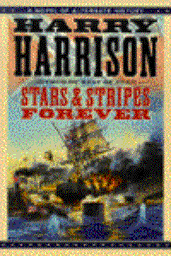 Nevertheless, as shown in the body of work he has produced, the
author is not afraid to face up to the problems and contradictions of the USA.
At least in his novels, he is able to change the world: his latest, Stars
and Stripes Forever, is part of a “What If?” trilogy where Federal and
Confederate troops unite to defeat an invading British force during the American
Civil War. With the help of “ironclad” warships, they defeat the Royal Navy and
invade Britain and Ireland, in the process, liberating that country from
British rule.
Nevertheless, as shown in the body of work he has produced, the
author is not afraid to face up to the problems and contradictions of the USA.
At least in his novels, he is able to change the world: his latest, Stars
and Stripes Forever, is part of a “What If?” trilogy where Federal and
Confederate troops unite to defeat an invading British force during the American
Civil War. With the help of “ironclad” warships, they defeat the Royal Navy and
invade Britain and Ireland, in the process, liberating that country from
British rule.
There should be no need to defend SF against critics who still consider it nothing but childish entertainment. Readers of SF are, sometimes unwittingly, also studying society. In Harrison’s case, he makes political and social comments about America while also entertaining his readers. His philosophy is, “Put the boot in!…I think science fiction writers are missing the opportunity a lot to make politial [and] racial statements.”14 The final word belongs to Rachel Campbell-Johnston who states, “[SF’s] task…has been to respond to possibilities, to the hopes and fears, the dangers and delights of the future. Science fiction writers grapple with and form our philosophical futures as much as scientific ones. They should be taken more seriously than little green men.”15
Notes
1 Paul Hoggart, “Beam me up Scotty,” Times 11 May 1998: 47
2 Harry
Harrison, “Great Figures of SF--John W.
Campbell: reminiscences by a writer/editor who knew him,” World Science Fiction Convention, Brighton, 28th Aug. 1987.
3 Harry Harrison, afterword, Nova 4, ed. Harry Harrison (London: Sphere, 1976) 220.
4 The Sci-Fi Files, narr.
Stephen Baxter, prod. Peter Swain, Channel 4, 13 Jun. 1998
5 Harry
Harrison, introduction, Galactic Dreams, by
Harry Harrison (London: Legend,
1994) 7.
6 “Beam me up,
doc,” The Express 24th Oct. 1998: 13.
7 Max Glaskin, “Watch out: teddy has his eye on you,” Times Inter//face 01 Apr.
1998: 3.
8 Harry
Harrison, Homeworld, (London:
Grafton, 1987) 64.
9 Helen
Rumbelow, “Yes, there is someone
watching you – the boss: The office machines and the laptop you take home may
be spying on you,” Times 15 Jun. 1998: 19.
10 “Martian Plague
Fear,” Daily Mail
17 February 1998:
20
11 Rachel
Campbell-Johnston, “Are we living in a
world invented by science fiction?” Times 10th Jun. 1998: 19.
12 Harry
Harrison, Rebel in Time, (London:
Grafton, 1986) 114.
13 Harry
Harrison, interview by Paul
Witcover. Del Rey Alternate
History. http://www.randomhouse.com/delrey/althist/authors/harrison_int.html
14 Harry
Harrison, personal interview, 18th September 1998
15 Rachel
Campbell-Johnston, “Are we living in a
world invented by science fiction?” Times 10th Jun. 1998:
19.
Title Page and Copyright details