 |
|
|
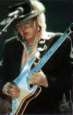
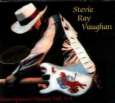
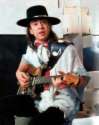
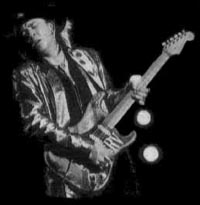
| Stevie Ray Vaughan
�Something of a legend�, says Rolling Stones magazine, who recently named Stevie Ray Vaughan one of the top 10 guitarists in rock history. �His playing reached out to you. He wasn't so concerned with technique and flash, but at the same time, he had it by the truckload. He never let technique rule his heart; he always played directly what was on his mind", says Steve Vai. �As a guitar player, he had an incredible signature tone and an extreme intensity. He played one of the most difficult guitars to play - the Fender Stratocaster - and he played with really heavy strings.�, says Joe Satriani. �It was an honor to have him do [my] tunes, because just like I went to Muddy Waters and paid tribute to him, everyone pays tribute to someone they admired a lot. Music is handed down to the next generation�, says BB King. Austin�s favorite son was born in Dallas, Texas, on 3 October 1954 at the Methodist Hospital. During his childhood, Stevie would be inspired into guitar playing by his older brother, Jimmie (b.1951), which eventually landed him his first guitar in 1964, a plastic toy from Sears, the same year Jimmie also received his first. When he was in junior high school, he began playing in a number of garage bands, which occasionally landed gigs in local nightclubs. It was in 1965 when a friend of Jimmie�s, called Doyle Bramhall was impressed at Stevie�s guitar talent at age 11, who encouraged him to keep on playing � �He was the first one that ever told me I was good." However, in 1965, parents of Stevie and Jimmie, Jimmie and Martha Vaughan, tried to put a stop to their sons musical careers after being alarmed by their indulgences with such drugs and alcohol. The result saw the moving of Jimmie with Doyle Bramhall in an apartment. At home, Stevie�s life couldn�t have been more terrible. He was severely restricted from his musical activities leaving him bored and unhappy. An attempt at life outside saw Stevie working as a dishwasher in a Dallas burger joint called Dairy Mart, where he made his final decision: to quit and play guitar after falling in a barrel full of grease � "Part of my job was to clean out the trash bins. One night, I was standing on top of a barrel, [and] the top caved in. I fell in grease up to [my chest], and right then I decided 'I'm not gonna do this anymore. I'm gonna play guitar." Leaving school at the age of 17, Stevie sat in with a high school band called Cast Of Thousands for two songs as they record an album called A New Hi. The following year (1972), Stevie joined a rock band called Krackerjack but quit after the lead singer wanted them to wear face paint on stage. Soon, Stevie would find himself in a major band (Double Trouble) with bassist Tommy Shannon from Krackerjack. In 1973, Marc Benno invited Stevie to record in his band called the Nightcrawlers, which featured Doyle Bramhall. The Nightcrawlers were almost successful until their record label A&M decided not to release the record. Disappointed, the band traveled back to Texas. On his way back home, Stevie purchased a battered '59 Stratocaster in Ray's Music Exchange in Austin. He named it "Number One" or �First Wife� and this becomes his favorite guitar for the rest of his life. Stevie left the Nightcrawlers disappointed, but instead, joined the Cobras with Paul Ray. The Cobras were one of Austin�s popular bands. For the next two and a half years, Stevie played with the Cobras on the Austin Club Circuit, who eventually won �Band Of The Year� on an Austin music poll (1977) (The line-up stars Stevie Ray, W.C. Clark (bass), Lou Ann Barton (vocals), Freddie "Pharoah" Walden (drums), and Mike Kindred (keyboards). The following year saw the resignation of W.C. Clark, the bands bassists. He was replaced by Jackie Newhouse. For a while. Saxophonist Johnny Reno briefly joined the band. Freddie Walden later quit the band and was later replaced by Chris "Whipper" Layton. Following the departure of Freddie Walden, the band renamed itself Triple Threat. The core of Double Trouble was forming. In 1980 Lou Ann Barton left Triple Threat to join Roomful Of Blues. Stevie Ray renamed the group Double Trouble. Their big break came in 1980, when they performed at the Steamboat 1874 club in Austin on April 1. This performance was recorded for radio and later released as the 1992 album, �In The Beginning�. On January 2 1981, Tommy Shannon replaces Jackie Newhouse on bass. A taping of a performance at an Austin music festival ended up in the hands of Mick Jagger, Rolling Stones frontman. This taping landed the group a gig to play a semiprivate party for the Rolling Stones at New York's Danceteria on April 22. Almost rising to their peak, the band performed at the Montreux International Jazz Festival in Switzerland, the first unsigned and unrecorded band to do so. This became the bands big break. The reaction was mixed. The album, Live in Montreux features the crowd booing as well as applauding. The band were devastated, yet they met two musicians who loved the bands sound and would have a profound effect on the bands fortunes. One of these musicians was David Bowie, who gave Stevie the guitar spot on his �Let�s Dance� album. The second musician was Jackson Browne, who offered the band free use of his studio. The demo they recorded there became their debut album, �Texas Flood�. It was nominated for two Grammy awards: "Best Traditional Blues Recording" and "Best Rock Instrumental Performance" (for "Rude Mood"). The band also appeared on the "Austin City Limits" television show. Stevie won three categories in the Guitar Player's Readers Poll: "Best New Talent", "Best Blues Album", and "Best Electric Blues Guitarist" (beating out none other than Eric Clapton!). He became only the second guitarist in history to win three Guitar Player awards in one year (the first was Jeff Beck). Stevie also won the "Best Electric Blues Guitarist" award every year until 1991. With the release of their debut album and the follow up, �Couldn�t Stand The Weather�, the bands success grew. Couldn't Stand The Weather is released on May 15. Stevie won his first Grammy: "Best Traditional Blues Recording" for his performance of "Texas Flood" from Montreux (this song appears on Blues Explosion from Atlantic Records). "Voodoo Chile (Slight Return)" from Couldn't Stand The Weather was nominated for "Best Rock Instrumental Performance". In November, Stevie wins two W.C. Handy National Blues Awards: "Entertainer Of The Year" and "Blues Instrumentalist Of The Year." It was the first time a white person has won either award. In 1985, 1985 - Keyboard player Reese Wynans joined Double Trouble to record their third album, �Soul To Soul�, which was released on September 30. It became Double Trouble's third straight gold album. Stevie received his fifth Grammy nomination: "Best Rock Instrumental Performance" (for "Say What!" from Soul To Soul). He also produced Lonnie Mack's comeback album Strike Like Lightning and played in several of its songs. On April 10, Stevie played "The Star Spangled Banner" for opening day of the National League baseball season at the Houston Astrodome, where he was booed by the crowd � the booing had a profound effect on Stevie. However, the success grew with a price. The drugs and the alcohol taken by the band started to take it�s toll. By the time of �Live Alive�, Stevie Ray Vaughan was about to break. In Germany 1986, during a tour in Europe, he began vomiting blood in his hotel room. Later in the tour, at the Hammersmith Palais, he fell off a gangplank when leaving the stage: the rest of the tour was cancelled. Both Stevie and Tommy checked themselves into rehab and emerged sober. He produced two albums, which proved that he had lost none of his passion: 1989�s �In Step� and 1990�S �Family Style�, with his brother Jimmie. At the end of August in 1990, Stevie and Double Trouble appeared on the bill at two Eric Clapton gigs at Alpine Valley, a ski resort in Wisconsin. After the show, on the 26th, Stevie boarded a helicopter on its way to Chicago. His helicopter never returned. In fog, it had flown into a hillside, killing all those on board: Stevie Ray Vaughan, the pilot and three members of Eric Clapton's entourage. Stevie�s final resting place was at Laurel Land Cemetery in Dallas, Texas on August 31. Mourners include Billy Gibbons, Stevie Wonder, Buddy Guy, Bonnie Raitt, Ringo Starr, and Dr. John. Outside the chapel, more than 3,000 fans gathered to say goodbye. Thanks for taking the time to read my article. I hope you enjoyed reading it as much as I have enjoyed writing it for you. Next time, I shall be writing Stevie Ray Vaughan. Part 2 - his guitars. GoodNight_AmyLee Continuing on from the Stevie Ray Vaughan Pt1; this is the second part. In this article I�ll post details of Stevie Ray Vaughan�s prestigious guitars that he kept, played and devoted his life to, before he died on August 26th 1990, in a helicopter crash after appearing at an Eric Clapton gig. Stevie Ray Vaughan has always been familiarly known as a Fender Stratocaster player, playing the likes of Number 1 or First Wife, Charley, Red, Scotch, Yellow or Butter and Lenny Stratocaster. However, Stevie Ray did also play other types of guitars (Dobro etc..). First Wife or Number 1 Stratocaster This is perhaps the most familiar Stratocaster that Stevie Ray played and it was also his favorite. This guitar was a battered 1963 Stratocaster with a 1962 neck. Stevie believed that the body was made in 1959, but a recent examination of the guitar by several Fender employees confirms that it was a 1963 model. (In Stevie Ray Vaughan Pt 1, I made a mistake, it was a 1963 model, not a 1959 model). Stevie first purchased Number One in 1973 from Ray�s music Exchange store in Austin Texas, following his departure from the Nightcrawlers. Shortly afterwards, he joined the Cobras with Paul Ray. In an interview, Stevie Ray said that he knew straight away that there was something special about First Wife. He liked the sunburst finish and the thick, oddly shaped D-neck. Stevie Ray has been known to have large hands and so the unusually thick neck felt comfortable. "I didn't even have to play it - I just knew by the way it looked that it would sound great. I was carrying my '63 Strat and asked if [Ray] would like to trade. Thank God he did, and it's been my main axe even since." Number One originally had a white pickguard and a right-handed tremelo bar. Stevie replaced the white pickguard with a black one that now adds the "SRV" lettering. Rene Martinez (Stevie�s guitar technician 1985) recalls how Stevie would sometimes resort to searching the ground around truck stops to find replacement letters when the old ones scratched off. In 1977, Stevie added a gold left handed tremelo allowing him to recreate his own upside down guitar (Jimi Hendrix and Otis Rush). The case concerning Stevie Ray�s pickups have classed some debate. Many SRV fans believe that Stevie sent the pickups to Fender to be rewound, and that they were over wound by accident. The amazing sound of Number One seems to support this idea, but the Fender employees who examined the guitar reported that the pickups were stock except for the shielding that had been added. Eventually, Stevie, with the help of Rene replaced the Stratocasters stock pickups and upgraded them with Dunlop 6100 bass style frets. These huge frets gave Stevie Ray the sustain he needed and helped during string bending. They were also especially important to Stevie as he always use the thickest string sizes, ranging from .013 to .018! It was common that Stevie Ray�s hands would wear out and tear through his skin, so sometimes, Rene would convince him to switch to smaller strings. Number One had been severely abused during it�s lifetime with Stevie. On stage, Stevie Ray would kick it, pound it, rattle it, ride it like a surfboard and even holding it by the tremelo bar. Number One could only take a certain amount of abuse before Stevie Ray was considering retiring it in 1989. All the abuse scratched and stripped the finish on the body. Stevie�s strumming also wore out the surface of the guitar, particularly above the strings. A huge gouge is visible on the top of the guitar. As if you thought that wasn�t enough, sometimes, Stevie Ray would bounce his guitar off a wall, catch it, and keep playing. This was a trick that his brother, Jimmie Vaughan introduced him to. This damage caused the head stock to nearly split in two. This was repaired by Rene. The taped-up headstock can be seen in a picture on the inside of the CD leaf from �In the Beginning.� The neck had been repaired so many times that it eventually would not take new frets. It was beginning to get difficult to play it. Rene resorted exchanging the neck from Scotch to Number One. In 1990, that neck was broken at a show in Holmdell, New Jersey, when a piece of stage equipment fell on several of Stevie's guitars. Rene eventually ordered a replacement neck from Fender and received a copy of the 1962 neck. Number One is currently in possession of Jimmie Vaughan, Stevie Ray�s brother (After Stevie's death, Rene Martinez put the original neck back on Number One and presented it to the Vaughan family), although there are rumors that Number one was buried with Stevie in Dallas. The Lenny Stratocaster Lenny was an brownish-orange 1963 maple-neck Stratocaster. Lenny was named after Lenora Bailey, Stevie Ray�s wife from 1979 to 1988. Apparently, Stevie found the guitar in a pawnshop. He could no afford to pay and so one of Stevie�s roadies, Byron Barr bough it for him. He gave the guitar to Lenora and they both presented it to Stevie Ray for his 23rd birthday in 1976. Apparently, Lenora was supposed to pay Byron for the guitar (she and a few friends helped to raise money), however, it was Stevie who settled the debt, with cash and a leather jacket. Lenny was originally a think rosewood neck, however, Stevie Ray replaced it with a thicker, non-fender maple neck. This neck was presented to him by ZZ Tops� Billy Gibbons. Stevie kept the tremelo arm, pickups and frets in their original condition. Sometimes in 1986, Stevie would add a filigree-style decal to the bridge and put his �SRV� initials on the pickguard. Rene Martinez also modified the tremelo unit to be "floating", which enabled Stevie to either pull up or push down on the bar to bend the strings with immense force. Lenny was used with the lightest strings than all Stevie Ray�s other guitars. This would enable Stevie Ray to create a mellow sound that he used for a lot of his slow songs, including, Lenny (Duh?) and Riviera Paradise. Little is known where Lenny is kept nowadays, but rumors persist that Jimmie Vaughan has it. The Charley Stratocaster People often make the mistake of thinking that Charley was a Fender Stratocaster. However, it was not. It was a Stratocaster-style guitar that was assembled from the spare parts by Charley Wirz of the Charley�s Guitar Shop in Dallas. Wirz often worked on Stevie's guitars and remained a close friend until he died in 1984. Charley is all-white with a rosewood neck. On the back is a girlie-style pinup caricature and carved into the neck's heel plate are the words "To Stevie Ray Vaughan, more in �84�. The headstock has been imprinted with a "Charley's Guitar Shop" logo. Wirz installed three Danelectro "lipstick tube" pickups and rewired them to his own configuration. This provided Stevie Ray the tone for such tracks as "Couldn't Stand The Weather", "Tin Pan Alley", and "Life Without You" (which is actually a tribute to Charley Wirz). The Red Stratocaster Red was one of the lesser known Stratocasters that Stevie Ray possessed. Red was a 1964 Stratocaster with a rosewood neck. This red color was later offered by Fender as a custom color option. Later, Rene Martinez installed a left-handed 1964 rosewood neck on Red sometime during the mid 80's. Not much change was undergone on the Red Stratocaster, however, Stevie did add heavier gauge strings and "SRV" initials to the guitar. Stevie liked to use Red for "Love Struck Baby" and Pride and Joy". He also used sometimes used Red instead of Number One for "Rude Mood". Stevie liked to play it rather clean, sometimes with an Echoplex and the Vibratone unit. Butter, or Yellow There has been some debating going on about whether Stevie called this guitar Yellow or Butter, or whether it even had a name. Some fans have called it Yellow to distinguish the Stratocaster, since it�s yellow. Yellow is a certified 1959 Stratocaster that was given to Stevie Ray by the lead guitarist of Vanilla Fudge. Yellow was restored by Charley Wirz since it was presented in poor condition. The previous owner had hollowed out the body to accept four humbucker pickups. Wirz removed these and made a new pickguard in which he placed a single Fender pickup just below the neck. Stevie Ray bears his initials where the two pickups would normally be placed. This hollow body gave Yellow�s tone for songs such as �Honey Bee� and �Tell Me�. Unfortunately Yellow was stolen in 1985, however it is now recovered and on display now at the Las Vegas Hard Rock Caf�. The Scotch Stratocaster Scotch was a semi-mongrel 1963 Stratocaster that was coloured in a dark cream colour, i.e. Scotch. It includes a rosewood neck and a tiger-striped pickguard, custom made by Rene. This Stratocaster was favoured by Stevie Ray once Number One was considered incapable of playing due to serious neck problems. The main modification of this guitar is seen by the brass nut, later included. In late 1989, Stevie swapped the neck from Scotch onto Number One, and installed a left-handed neck onto Scotch. Stevie regularly played this guitar on "Leave My Girl Alone" on stage. The Main Stratocaster This is another one of Stevie Ray�s lesser known guitars. Main was the custom Hamiltone Lurktamer Strat-style guitar, built by James Hamilton of Buffalo, NY. The guitar was given to Stevie as a gift from Billy Gibbons in 1984. Main featured a neck-through-body design, unlike any other guitar Stevie owned. The neck shape is similar to that of a Gibson Super 400 and very much like the neck on Number One. It�s fretboard is ebony with an SRV pearlroid inlay. The pickups were active EMG�s with an onboard preamp. Stevie regularly used Main on stage for "Couldn't Stand the Weather" and "Cold Shot." The Dobro Resonator Dobro is a specific brand of resonator guitar. This is the type of acoustic guitar that has a large steel resonator. The sound is thinner, louder and somewhat distorted sounding. A Dobro is a acoustic guitar that has a metal resonator in place of a soundhole, and is used mostly for playing slide. They are most popular among blues players. Johnny Winter has used them a lot. The guitar from the front cover of SRV�s In Step featured a Dobro acoustic resonator. Dobro is a brand name associated with Fender. The Unknown Black Stratocaster This guitar raises somewhat of a mystery, however, thanks to Rene, in a recent interview with Guitar Buyer, we are able to know the origins of it. It's a black Japanese Stratocaster with the inlay "SRV" around the 12th fret extending towards the upper fretboard. The Japanese Stratocaster was a gift from his guitar tech, Rene Martinez (1985) - he purchased it himself and when SRV asked to play it, he got stuck to it, trashing it, throwing it on the floor, walking on it and even holding the guitar by the tremelo bar. Appalled at himself, he said sorry to Rene but Rene told him he could keep the Stratocaster. The Stratocaster is completely stock besides the SRV inlays. Other guitars that I couldn�t find much information on were, the 28th National Steel guitar and the Double Neck guitar. I think that�s all. Please correct me if I�m wrong. Well, that�s all for Stevie Ray. |
| H O ME AR T GALL ERY TAB ULAT URE MUS IC COR NER FOR UM SEA TTLE CA LIF ORNI A LON DO N PAG E O F TH E WEIRD BO OKS GU IT ARS SUN SE T GALLERY WAV ES LES SONS |
| H O ME AR T GALL ERY TAB ULAT URE MUS IC COR NER FOR UM SEA TTLE CA LIF ORNI A LON DO N PAG E O F TH E WEIRD BO OKS GU IT ARS SUN SE T GALLERY WAV ES LES SONS |
 |
 |
 |
 |