Seeing Dollars In Donuts
January 4th, 2002
By DeAnn Rossetti
Mercer Island Reporter
His father had the seventh franchisee for Kentucky Fried Chicken, his mother raised her children on homemade ravioli, and his sister, Dorene Centioli-McTeague, brought specialty pizza company Pagliacci to the Pacific Northwest. His other sister has an Italian specialty foods distribution business.
There's no doubt about it. Gerard Centioli, founder, president and CEO of ICON LLC, who brought Krispy Kreme Doughnuts to the Pacific Northwest, grew up in a family of ``foodies.''
``Food was always important to my family,'' Centioli said. ``We didn't just sit down to eat because it was 6 o'clock. Dinner was an experience.''
Centioli started working in his father's restaurants when he was 9, scrubbing pots and doing ``whatever needed to be done.'' He says he learned all aspects of the restaurant business from working in KFC stores -- everything from hiring people to real estate and construction to marketing strategies and ordering produce.
After receiving his bachelor of business administration from Gonzaga University in Spokane, Centioli went to work for his father as assistant to the president and vice president of Gil's Enterprises, Inc. His father merged the company with Collins Food International, Inc. in 1983 so that he could retire, and Centioli became regional vice president of the Kentucky Fried Chicken Division of Collins Food International (CFI).
He later became CEO of Maggiano's/Corner Bakery division of Lettuce Entertain You, and then CEO of the emerging concepts division of Brinker International, where he worked on the development of restaurant concepts, such as Maggiano's Little Italy and Romano's Macaroni Grill.
Maggiano's Little Italy, the Corner Bakery and Romano's Macaroni Grill all flourished under Centioli's tutelage, but he grew weary of creating concept restaurants. So in 1999 he and two partners formed ICON LLC, to develop partnerships with well-established restaurants and franchise them in other areas of the country.
``We wanted a company that would partner with and grow existing food service icons,'' Centioli said.
They've since done two deals with Joe's Stone Crab, a famous crab restaurant in Florida that they brought to Chicago.
The second ``food icon'' that ICON partnered with was North Carolina's famous Krispy Kreme Doughnuts, a company founded in 1937.
``We'll own the 30 Krispy Kremes opening up in Washington, Oregon, Alaska, Hawaii and British Columbia,'' said Centioli. ``We knew the product would be well received here, but that's an understatement when you see that the results have been way beyond expectations.''
The Krispy Kreme that Centioli and company opened in Issaquah set an all-time record for Krispy Kremes in the U.S., selling $454,125.00 worth of hot glazed treats in its first seven days of business last October.
``That's a lot of doughnuts,'' quips Centioli.
Both Joe's (Stone Crabs) and Krispy Kreme brands have become synonymous with their products. Get any 10 foodies in a room together, say ``doughnuts'' and they'll say ``Krispy Kreme.''
The Issaquah Krispy Kreme still has long lines in the drive-through and out-the-door lines for their 15 varieties of doughnuts.
The original Krispy Kreme in North Carolina still manufactures all the highly secret doughnut mixes, and even creates the patented production equipment that extrudes little rings of dough, raises them, boils them in vegetable oil until brown and then sends them through a waterfall of glaze.
Centioli admits to enjoying eating the food at Joe's Stone Crab near his home in Chicago, and Krispy Kreme in Issaquah.
``I have to work out every single day for an hour,'' he said. ``If I didn't love to eat good food, I wouldn't be in this business.''
Centioli travels from Chicago to Seattle every month, and notes that his company is seeking four other famed brands to add to their repertoire.
``The thing about Lettuce (Entertain You, Inc) is that you can create and operate new businesses, and that's exciting, but you can't create history-- and Krispy Kreme has 64 years of history,'' he said.
Centioli notes that ICON has a team for each of its facilities dedicated to ensuring it has all the administrative and marketing services it needs. That brings ICON's total employees to 400.
Centioli's two teenagers, Lauren and Cicilia, have already worked a couple of shifts at Krispy Kreme after school and during vacations, so he's looking forward to perhaps seeing the family food dynasty continue.
``I would never pressure anyone to get into this business, though,'' he said. ``It's very hard work, and you have to love it to be successful at it.''
Centioli notes that he enjoys specific restaurants here because he can relax and not worry about whether every customer is having a good time.
``If I'm in the mood for a fast burger, I go to Dick's, and if I want fish and chips, I go to Spuds on Alki,'' he said. ``I make it a point never to eat on airplanes, so when I get off the plane in Seattle I go to 13 Coins at SeaTac.''
He says he's actually picky about what he eats, and believes that when it comes to food, fancy doesn't necessarily mean good.
``One evening my son and I stopped in the U-District just to get popcorn with real butter at the Varsity,'' he said. ``I make my dining decisions based on quality and exactly what I feel like eating at that moment.''
Centioli said the best part of his job has been watching happy customers walk out of Krispy Kreme with a smile on their face.
``People are just passionate about those doughnuts,'' he said. ``They taste them and say, `Oh my God this is unbelievable!' and that's what it is all about..''
His biggest challenge has been consistency.
``The day in, day out execution is most important, since we are open 24 hours a day, 7 days a week,'' he said. ``You can't let down because if you are my next customer and I don't serve you well, you won't come back. And you'll tell your friends that we've let you down.''
The Krispy Kreme doughnut machine makes 235 dozen doughnuts per hour, and has been doing so for months, said Jamey Cutter, the market director for Issaquah Krispy Kreme.
``We've been very fortunate with sales here,'' Cutter said.
It's all in the name, said Centioli. ``These places (Joe's Stone Crab and Krispy Kreme) are a success because the customer understands exactly what they stand for.''
You can find out more about doughnuts, doughnut lore and Krispy Kreme's famed glazed doughnuts at www.krispykreme.com
A new place for preemies - Overlake opening level 3 neonatal care unit
January 9th, 2003
By DeAnn Rossetti
Mercer Island Reporter
In a hurry you arrived this morn,
In the special care nursery you came,
But soon you'll be home all the same.''
-- poem on Asia Wang's layette in the Overlake Neonatal Intensive Care Unit, written by the nursing staff
The Neonatal Intensive Care Unit at Overlake Hospital is whisper-quiet, with only the squeaks of a rustling preemie or the sound of a nurse updating parents breaking the calm silence.
Tiny Asia Wang, who weighed only 3.9 pounds at birth, slumbers in her layette atop a fluffy blanket to keep her tender skin warm. Born at 35 weeks gestation, she has gained a pound since Dec. 8, and will likely have doubled her weight by the time she leaves the NICU sometime around Jan. 12, her original due date.
Liat Perlman, who weighed 4 pounds and 11 ounces, was born only four weeks early, but she, like many premature infants, needed a gastric tube to be fed, because she wasn't able to bottle or breastfeed. Her parents, Kerry and Matthew Perlman, were able to visit her whenever they needed to, and found that level 2 care at the Overlake NICU included lots of parent education.
``They made sure we were holding the bottle correctly when we were feeding her, and corrected us when we changed diapers or gave her a bath,'' said Kerry Perlman, a Mercer Island native. ``They (nurses in the NICU) were very caring and seemed genuinely concerned about all the babies.''
Overlake Hospital has had an NICU for 18 years, but formerly it was only outfitted for level 1 and level 2 babies, not for the premature infants requiring more intense medical care, level 3.
Level 1 is a normal, full-term newborn with no transitional problems from intrauterine life to life outside the mother, said Julie Wehmeyer, director of Overlake's Childbirth Center.
Level 2 is intermediate care, provided to babies born at 34 to 36 weeks, but not extremely premature; they might have respiratory problems, need IV therapy or have problems maintaining body temperature.
Level 3 care is for babies born at 28 weeks gestation, who sometimes weigh in at only a pound.
``Most of these babies have multiple system problems, so it's not just their lungs, but their heart and kidneys, or stomach and vision, etc.,'' said Wehmeyer. ``Now we can care for these babies who need ventilator support or have more complex medical needs.''
Wehmeyer said that Overlake Hospital had decided to remodel its NICU in 2001, and planned on adding rooms big enough to meet the state requirements for NICUs and to hold approximately $100,000 worth of medical equipment in each room. Overlake had already applied for a Certificate of Need from the Department of Health in August 2000, but was turned down when the DOH accidentally mixed up Overlake's birth rate numbers. Overlake appealed and the DOH approved a Certificate of Need in December 2001.
Though there is a level 3 NICU at Evergreen Hospital in Kirkland, Overlake is the main provider of hospital services for the communities along the I-90 corridor, including Mercer Island, Bellevue, Issaquah and Sammamish.
Approximately 3,500 babies were born at Overlake last year, and the hospital has maintained an annual increase of 3 percent of births since 1990. The number of level 2 and 3 newborns have skyrocketed, with a 19.8 percent increase in level 2 and 3 births from 1999 to 2000; of the 3,500 births, 300 required level 2 care, and 40 required level 3 care.
Wehmeyer and her staff see the increase as a combination of population growth on the Eastside and the increase in fertility rate and age of mothers of newborns.
``They're doing a lot more with fertility treatments now, and more complex pregnancies are maintained than in the past,'' said Wehmeyer. ``Women had miscarriages in the old days.''
The remodel took three large rooms that comprised the NICU, and turned them into individual infant care stations. They split the unit in half, remodeling one half of the NICU while the other was in use. The four level three rooms that resulted from that remodeling are spacious and bristling with technology, from computer monitoring stations above the beds to special bathing sinks with warming lights and Murphy beds for parents to snooze on while their baby recovers.
``Most (level 3) babies stay here for awhile and then graduate to the other rooms,'' said Wehmeyer. ``We've tried to create a calm, quiet and private atmosphere for parents and their babies.''
There is direct access from the operating rooms to the NICU for the doctors as well. Previously, Wehmeyer notes, sick or premature babies on the Eastside were taken to Children's Hospital.
``Now we can offer a continuum of care for high-risk women and infants right here, so parents don't have to travel,'' said Wehmeyer. ``But to make a high risk NICU you need a partner who is experienced and competent, so we talked with Children's Hospital and the University of Washington to create a collaborative program that supports regional care and doesn't duplicate programs.''
Though the NICU is open, the full program for level 3 infant care won't be implemented until spring, Wehmeyer said.
``We'll have a neonatal nurse practitioner on staff to access and evaluate high-risk newborns 24 hours a day, seven days a week,'' she said. ``Now that our state certification has been approved, we are ready to formalize our agreements with our partners and move forward. This place will be a boon for mothers and their children.''
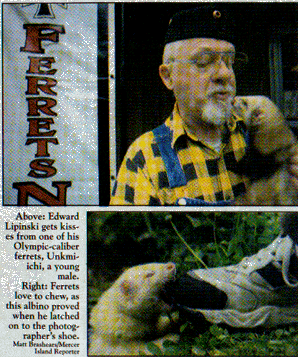
Third Place Award Winner : Society of Professional Journalists-May 15, 1999: "Personalities Category" The word "ferret" comes from a Latin word meaning "little thief" and once some people see this long and lanky, fuzzy and funny breed of polecat, they'd agree that these critters can steal your heart. "They're smart, clean and inquisitive," said Ferrets Northwest owner and ferret-loving Islander Edward Lipinski. "That where we get the infinitive 'to ferret out': When you have one in your home, that phrase takes on a whole new meaning. They'll steal your undershorts if you're not careful!" Lipinski should know. He's got up to 30 ferrets in his house at any given time. Some have been rescued from abandonment or homes where they were no longer welcome. Others are just pets that Lipinski acquired. It all began when his daughter, Leah, wanted a soft,cuddly pet, said Lipinski. "We bought her a rabbit, and it turned out to be the rabbit from hell. So the newest pet on the market was the domesticated house ferret. We bought one and were really delighted with him. They're very affectionate animals." Lipinski and his wife, Anne, moved to Mercer Island in 1966. After graduating from the University of Maryland, the Pennsylvania native worked at the Beltsville Agricultural Resource station as a research entomologist. "I was the bug guy," he said. "And I had the most peculiar job. I had to dissect the gland at the base of the brain of the cockroach which keeps the female cockroach from becoming sexually mature. " But Lipinski was derailed from this important work when he met his wife at a church folk dance, and they moved to Seattle. He worked as an engineering technical writer for The Boeing Company for 18 years. Lipinski retired in 1981, and took over the "Ferret Fanciers of Puget Sound," a home-run club and ferret rescue operation, turning it into the easier-said "Ferrets Northwest." "I thought, well, why not? I love these critters," said Lipinski. Ferrets are a member of the Mustelidae family of animals, along with ermines, weasels, badgers, minks, stoats, skunks and wolverines. The "albino European polecat" which is thought to be the breed from which all current ferrets descend, was originally bred to track down and kill rodents, such as rats, which suit its elongated form and razor-sharp senses of smell and sight. Boeing used this svelte critters during the 50's to pull wiring into the small spaces in their jets. In 1984, Lipinski, in conjunction with a veterinarian who specialized in ferrets, set up a display of ferrets in Waterfront Park in Kirkland. Ferret owners and admirers were invited to attend a picnic get-together and talk about their pets. "We started, for entertainment, to race a few of the ferrets against one another in harnesses, with the owner running alongside holding onto the leash. Then someone said, hey, my ferret loves to pop balloons.' so we had a balloon popping contest to see how many a ferrets could pop in a minute. Finally, somebody realized that the ferret and the otter are in the same family, so we got a kid's swimming pool and set up swimming races. " That was the beginning of the seminal event that has become the Ferret Olympics. At noon on Sunday, June 28, Sayres Park on Lake Washington Blvd is going to become Nagano for Seattle and Eastside Ferrets and their owners. Participants will vie for "certificates of ferret merit" in events ranging from "the paper bag escape" to "wet ferret bowling," "the slalom zigzag course" and "yawning,""kissing" and "licking," "Ferrets can swim 1.74 miles per hour and sprint at 5.63 miles per hour, " boasts Lipinski. "The great thing about these contests is that we have a chance to get scientific statistics on what a ferret can really do. This year we'll be conducting a ferret hearing response tests to test their reaction time to specific sounds." The reason that's important is because ferrets have been known to react aggressively to high-pitched squealing or screaming noises; hence Lipinski lays down the law to prospective ferret owners when they come to adopt one of his furry refugees. "Ferrets aren't the best pet for everyone," he said. "I won't allow them to go to homes where there are infants or female children under age 7, because babies cry and little girls vocalize when they play, and when a ferret hears sounds pitched at such high frequency, it engenders their latent hunting instinct and they will jump up and bite the child." Lipinski also notes that households with other animals such as dogs, hamsters, rabbits, snakes and iguanas are not good places for ferrets as they see some animals as natural prey and others are natural enemies. Non-neutered or spayed ferrets tend to be much more aggressive, too, he noted. As a hobby, Lipinski creates "predator-calls" by imitating the sounds that rabbits or other animals make in the wild. He'll be using those calls during the Ferret Olympics to see how the ferrets react and which sounds draw them the fastest. "That will make it easier to find lost ferrets," he explains. Lipinski's playful ferrets are unusual in what they eat. Though commercial "ferret chow" is available, Lipinski's created his own mixture, called "Lipinski's Ultimate Mustelid Porridge Soup," or "LUMPS." a stew containing of meat, bone, vegetables, fruit, dairy products and yeast. "I recommend that ferrets eat the widest possible diet," said Lipinski. "I have turned ferrets next to death around with my LUMPS, because it contains brewers yeast, onions and garlic...it even repels fleas!" he noted with a chuckle. Lipinski's ferrets seem to love to shower with their owner, and he maintains that ferrets are hygienic and clean-smelling pets. "They do love to steal things, though," he says. "They'll steal and hide anything that's bright and shiny, and they love to steal things with your scent on it, like underwear. So you have to learn to put your laundry in a hamper, with a lid, and hang your house plants up high, because they also love to dig." Lipinski's wife discovered that ferrets like the silky feel of nylon when she found one nesting in her bureau drawer. "My daughter, Nyla, never really took to ferrets, and my wife isn't particularly found of them, either." laughed Lipinski, "but they tolerated them because they know ferrets are such a delight to me. I celebrate "frettchenvergnuegun (the joy of ferrets) every day!" |
Fine dining Wine, etiquette expert comments on American table manners
Thursday, February 25, 1999
By DeAnn Rossetti
Mercer Island Reporter
An emperor was once asked to choose between a beautiful woman and a bottle of fine wine. He supposedly chose the wine because, he said, it will age better.''
``Dieter Schafer, a wine, etiquette and hospitality educator, would probably agree.
Schafer's urbane and poised demeanor combine with his elegant German accent to lend a feeling of proper form and genteel understanding to everything he does.
His newsletter, the WineNews,'' is distributed to clients and other interested aficionados of the grape. It includes such diverse things as a listing of wine events, a French food pronunciation guide and an article defining the Japanese term Umami,'' which means a new way to taste food. He has worked at nearly every job in the hospitality industry, from hotel management to sommelier, from a concierge to general wine steward.
``He is a member of several international professional organizations, including the L'Ordre Mondial des Gourmets Degustateurs and the Society of Wine Educators. After graduating from the hotel school in Tegernesse, Germany, he perfected his knowledge in hotels and restaurants in Zurich, London, Morocco, Normandy, Scotland, and Paris.
Schafer, a native of the Rheingau wine region of Germany, has moved from country to country throughout his life, but finally landed in the United States in 1967, via Canada. In the '80s, he taught in Greece and Turkey, then moved to San Francisco. He came to Mercer Island six years ago, where his fiance lives.
Schafer began using his expertise to teach others about the hospitality industry and food service management at places like Lake Washington Technical College in Kirkland and at Chateau Ste. Michelle in Woodinville. Three years ago, as he was getting more business in wine dinners, bar service and etiquette seminars, he decided to develop a wine newsletter with wine-tasting information and articles on the latest in food and wine. ``I didn't want to charge for it, as it was free advertising for me,'' he said. ``But I stopped it eventually, and just started it again last summer.'' Now the WineNews, which Schafer does on his computer at home, comes out quarterly, and costs $1.25 an issue or $5 annually, and has 500 subscribers.
Interestingly, he doesn't recommend the standard white wine with fish and red wine with beef. There are certain things you don't do, such as have a heavy red wine with oysters,'' he said. But I know people in France who drink red wine with any food; they don't even know what grape is in it.''
`` Schafer recommends that with light meals that contain foods such as salads and fish, serve a light-bodied wine, such as chardonnay, but with a heavy meal that contains foods higher in fat, such as steak and potatoes, a cabernet sauvignon or full-bodied red wine is more appropriate, because it's less flimsy and will complement hearty meals.
Schafer hosts dinners at various restaurants in town to teach gaffe-enslaved Northwesterners how to eat properly. He has discovered that the locals have much to learn.
``Americans eat much too fast,'' he said. They spend $100 per person and are in and out of the restaurant in a half hour. I am still eating my appetizer and they are done.''
``Some common gaffes he sees are making a sandwich'' of the dinner bread by cutting it in half, then buttering the insides and eating it whole; sharing food and improper napkin usage.
`` You should break off a small bit of bread with your fingers, butter it and eat that one piece,'' he said. And if you want to share your entree, hand your whole plate to the person you wish to share it with first, so they can cut off a piece before you've moved things around. Also, your napkin should never leave your lap until you are leaving the restaurant.'' Too many people put their napkins on top of their plate, which is wrong, or they fold a dirty napkin, which is absurd, according to Schafer.
`` I teach both the American and European manner of utensil use,'' Schafer said. I've lost a lot of friends; they don't want to eat with me because they're afraid they aren't eating properly.''
``His classes and dinners out are not only geared to learning etiquette, but to take the mystery out of ordering fine wines with dinner and enjoying the pleasures of the Pacific Northwest's excellent vintages. Thirty years ago, it was not easy to find a good wine here,'' he said. Now Oregon makes better pinot noirs than the French from Burgundy.''
``Schafer also has definite opinions on the quality of cuisine offered locally. He cites Jeremiah Tower of the new Stars restaurant as an excellent chef who understands that good food doesn't have a name. You can't go into a good restaurant any more and say they are serving French or Italian food, because they serve world cuisine, a whole variety of dishes,'' he said. You know you have it made when you can't figure out where your ad should go in the yellow pages.''
``Schafer is so busy with all the facets of his business that he barely has time to seek an office space for his expansion. ``I am looking for a location on the Eastside for a wine bar in the evening, a classroom in the daytime and with space for an office as well, usually a table in the corner,'' he said. ``That's how most restaurants work.''
The
Kindering Center: Special needs, special children
Thursday, June 1, 2000
By DeAnn Rossetti
Mercer Island Reporter
Becky Showalter's son Ross weighed a mere pound and 12 ounces
when he was born four months premature. He was deaf and had
developmental delays in his motor skills. One side of his body
was developing at a slower rate than the other.
The Showalters were so concerned about the present, so focused on
Ross' immediate needs that they didn't think about future
schooling. It was a friend, Janet Morse, who suggested that they
call the Kindering Center. ``I'd never heard of the center
before,'' recalled Showalter, ``and we'd had such a battle
keeping Ross alive in the hospital for five months that I was in
denial. I couldn't see us needing them.''
But Ross's pediatrician recommended the Kindering Center physical
therapy for his asymmetry, so he joined the center for physical
therapy and a toddler play group in which the use of sign
language was common. ``It helped his fine motor coordination to
play with the toys and other children with similar challenges.''
said Showalter. ``It gave him confidence, and because it was for
parents and toddlers, we had the opportunity to learn to work
with him in ways that would stimulate his motor skills.''
Ross learned to walk at age 3 at the Kindering Center. It was a
breakthrough for his family. ``One day I went to pick him up and
the therapist told me to wait right there in the lobby,'' she
said. ``She had Ross come out, walking in his little walker. It
was a very emotional moment.'' Ross improved his motor skills and
graduated to the Northwest School for the Hearing Impaired, where
he is now running and jumping in his first grade class. ``The
Kindering Center made a huge difference for us,'' said Showalter.
``By the time we graduated -- and I say 'us' because we were all
in it together -- we felt like the situation was manageable.
Kindering gave us hope that we could meet Ross' needs.''
Having a baby is an joyous event in most people's lives. But if
your child is born with Down syndrome, is premature or has
developmental delays, that joy can turn to fear and frustration.
Where can you go to get the help that your child and your family
need?
Many Mercer Island parents have sent their children to the
Kindering Center, an award-winning rehabilitation center that
provides critical intervention services to children from birth to
age 3. With one in five infants in the United States at risk for
developmental problems, there is increasing demand for the
Kindering Center's physical, occupational and speech therapies.
The 36-year-old facility also provides foster-care referrals,
support groups for mothers and fathers, night classes in English
and other languages for parents at risk of neglecting their
children, and psychological counseling for families.
And until 1998, you would have been able to have your child enter
the school and start working with Kindering Center's speech,
physical, mental health and other therapists. But now the center
is overcrowded and unable to meet the demand. Many children who
need services are turned away.
``I've been here for 22 years and we've always been able to
shoehorn in families that needed our services,'' said Mimi
Siegel, Executive Director of the Kindering Center. ``In 1998,
for the first time, we had to close enrollment; by the end of the
year, we'd turned away 75 families. In September of '99, we found
that we were already full by the time the school year began.''
The Kindering Center turned away 110 families last year and
expects to triple that number this year, as it receives 20 to 30
calls a month for services it can no longer provide due to lack
of space. That's why Mercer Island families like John and Janet
Morse are co-chairing a capital campaign called ``From Crisis to
Courage.'' Its goal is to raise $3.3 million to build a 12,500
square-foot, three-story addition to the school for classrooms,
therapy space, treatment and counseling rooms.
``This is a passion for our family,'' said John Morse. ``We have
a boy (Brad) with Down syndrome, and at 4 months he started at
the Kindering Center and was there for four years, receiving
physical therapy to help him sit up and walk, speech and language
therapy. Plus we attended support groups for parents. We were so
grateful that there was a place like this where they know exactly
what they are doing and how to help.''
Early intervention with special needs children is key, according
to pediatric experts, because it sets the child up for achieving
more academically and socially later in life. Because Brad Morse
began physical and speech therapy early, and later attended
preschool at the Kindering Center, he was able to attend school
at Patty's Play Center and Emmanuel Preschool with the support of
the Mercer Island special education program.
``Brad was able to go to regular preschool because the Kindering
Center brought him up to speed, and gave him an edge up'' Janet
Morse said. ``He went to kindergarten at Lakeridge and is now in
first-grade and is doing really well. He loves school and is
learning to read, write and spell.''
``It's been well established that birth to age 3 are critical
years for development, and you miss a window of opportunity if
you don't intervene in those years,'' Siegel said. ``We have
research that shows the efficacy of that intervention, in that it
can raise a child's IQ by 10-13 points, so turning away even one
family that needs services now seems unconscionable. I feel just
heartbroken about it.''
Siegel notes that there are other centers like Kindering in
Seattle and outlying communities, but they are full, too. There
are four reasons for the boom in children with special needs,
according to Siegel. One reason is simply the growing population
of the Eastside expanding at a rate of 2 percent a year. Another
is that families hear of Kindering's reputation from their
pediatricians, and are often referred by neonatologists before
the infant is even out of the newborn intensive care unit.
``Nationally we are seeing a higher incidence of autism,
representing one in every 600 births, which is an explosion,''
Siegel said. ``And medical science is able to save premature
infants with lower birth weights than ever before, but these
children often have developmental problems.''
Island resident Kathleen Holt's son James was born with a rare
chromosome disorder that left him with a cleft palate, heart
trouble and a seizure disorder.
``A social worker from Overlake offered to help us put him in
foster care, which was devastating to us,'' Holt said. ``With
Jim, we didn't know where to go or what to do. They told us there
was a 90 percent chance he wouldn't live through the year. But
when we took him to Children's Hospital, we kept hearing about
Kindering Center from the doctors and the nutritionist. Once we
got in the door, it was a gift knowing that we didn't have to
shoulder all the issues by ourselves.''
The Holts utilized the child care facilities at Kindering where
children with special needs are the norm, not the exception.
``I don't know what we would've done without them because it's
hard to find child care for special needs kids,'' Holt said.
``They would do the exercises with him in child care so he would
be constantly learning. It's unfortunate that they had to close
that part of the Kindering Center for lack of staff, space and
funding to handle all the kids with needs that come to them.''
Though James, now 4 years old, has hip and kidney surgery in his
future, he has outgrown his seizures, is off the seizure
medication and goes to Patty's Play Center two mornings a week to
socialize with typical preschoolers.
``They've adopted him,'' Holt said. ``The other kids push his
stroller around and bring him toys all the time. There's always
someone from the school district with him, and he works with a
physical therapist, too. They accept him for what he is, and
aren't afraid of him.''
The Holts also used the counseling facilities at the Kindering
Center. ``Everyone at Kindering Family Counseling helped us keep
our family in focus,'' said Holt. ``They helped our son Thomas
figure out how to deal with his brother, who had an 'extra belly
button' for his gastric (feeding) tube and helped us learn about
the respite care that was available to us through the state. It
was a very nurturing environment.''
Sixteen years ago, Islander Drew Petschl was born seven weeks
premature 16 years ago, with Rubenstein-Taybi Syndrome. ``When he
was 5 months old, his pediatrician thought he would benefit from
physical therapy,'' said Gae Petschl, Drew's mother. Drew's upper
body was stiff and he was doing unusual posturing, which can be a
sign of abnormal muscle tone, so he received physical therapy two
times a week. His mother appreciated the Kindering Center's
gentle approach to helping her son gain ground during physical
therapy.
``They worked with him, but it looks like play, and though he was
resistant at first, with patience and kindness, he actually ended
up enjoying it,'' she said.
Drew was delayed in his speaking ability, so he learned sign
language, like all the children at the Kindering Center.
``He was very frustrated because he couldn't verbalize,'' Petschl
said. ``When he learned to sign for his basic needs, he became a
happier child, and because they also teach the parents to sign,
we then had a form of communication, which was a real
breakthrough for us as a family.''
Drew learned to interact with people while at the Kindering
Center, and after graduating from Kindering, went to preschool in
Issaquah. Now he's in a special education program at Mercer
Island High School, where he helps out in the kitchen and with
attendance.
``Because of the early intervention he had, his physical and
language skills got him where he needed to go,'' Petschl said.
``The Kindering Center is a fabulous place that is near and dear
to our hearts. We all learned a lot about the world of
disabilities and future expectations there.''
The Kindering Center's 9,000 square-foot facility will undergo a
remodel, and ground breaking will begin on the new addition in
spring of 2001. Fund-raising will focus on family, friends,
founders and alumni, with the board of directors pledging
$612,000 of the needed $3.3 million. The staff hopes to move to
the new facility in the spring of 2002.
``The number one thing we want as a result of this campaign is to
get rid of the waiting list,'' Siegel said. ``We'd like to be
able to offer physical, occupational and speech therapy for
children 3 to 10 years of age and have more programming for
children with autism, as well as more support groups, more
counseling, and parent education opportunities for parents and
siblings of children with special needs. It's only a matter of
space and time. We don't want to turn anyone else away.''
He
delivered milk to your door -- for 33 years
Thursday, January 28, 1999
By DeAnn Rossetti
Mercer Island Reporter
Dennis McNeeley has never had to worry about running to the store for a 1/2 gallon carton of milk -- mainly because he has been delivering those cartons for 33 years for Smith Dairy in Kent.
Mercer Island has a long history of home milk delivery.
In 1908, Swan Person, a Swedish immigrant, bought 12 cows, and soon after began delivering milk in a cart, drawn by his horse, Jumbo. There wasn't a West Mercer Way when he began, and making it through the muddy streets wasn't easy. In the 1920s and 30s, Thelma and Henry Rydeen would deliver milk to houses on the shores of Lake Washington in a rowboat, picking up bottles of bootleg whiskey when they washed up on the shore.
The Kristoferson homestead was one of the earliest dairy farms on the Island and The Lucas family farm and dairy competed with the Persons for customers.
McNeeley's route was 50 miles long, and included dropping off 800 half gallons of milk a day for four days a week, through every kind of weather, with no holidays off. ``When I started in 1966, you went out at 7 a.m. and had to be off the truck by 3:30 p.m., but now, you start at 6 a.m. and it's 6 p.m. when you get back in. To make a good living, you have to peddle a lot of milk and have an understanding wife.''
McNeely began working as a milkman when his uncle, a milkman in Bellevue, told him a Smith Dairy route was available. McNeeley got the job and was only given a week to break in on the hills of the Rock. I got lost every day for two months,'' he said. Back then, I had three routes, but I broke them down to two.''
``McNeeley would wear a milkman's coat and a pair of striped bib overalls as his uniform and deliver milk in bottles, which in the '70s changed to plastic. They even tried plastic returnables, but those didn't work, so they changed over to paper cartons,'' he said. We used to deliver more whole milk, but now there's six kinds of milk, plus we've delivered Starbuck's Coffee, cookie dough, and last year I delivered Flaherty's pies, which went pretty good.''
``He also went independent, and bought, during the course of his career, eight different trucks to carry the milk to Mercer Island homes. ``Mercer Island is one of the harder milk routes because of all the hills; we're on top of a mountain here,'' he said. ``It's either up or down -- you don't get very many flat spots in the road.'' McNeeley noted that he's pushed a few stalled cars up or downs those hills in the past 33 years.
McNeeley retired as of Jan. 1 this year, and the 57-year-old Enumclaw native can recall only one incident that took the pleasure from his daily milk run. I got nipped on the chest by a local dog,'' he said. I got five stitches from it, but I still delivered to that family afterwards.''
``He and his wife plan to do some traveling, hunting and fishing, but McNeeley notes that his wife isn't totally happy that he's quit delivering milk. She's starting to complain that now she has to buy milk from the grocery store,'' he said. It'll run the grocery bill up $100 a month.''
``McNeeley sold his milk route to Jerry Holt, a man young enough to take on the challenge. He's about 24, which is how old I was when I started,'' he said. I told him that he has to keep the route up, because if it starts slipping, he won't make ends meet. I also told him don't worry about going home, but break the wife in easy.''
``When McNeeley began his route, there were eight other milk trucks dropping off dairy products at the door on Mercer Island, but now there's only one. Ironically, McNeeley can't enjoy some of the products he delivers or the candies and cookies that generous Islanders leave for him at holiday time. ``The doctor had to take me off milk because I drank too much,'' he said.
``I was my own best customer for awhile, but then I couldn't have anything with cholesterol, and I got diabetes when I was 50,'' he said. ``So now all I can have is skim milk and I have to lay off the cheese.''
Buttercup the Chicken is Crowned
Queen of the Critters
Thursday, July 22, 1999
By DeAnn Rossetti
Mercer Island Reporter
 The atmosphere was tense, the
judges huddled and swapping notes, and the contestants were
panting for the glory of being crowned the Royal Critter'' of the
1999 King County Fair. This year's Critter Crowning Contest'' was
held at Luther Burbank Park on Mercer Island on July 15, complete
with plenty of press and King County Executive Ron Sims to crown
the winner.
The atmosphere was tense, the
judges huddled and swapping notes, and the contestants were
panting for the glory of being crowned the Royal Critter'' of the
1999 King County Fair. This year's Critter Crowning Contest'' was
held at Luther Burbank Park on Mercer Island on July 15, complete
with plenty of press and King County Executive Ron Sims to crown
the winner.
``Pookie, a Bernese mountain dog, and Darla, a miniature donkey, tied for third place, while Gentleman, a Limousin steer, swiped second place with a courtly bow.
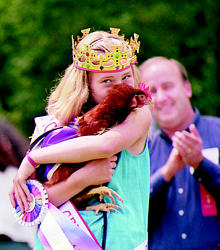
But it was Buttercup, a Rhode Island Red chicken, who took the crown, with her queenly poise and flowing purple robes.
``She's feeling really good,'' said owner Sondra Edwards about her pet's win. She's queen of the barnyard at home, and now she's queen here, too.'' Edwards raised 3-year-old Buttercup from a chick, and noticed her fearless ability to challenge the limits of chickenhood early on. She likes to hug, sing and ride horses,'' said Edwards. She's friendly and there for everyone.''
``Getting a chicken ready for the stage isn't an easy task, however. It takes two people to bathe this chicken,'' said Edwards. I put her in the tub, but she wouldn't let the water get above her neck. Then I took a toothbrush and soap to her legs, which made her very mad at me.'' Buttercup's winning diet includes cat food and bird seed, and daily walks on a leash to keep her trim. She doesn't lay eggs anymore, but is a retired bird who occasionally sits on other hens' eggs, just to keep in practice.
``How will the Edwardses and Buttercup celebrate their victory? We're gonna have a big honkin' barn party,'' said Edwards. But we'll pass on the chicken wings.''
``Nearly every kind of feathered and fur-bearing critter was paraded though the amphitheater, from Siamese-twin tabby cats to a Boer-Nubian goat, a French lop-eared rabbit, a Southdown sheep. a pot-bellied pig and two llamas.
Dezi, a 10-year-old Arabian horse owned by Maxi Gumprecht of Mercer Island, was especially nervous, surrounded by loud announcements and the grunts, snorts and barks of other animals. We're headed for a disaster here,'' said Gumprecht, who was dressed in traditional riding garments complete with boots. Unfortunately, Dezi managed to prove her owner right by fertilizing the stage moments after her entrance, which didn't seem to faze her owner. I've been riding for two and a half years,'' said the 8-year-old Gumprecht. It never scares me.'' Gumprecht noted that she felt her horse deserved to win because, She's pretty, she's gentle and she has a winning spirit.''
``Grape Jelly Muffin, the Boer-Nubian goat, and her owner Natasha Lovell were crowd favorites, as when the master of ceremonies queried Lovell about her other goats, she replied. I have two other goats, but they're boys, and boys are stinky.'' Grape Jelly Muffin, however, is the light of her owner's life. She's sweet and I can spoil her because she eats almost anything,'' including grape jelly muffins, which is how the goat got her name.
``King County Executive Ron Sims was busy chatting with his old college buddy, Penny Coyne from radio station KYCW, who added a KYCW ``butt sticker'' to Sims, as well as to most of the animals in attendance. Judges included King County Councilmember Brian Derdowski, King County Park System Director Craig Larsen and King County Fair board members. The critters were judged on factors such as personality, likability and overall appearance and health.
``This was the closest contest I've seen,'' said Sims. ``There was a good variety of animals, and it was hard to choose.'' Sims noted that the weather was also a factor in getting hizzoner to Luther Burbank Park. ``On a day like today I love being out of the office,'' he said. ``And I enjoy this. I have a dog at home named Sonic who is definitely a critter.''