|
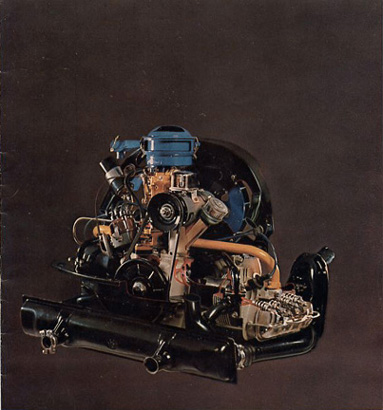
First, we build the Volkswagen engine.
We use aluminum and magnesium alloys
to make it as light and strong as an airplane
engine. (The complete engine weighs in at
only 182 pounds S.A.E.) |
We use two pairs of horizontally opposed
cylinders. And make them lie flat. To give
the VW engine a low center of gravity. Also,
we make the pistons with an unusually short
stroke and low speed. To give the VW engine less friction, longer life. (It's not unusual
for a VW to go over 100,000 miles on its
original pistons and cylinders.) |
Now, we're ready for the carburetor. We
use a single-throat downdraft type with an
automatic choke and accelerator pump. To
give the VW good acceleration and keep its
fuel consumption low. (As a matter of fact,
most people get around 32 miles on a gallon
of regular gas.)And of course, we cool the engine by air.
So we do away with: anti-freeze, water, water
pump, hose, hose connections and all conventional-car-radiator problems. In fact, we
do away with the whole radiator. |
So it's virtually impossible to have: leaks or rust or a
steaming, boiled-over radiator. There's no
need for a winter change-over. Or a summer
change-over. (Or the accompanying repair
bills, either.)
Next, we put in the oil cooler and fuel
pump and fan and bearings and connecting
rods, and crankshaft and crankcase, and
crankcase ventilating system. We do it all
by hand, and inspect it at each stage of its
assembly. Then, we run the engine to break
it in. (You can take your VW up to top speed
the first time you drive it.) |