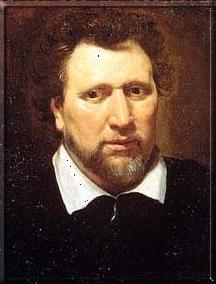
killed a fellow actor, Gabriel Spencer, in a duel in the Fields at Shoreditch and was tried at the Old Bailey for murder. He escaped the gallows only by pleading "benefit of clergy". During his subsequent imprisonment he converted to Roman Catholicism only to convert back to Anglicism over a decade later, in 1610. He was released forfeit of all his possessions, and with a felon's brand on his thumb.
Jonson's second known play, Every Man in His Humour, was performed in 1598 by the Lord Chamberlain's Men at the Globe with William Shakespeare in the cast. Jonson became a celebrity, and there was a brief fashion for 'humours' comedy, a kind of topical comedy involving eccentric characters, each of whom represented a temperament, or humor, of humanity. His next play, Every Man Out of His Humour (1599), was less sucessful; as with Cynthia's Revels (1600) a satirical comedy displaying Jonson's classical learning and his interest in formal experiment.
Jonson's explosive temperament and conviction of his superior talent gave rise to "War of the Theatres", In Te Poetaster (1601), he satirised other writers, chiefly Thomas Dekker and John Marston. Dekker and MArston retaliated by attacking Jonson in their Satriomastrix (1601), in which the plot was mainly overshadowed by its abuse of Jonson. Eventually the writers ceased their feuding; in 1604 Jonson collaborated with Dekker on The King's Entertainment and with Marston and George Chapman on Eastward Ho. A passage in the play, derogatory of the Scots, offended James I, and the three playwrights spent a brief time in prison.
Jonson's great period, both artisically and financially, began in 1606 with the production of Volpone. This was followed by three other comedies, Epicoene (1609), The Alchemist (1610), and Bartholomew Fair (1614). He became a favourite of James I and wrote many masques for the court. He was the author of two Roman tragedies, Sejanus (1603) and Catiline (1611). With the unsuccessful production of The Devil Is an Ass in 1616, Jonson's good fortune declined rapidly. With the accession of Charles I, his value at court was less appreciated.
Jonson was appointed City Chronology of London in 1628, the same year he suffered a severe stroke. His friends kept him company in his final years and the King provided him some financial comfort. Jonson died on August 6, 1637 and was buried in Westminster Abbey under a plain slab on which was later carved the words "O Rare Ben Jonson!"
His last play, Sad Shepherd's Tale, was left unfinished at his death and published posthumously in 1641.
|