| CD REVIEWS |
 |
| I have seen and heard this hard-working band of Ecuadorians several times this summer in Hamilton and was mesmerized on each occasion. While the rhythmic magic of their live performances was expertly produced on this recording (in Ecuador), it was more effectively experienced in the more liberated environment of the outdoor festivals at which they were playing. These are experienced buskers who are nevertheless modest but polite when interacting with their audience. Their female singer/guitarist even took the time to thank fair-skinned people like me for staying to listen, despite the risk of sunburn. The music itself conjures up visions of a sunny village in the Andeans mountains celebrating its love for life and family in a manner that is understood on a global basis. Although the lyrics are composed and sung in their native language of Quechua, anyone who has studied basic Spanish would be familiar with the word, �amor� (love); nothing else is needed to appreciate its essence and beauty. The dominant, identifying, instruments are the pan flute, recorder and acoustic Spanish guitar, of course, but these are successfully layered with the more modern electric bass and synthesizer, for added percussion and brass elements, as well as several stringed instruments resembling miniature guitars and mandolins. While all seven members provide backing choral vocals, at least two or three (male and female) of the players often alternate on powerful, passionate lead vocals. Just as �Imbaya� is classified as a type of Native people, a North American equivalent, Mohawk, is paid homage on �Mohicano�. Although many of the songs are passionate tributes to their families (�Mi Ni�a�) and �El Amor de Mi Vida� and country (�Tormenta de Los Andes� and �Caminito de Llamas�, they acknowledge less fortunate people on �Llaqui Runa� (Sad Native) and �Triste Soledad� (Sad Loneliness). The multi-layered charting of the arrangements is reproduced splendidly on this recording, no doubt because they have mastered it in their live performances as well, so there are not many solos. They work as a team, but it�s easy to see that each individual is capable of shining on his/her own, on whichever instrument is chosen to play � bravo! Curiously enough, you will just have to watch out for them on their 2004 summer tour throughout Ontario, Qu�bec and Manitoba, as their scheduled (or unscheduled) appearances apparently do not appear on their website (www.theimbayakunas.com) until after the fact. |
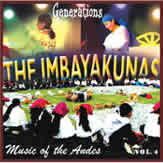 |
| GENERATIONS - THE IMBAYAKUNAS (CD Review) |
| TO RETURN TO THE CD REVIEW INDEX PAGE, |
 |