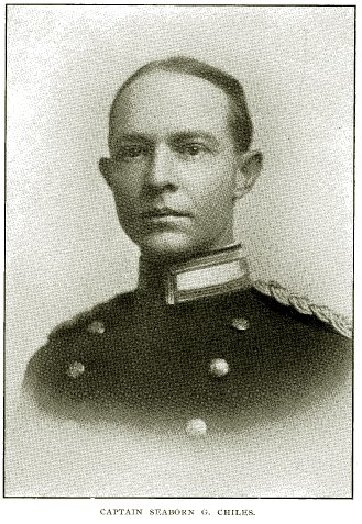
SEABORN GREEN CHILES
No. 3800. CLASS OF 1897.
Died, October 2, 1908, at Ft. Benjamin Harrison, Ind., aged 35.
SEABORN GREEN CHILES was born August 5, 1873, on his father's
plantation, three miles south of Gainesville, Florida. His ancestors were
from Georgia and South Carolina, and in the latter State were represented by
the Lawtons, Roberts and Maners. His father, J. W. Chiles, now resides at
Lakeland, Florida, and his mother was a daughter of Colonel J. M. Raysor,
who emigrated from South Carolina to Florida.
Chiles' early education was obtained in Valdosta, Georgia and Fort
White, Florida, and the greater part of his boyhood was passed in the latter
named town.
At about the age of sixteen he entered the Florida State Agricultural
College at Lake City and pursued a course of study until during his senior
year, when Congressman Bullock appointed him to a cadetship at the United
States Military Academy. His college days at Lake City were marked by
earnest effort and corresponding reward, which were attested by an
appointment as one of the two cadet captains, and by the very high
recommendations of every member of the faculty as to his worth and ability
as a student. His fondness for the military naturally fitted in with an
appointment to West Point, which institution he entered June 15, 1893.
Few are they of the Corps of Cadets between 1893 and 1897 who do not
remember "Seab" Chiles. Especially was this popularity marked in his own
class of '97. This sprang from no prowess on the athletic field, for he was
not an athlete. And although a student who maintained a creditable record,
he was no vigorous contestant in the "game of tenths." His hold on his
fellow man came from an instinctive quality of leadership, from that
sociability of disposition, that fondness for good fellowship which made him
the attraction in every assemblage of his classmates. He was gifted by
nature with a brightness of intellect, he possessed a drollness of wit and
humor, and his friends always delighted in his society where sparkling
reminiscences of the past and pungent experiences of the present were themes
of a most entertaining nature.
Upon graduation in June, 1897, there were a very limited number of
vacancies in the Infantry, and "Seab," like a number of others, was
appointed an additional Second Lieutenant; his assignment taking him to the
Twelfth Infantry at Fort Niobrara, Nebraska. From his entrance into the
service, his efforts were always indicative of a keen appreciation of duty;
while his natural ability and practical judgment afforded easy and
satisfactory solutions to the various problems that arose.
His regular vacancy occurred in the Eleventh Infantry, and he joined
that organization April 19, 1898, at Jefferson Barracks, Missouri. The
remainder of his service forms a part of the history of that regiment,
having served with it until his death.
The regiment was ordered to Mobile in the spring of '98, but did not
become a part of the force dispatched to Cuba. However, Chiles' hopes were
partially realized later in the year when opportunity came for active
service in Porto Rico; and on August 10th and 13th he participated with his
company in the engagements at Hormigueros and Las Marias. After peace was
declared, the Eleventh Infantry remained in the island until April, 1902;
and during this period Chiles performed the various duties of a sub-altern,
staff officer, company and post commander. He was promoted to the grade of
First Lieutenant, March 2, 1899.
As Adjutant of his battalion he accompanied it to the Philippine
Islands, sailing from San Francisco, April 21, 1902. His vacancy as Captain
occurred May 28, 1902, and was assigned to the Sixteenth Infntry. However,
he never joined his new regiment but was transferred to the Eleventh
Infantry under date of June 18, 1902. He served in Mindanao and Jolo with
his company, and experienced the harrowing conditions of duty among the wild
and fanatical Moros.
After about two years in the Islands, the regiment returned to the
United States and took station at Fort D. A. Russell, Wyoming. From this
station, Chiles entered the Infantry and Cavalry School at Fort Leavenworth,
Kansas, September 1, 1905. During the school year he showed special ability,
gained the distinction of "distinguished graduate" (having stood nine in a
class of fifty-one) and was made a member of the Staff College class for the
following school term. During the summer of 1906, he attended maneuvers at
Camp Benjamin Harrison, Indiana, and upon the opening of the school year,
September 1, 1906, he entered the Staff College at Fort Leavenworth. His
course was interrupted on October 1st, when he was ordered to join his
regiment, which had been designated as a part of the expeditionary force for
service in Cuba.
Practically all of this period of Cuban service was spent at Holguin,
where he commanded his company, and at times the post, and was detailed as
Intelligence Officer of that district for the purpose of securing detailed
information of a military nature.
On July 21, 1907, he left his station in Cuba to re-enter the Staff
College, and on June 30, 1908, he completed this course. During July, 1908,
he participated in a ride with the Staff Class from Manassas, Virginia to
Gettysburg, Pennsylvania, for the purpose of studying various campaigns and
battles of the Civil War. During the month of August he was engaged in
maneuver duty at Dale Creek, Wyoming, and during the month of September on
similar duty at Fort Benjamin Harrison, Indiana.
Only a day or so before the completion of these maneuvers he was taken
sick and admitted to the hospital. After an apparently slight illness of two
or three days, he died, very suddenly, on October 2d. His body was interred
at his old home in Fort White, Florida.
Seaborn Green Chiles represented many qualities of the efficient officer
and thorough gentleman. Possessed of a high degree of ability, he also bore
that characteristic of forcefulness, which is indispensable to the officer
of. value. His exuberant spirit of young manhood was naturally tempered in
his later years, and to casual acquaintances he appeared somewhat reserved.
But to his friends he was always the same interesting and attractive
character.
The last body of officers with whom he was associated, and before whom
each individual of that body was ever subjected to a minute test, was the
group of officers connected with the Army Service Schools. By each of them
he was highly favored in their affections and most unanimously judged to be
a man of force and mental vigor. In their social and official gatherings he
was one of the leading spirits. In the former, to him they always turned for
that brightness of thought and good humor which established such occasions
as among the very happy memories of the past.
Yet there is the other side, and recollections are deeply marked with
thoughts of sadness. And although those lovable and enduring traits are
linked to the past, their influence ever shines among those who called him
friend.
To his intimates, "Seab" possessed that bigness of heart, that high
standard of conscience, that innate force of character, elements which
always strongly bind certain kindred souls. These indefinable forces so weld
members of such a coterie that no powers from without can weaken that union;
while from within there is that silent understanding, that community of
trust which can never be broken.
A CLASSMATE.
Pages 67 to 71, "Forty-Firt Annual Reunion of the Association
of Graduates of the United States Military Academy at West Point, New York,
June 14th, 1910." Saginaw, Michigan, Seeman & Peters,
Printers and Binders, 1910.