
son of Nathan A Hobbs and Mary Lankford
Civil War Soldiers Index
Aug 16 - Sep 2, 1862
The Coming of War
Jun3 - Aug 1, 1863
May 4 - Jun 12, 1863
Mar 28 - Apr 9, 1865
Apr 9, 1865
Office of Secretary of State Max Cleland
THIRD REGIMENT GEORGIA VOLUNTEERS
--------------------------------------------------------------------------------
The 3rd Regiment was organized in April 1861 with companies from Burke, Clarke, Greene, Houston, Morgan, Newton, Putnam, Richmond, and Wilkinson counties. The 3rd served early in the war at Norfolk, Va., where it assisted in converting the Union ship Merrimac into the Confederate ironclad Virginia. A part of the regiment served in the famous battle against the Union ironclad Monitor on March 9, 1862.
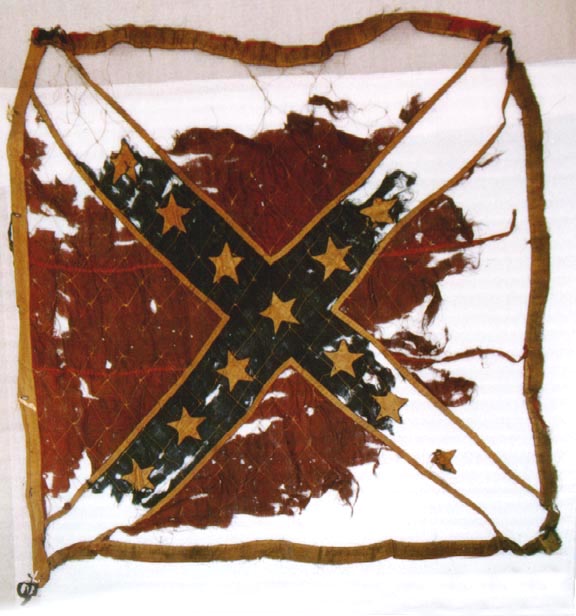
The unit had just 600 available soldiers when it held off three enemy brigades at South Mills, N.C., in April 1862. Maj. Gen. Benjamin Huger authorized the regiment to inscribe the site of that battle on its flag. It may have done so on a different banner. In a letter written after the engagement, Pvt. Samuel Tenney of Company K reports, "During the action, our men shot down two of the enemy�s battle flags, while our own blue flag waved throughout the battle though pierced by five bullets." Perhaps the unit inscribed "South Mills" on that blue flag, which would have preceded the one pictured here.
The flag in the Georgia Capitol likely received its baptismal fire in the Battle of Oak Grove (King�s School House) near Richmond, Va., June 25, 1862. At Chancellorsville the regiment captured 300 prisoners and three cannon. At Gettysburg, despite suffering 196 casualties and having its colors shot down seven times, the 3rd captured several pieces of artillery. This regiment was also instrumental in turning back the Federal forces at the Crater during the siege of Petersburg, capturing three stands of colors and part of an artillery battery in the melee.
The regiment�s color bearers paid dearly to defend the flag. The original color guard of 10 men all died in battle except E. R. Hughes, who was severely wounded. Alexander Langston of Company C met death while carrying the banner at Gettysburg. Dennis Ryan of Company B was wounded beneath the flag at Spotsylvania Courthouse and later killed by the explosion at the Crater. Cpl. Robert W. Bagby of Company H lost an arm while carrying this flag in battle at Reams� Station, Va., August 25, 1864, and Frank Barnwell of Company C was desperately wounded at Hatcher�s Run, Va., February 5, 1865. James Hicks of Company I bore the regiment�s color to the end of the war. The flag itself was not spared; it was ripped by 53 minie balls and fragments of a bomb shell.
The 3rd Regiment never lost or surrendered its flag. At Appomattox, Hicks tore the flag from the staff and presented it to Col. Claiborne Snead, who wrapped the treasured cloth around him under his coat. Lt. Garrett S. Oglesby of Company G later gave it to Mrs. Blanton, wife of a Presbyterian minister in Salem, Va. She protected it until railroad transportation was renewed in the South. Then she sent it to Colonel Snead in Augusta, Ga.
Survivors of the regiment formed a reunion association which eventually included both veterans and their descendants. A committee from the association, chaired by Colonel Snead�s daughter, donated this flag to the State of Georgia.
After outstanding performance during the Seven Days� Battles, Ambrose R. Wright was promoted to the rank of Brigadier general from the 3rd Regiment. Wright achieved the rank of major general in 1864 and served the Department of South Carolina, Georgia, and Florida. During the war, Wright was elected to the Georgia State Senate and chosen president of that body in absentia.
Field Cross Edge Stars (13) Border
Color: Red Dark Blue,
4 �" wide White,
3/4" wide White,
5 ptd., each
3 �" dia. Orange,
2" wide
Material: Bunting Bunting Cotton
cambric Cotton
cambric Bunting
Method of attachment: Three whipped eyelets pierce the 2" wide, white canvas heading.
Star separation: Center-1st: 6"; Center-2nd: 12"; Center 3rd; 18"
STAFF 48" FLY 47"
--------------------------------------------------------------------------------
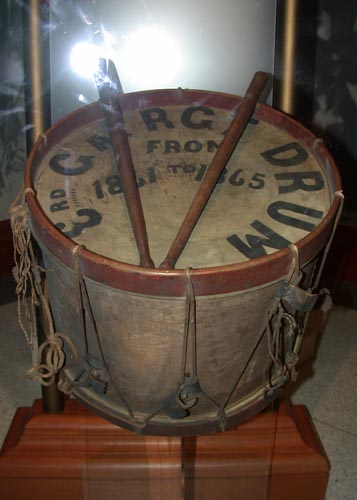
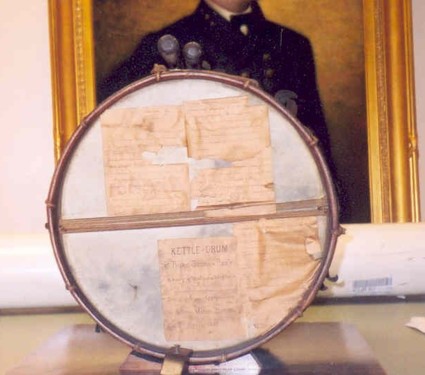
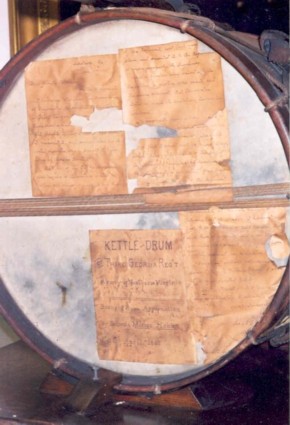
This drum entered Confederate service with Seaborn Barnwell of the Dawson Grays from Greene County, the unit which became Company C of the 3rd Regiment. The drum beat all the calls from the regiment�s formation at Portsmouth, Va., April 26, 1861 to its surrender at Appomattox on April 9, 1865. When the regiment stacked its guns, the drum was hung on the pile of rifles. Pvt. Minor Hobbs of Company C took the drum and brought it back to Greene County, Georgia. Capt. W. A. Wright, son of Gen. Ambrose Wright, preserved the drum until a survivor�s committee of the 3rd Georgia presented it to the State Capitol.
--------------------------------------------------------------------------------
3rd Regiment Georgia Volunteers
(Reunion Flag)
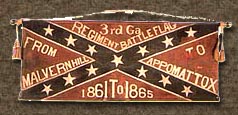
For many years before and after the turn of the century, veteran�s groups from both Northern and Southern armies held periodic reunions. These meetings created a demand for copies of Union and Confederate accoutrements and associated items. The veterans of the 3rd Regiment probably followed this peace-time banner many more years than they did their battle flag during the war.
Local and informal veterans� groups met in the 1870s and early 1880s, but United Confederate Veterans (U.C.V.) did not organize until 1889. At their first convention, which was held in New Orleans, the members elected John Brown Gordon, the governor of Georgia and former C.S.A. general, as the organization�s commander-in-chief. Thereafter, the U.C.V. held annual national conventions.
The reunion in Atlanta, July 20-23, 1898, typified these assemblies. Twenty thousand veterans attended, with the city hosting nearly the same number of Sons of Confederate Veterans (S.C.V.) and a like number of the United Daughters of the Confederacy . The U.C.V. conducted its formal business in an enormous exposition hall located in present day Atlanta�s Piedmont Park. The proceedings began with music by the reunion band, and invocation by the Rev. J. William Jones, chaplain general of the U.C.V., and welcoming speeches by local politicians. Then Clement A. Evans, division commander under Gordon during the war and now president of the convention, called the gathering to order. Over the following days, aging erstwhile officers recalled the glory and gore of battle in rolling rhetoric. The members passed resolutions on a wide range of topics, many of the motions expressing support for America in its war against Spain. The veterans also re-elected Gordon commander-in-chief for one more year.
The reunion achieved its major objective outside the convention hall. Each day old warriors thronged the streets, laughing and arguing in reminiscence, renewing bonds from 33 years earlier. Each night the city glowed under gas lights and oil lamps as hotels, civic clubs, and hundreds of private homes hosted receptions and cotillions. In a grand parade down Peachtree Street Friday afternoon, the army of silver-haired heros, preceded by the ranks of the S.C.V. and led by Gordon on horseback, drew wild cheering from thousands of spectators � despite an unscheduled downpour.
On that final day of the convention, Miss Winnie Davis, the "Daughter of the Confederacy," visited the hall, inspiring the old men to fling "their hats into the air in rapturous demonstrations of enthusiasm." Finally, the veterans voted to hold their next meeting in Charleston, and then they adjourned. The Atlanta Constitution reported that all participants declared the Atlanta reunion to be the grandest they had ever attended.
Field Cross Edge Stars (13)
Color: Red Dark Blue,
4" wide White-silver,
1/2" wide White-silver,
5 ptd., each
3 �" dia.
Material: Silk Silk Paint Paint
Method of attachment: A 55" decorative wooden rod has been inserted in a sleeve along the top of the flag.
Star separation: Center-1st: 5 1/2"; Center-2nd: 11"; Center 3rd; 16 1/2"
HEIGHT 19" WIDTH 46"
21 SEPTEMBER 1879 HOBBS, MINOR S. NASH, ELIZABETH A. Greene Co., GA
43 Hobbs, Minor 40 MW Painter 300
43 Hobbs, Elizabeth 30 F W Keep house
43 Hobbs, William 5 MW
1900 Taliferro Co., GA
This one shows they had no children. I found one in 1870. 204
Hobbs Minor Head MW July 1831 69 mar 20 yrs GA
Hobbs Elizabeth Wife FW May 1835 65 mar 20 yrs 0 ch 0 alive GA
(Minor might have been married and had a son or William was his brothers child?)
1910 Taliferro Co., Ga
Minor S Hobbs MW 79 mar 2X mar 30 yrs GA SC NC English Own Income
Elizabeth A Hobbs FW 74 mar 1x mar 30 yrs GA GA GA
