A CHEAP AND CYNICAL "SENSATION"

The first thing to understand about the controversy surrounding Mayor Rudolph Guiliani's decision to cancel city funding for the Brooklyn Museum if it went ahead with an exhibition called "Sensation: Young British Artists From the Saatchi Collection" is that it has nothing to do with the First Amendment.
Of course, that's not what you've heard from the so-called "arts community" and its supporters.
"Censorship!" thundered a The New York Times editorialist.
"At war with the First Amendment," said Floyd Abrams, the well-known lawyer who is representing the Brooklyn Museum in a lawsuit against the city.
Petitions are circulating, protest marches are being organized, radio and television talk shows are busy wringing their collective hands over the alleged "chilling effect" of the Mayor's action.
Relax.
There are several important issues at stake in the controversy over "Sensation."
Freedom of expression is not one of them.
Citing a picture of the Virgin Mary that features clumps of elephant dung and cutouts from porno magazines, Mr. Guiliani rightly described the exhibition as "sick" and "outrageous." (He might have cited plenty of other objects in the show, too, like the mannequins of pubescent females studded with erect penises, vaginas, and anuses.)
Mr. Guiliani acknowledged straight away that "If somebody wants to do that privately and pay for that privately, well, that's what the First Amendment is all about."
At the same time, he insisted that "You don't have a right to government subsidy for desecrating somebody else's religion."
Precisely.
But of course it depends on whose religion we are talking about. These days, it's always open season on Catholics. (Who was it who said that anti-Catholicism is the anti-Semitism of intellectuals?)
But consider what would have happened if, instead of the Virgin Mary, an artist had given the prophet Muhammad or the Star of David the dung-and-porno routine? Or what if Matthew Shepard, the homosexual who was brutally murdered in Wyoming, or a black had been accorded similar treatment?
In fact, the controversy over "Sensation" is full of ironies.
What if the Brooklyn Museum had decided to put a creche, including a statue of the Virgin, in its lobby come Christmas?
You can be sure that the American Civil Liberties Union would be on them in a flash: "Religious symbols in a public space? No way."
But festoon a picture of the Virgin with graphic depictions of female genitalia and elephant turds and stick it in a gallery upstairs and the ACLU will keep you in court forever if you try to withhold public monies supporting its exhibition.
Before the controversy broke, the Brooklyn Museum did everything it could to capitalize on the sensationalistic aspects of the exhibition.
Its publicity proudly announced that "T-shirts, including one packaged with a condom, with a choice of 'Safe' or 'Unsafe' emblazoned on it" would be for sale in the gift shop, as would toilet paper wrapped in yellow "Caution" tape.
The museum even sent around a mock "Health Warning" that cautioned potential viewers that "the contents of this exhibition may cause shock, vomiting, confusion, panic, euphoria, and anxiety," and advised them to consult their doctor before seeing the show.
In other words, so long as it cost them nothing museum officials gloried in the fact that the exhibition was outrageous; now they are wounded that people are outraged.
In the art world today, the First Amendment is routinely invoked to justify or protect objects and behavior whose entire raison d'etre is to shock and discommode.
These raids on the fringes of extremity have helped to transform the art world into a moral cesspool.
In testing the limits of free expression, the art world has demonstrated its emancipation from all manner of social and aesthetic norms.
But it has done so from the safety of a well-remunerated haven.
As George Orwell observed, writing about the culture that celebrated Salvador Dali, "if you threw dead donkeys at people they threw money back."
Trendy artists and their liberal supporters want the privilege of being shocking without the responsibility that goes along with it; they want to "transgress" moral norms, but they want to do so with impunity.
Indeed, they want society to congratulate them on their "courage."
We suffer today from a peculiar form of moral anesthesia.
It is an anesthesia based on the delusion that by calling something "art" we thereby purchase for it a blanket exemption from moral criticism: as if being art automatically rendered all other considerations--considerations of morals, manners, taste--beside the point.
There is no doubt that art can to much to enhance and deepen life.
But the cynical aestheticism that pretends that art trumps all other values cheapens not only the public sphere but ultimately art itself.
In such a situation, real courage is displayed by those who, like Mayor Guiliani, are willing to be outraged by the outrageous.
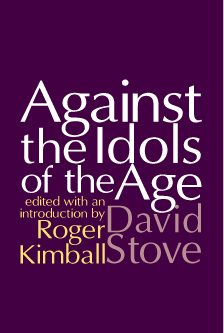
Roger Kimball is managing editor of the New Criterion and an art critic for the London Spectator . He is author of Tenured Radicals (newly revised and expanded) and co-editor with Hilton Kramer of Against the Grain: The New Criterion on Art and Intellect at the End of the Twentieth Century and The Future of the European Past: Essays from The New Criterion . He has written for the Wall Street Journal, the Times Literary Supplement, and Canada's National Post, among other publications. He has just published an edited volume of the philosophical writings of David Stove, Against the Idols of the Age.