The Idler's email list
To advertise in The Idler
Write a letter to the editor

(www.the-idler.com)
Volume II, Number 94





DEMONIZING THE BOMB IS DANGEROUS
By Ernest W. Lefever
It is certainly a good thing for the world that Hitler's crowd or Stalin's did not discover this atomic bomb.
--Harry S. Truman, July 25, 1945
The widespread condemnation of nuclear tests by India and Pakistan in 1998 reflects a persistent and mischievous eschatology that demonizes nuclear weapon. In so doing, it distorts the political and moral issues facing the major nuclear powers--the United States, Russia, China, Britain, and France--and their fledgling emulators in the Third World. On August 6 last year on the fifty-third anniversary of the Hiroshima bomb, Jimmy Carter, Mikhail Gorbachev, and other luminaries, asserted that these unexpected tests underscored the evils of nuclear arms.
The sharp criticism, especially in America, also reveals a lingering Wilsonian idealism that invests unwarranted confidence in multilateral agencies and comprehensive arms control treaties. Complaints that India and Pakistan had violated "international norms" recall Woodrow Wilson's plea in 1919 for the Senate to support the League of Nations: "Dare we reject it and break the heart of the world? The stage is set...by the hand of God."
Both New Delhi and Islamabad--for decades bitter adversaries over disputed Kashmir--justified their tests primarily in the name of self-defense, though each clearly sought to enhance its political clout and national prestige--as the organized public jubilation in both countries attests.
The case for India's tests was argued forcibly by Jaswant Singh, a senior foreign affairs adviser to Indian Prime Minister Atal Bihari Vajpayee, in Foreign Affairs ("Against Nuclear Apartheid," September-October 1998). Mr. Singh's central point is that India needs a nuclear and missile capability because it is situated in the "neighborhood" of a hostile China and Pakistan, each a potential nuclear threat. In pressing his case, he barely mentions India's intense desire for self-esteem and international prestige--to be a proud member of the nuclear club.
Emulating Prime Minister Nehru's Cold War penchant for blaming both sides, Mr. Singh accused the major nuclear powers, principally Washington and Beijing, of hypocrisy and double standards--of "nuclear apartheid," as he put it. Pakistan's justification, though less strident, was cut from the same cloth. Singh's self-serving brief aside, his charges of major nuclear power hypocrisy have some merit. As does his criticism of the arms control orthodoxy that places unwarranted confidence in the Nonproliferation Treaty (NPT) and the Comprehensive Test Ban Treaty (CTBT) to control the spread of nuclear arms and tame the behavior of those who possess them.
The attack on India's tests of May 11 and 13, and Pakistan's tests of May 28 and 30 recalls the outcry over India's first nuclear test in 1974. In both cases, critics were motivated in part by the demonization of all nuclear weapons--a phenomenon that started even before America dropped the bomb on Hiroshima in August 1945 and which persists to this day. Last year, for example, on the fifty-third anniversary of Hiroshima, Jimmy Carter, Mikhail Gorbachev, and other luminaries, asserted that the Indian and Pakistan tests underscored the evils of nuclear arms. Demonizing any new and more lethal weapon has a long history. When gunpowder was invented in the thirteenth century, critics called it satanic, some pointing to its sulfuric odor to underscore their point. In the 1860s when Swedish physicist Alfred Nobel invented dynamite, he felt so guilty that he established the Nobel Prize for Peace to atone for his sins.
Cursing the atomic bomb began in 1945 with another physicist, J. Robert Oppenheimer, who played a leading role in developing it. After witnessing the first atomic blast in New Mexico, he quoted the Hindu The Living Gita: "Now I am become Death, the destroyer of worlds." His sense of guilt fed his ambiguity about the atom bomb and his later outright opposition to the American H-bomb. (His repugnance did not deter him from passing atomic secrets to Soviet agents.) Other American physicists were also afflicted by nuclear pacifism and apocalyptic foreboding. When America detonated its first H-bomb in 1951, the hands on the Bulletin of Atomic Scientists doomsday clock were moved from five to three minutes before midnight.
Leo Szilard, the Hungarian-born physicist, who with Albert Einstein had advocated development of the atomic bomb, urged President Harry Truman on "purely moral grounds" not to use it against Japan. But Assistant Secretary of State Dean Acheson, like most presidential advisors, urged Truman to use the bomb--originally intended for Germany--against Japan as soon as possible. In his dairy on July 25, 1945, Truman said simply: "The most terrible bomb in history...can be made useful," adding, "It is certainly a good thing for the world that Hitler's crowd or Stalin's did not discover this atomic bomb." Hiroshima's Long Shadow
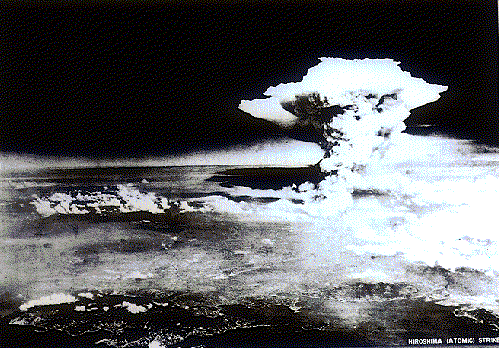
On August 6, 1945, the Enola Gay dropped an atom bomb on Hiroshima. Three days later another was dropped on Nagasaki. The following day, Emperor Hirohito sided with Imperial Japan's "peace faction" and accepted unconditional surrender. In an exquisite understatement, he declared that the war had "developed in ways not necessarily to Japan's advantage." These dramatic events ignited a debate that persists to this day.
Despite arguments by Gar Alperovitz (Atomic Diplomacy: Hiroshima and Potsdam, 1976) and other revisionists who label Hiroshima an American atrocity, most Americans then and now believe that Truman did the right thing for the right reasons--to end the brutal Pacific war and avoid a bloody invasion that could have cost a million lives--mostly Japanese. Mainline American historians concur.
Many critics of Truman's decision contend, however, that the atomic bomb is uniquely evil for one reason alone--its powerful destructive force. But what, one may ask, is the moral difference between killing 85,000 to 100,000 Japanese in Tokyo on March 9, 1945, with hundreds of fire bombs, and killing approximately the same number in Hiroshima with one bomb five months later?
True, atomic weapons have devastating radiation effects that conventional bombs do not. This fact intensified the debate between the demonizers and those who regarded the bomb--like all weapons of war--as politically and moral ly neutral. The apocalyptics, however, asserted that nuclear weapons had introduced a radically new and evil force in history. Half right. The force is new, but it is not evil. Nuclear arms, like tanks and fighter aircraft--like all technology--are morally and politically neutral. They can be used to liberate or enslave, to perpetrate aggression or to deter it. And like fire, nuclear energy will be with us until the end of time.
Damning nuclear weapons is much like damning war itself. The failure to distinguish between just wars and wars of aggression is the basic moral flaw of the political pacifist. This crucial moral distinction was absent from Erich Maria Remarque's powerful anti-war novel, All Quiet on the Western Front (1929), which fed the pacifism and cynicism of the interwar period.
Fortunately, the essential moral and politically neutrality of arms has been implicitly understood by all American presidents from Hiroshima until the fall of the Berlin Wall. Yet throughout the Cold War, each president's national security decisions were made more difficult by the confusion spawned by nuclear pacifists in the West who demonized the weapon and by nuclear apocalyptics who predicted Armageddon. Public discourse was further clouded by advocates of détente with the Soviet Union who blamed the superpower conflict mainly on Washington. This sorry record holds lessons for today. The H-Bomb and Nuclear Tests
Moscow's first atomic blast in September 1949 intensified the debate over whether America should build the H-bomb. Again, the lines were drawn between vocal apocalyptics and principled pragmatists. Albert Einstein warned of "general annihilation." Former ambassador to Moscow George Kennan opposed our H-bomb and urged us to set an example of restraint for Moscow. Oppenheimer opposed it on "moral and technical" grounds, as did Harvard's James B. Conant and Enrico Fermi. Three of the five Atomic Energy Commission members opposed it, chairman David Lilienthal casting the deciding vote with a cryptic warning: "We have to leave many things to God."
To resolve the matter, Truman set up a special committee chaired by then Assistant Secretary of State Dean Acheson. Rebuking Kennan, Acheson asked: "How can you persuade a paranoid adversary to 'disarm by example'?" He and most other advisers, including Edward Teller--"father of the H-bomb"--and the Joint Chiefs urged a "crash program." Dismissing the bomb haters, General Omar Bradley said it was "folly to argue whether one weapon is more immoral than another. The stigma of... immorality must rest on the nation which initiates hostilities."
It took Truman only seven minutes to accept Acheson's draft urging the AEC to continue its work on "the so-called hydrogen bomb." He authorized it on January 31, 1950. Turning to Lilienthal, the president said America should never initiate the use of "these weapons," which were designed for deterrence and self-defense. He recalled critics of his aid to Greece and Turkey (the Truman Doctrine) who had "predicted the end of the world [but] the world didn't come to an end."
Bomb demonizers came in all shapes and sizes. For over a decade, Herblock, the Washington Post's cartoonist--not distinguished for nuance--did his bit to portray the bomb as a satanic force. In 1949, his sinister short-legged atomic monster sported a Roman helmet and wore ordinary shoes, but after the H-bomb decision, he was given hairy hands and hobnail boots. Aping the Bulletin of the Atomic Scientists, Herblock's evil creature wore a doomsday watch and played ball with a hapless world.
Despite vociferous elite opposition, Truman's decision received overwhelming public support, and on November 1, 1952, the United States exploded its first H-bomb. Two years later, in August 1953, the Soviet Union conducted its own first hydrogen explosion. Then, with its Sputnik in 1957, Moscow demonstrated its intercontinental missile capacity. These developments, along with the increasing accuracy of weapons, underscored the dangerous strategic confrontation that lasted until the collapse of the Soviet Empire.
The most apocalyptic metaphor of the nuclear standoff portrayed two deadly scorpions in a bottle. In fear, one scorpion stings the other and in its death agony the second stings the first. Both fall to their death. A whimsical, but perhaps more accurate metaphor would be two porcupines in love. How do porcupines make love? Very carefully.
After Moscow acquired the H-bomb, both superpowers emulated porcupines. By ironic necessity, they were simultaneously enemies and allies. Though political and moral adversaries, they had a common interest in preventing a nuclear holocaust. All presidents from Truman to Bush rejected extreme nuclear eschatologies in favor of political prudence, including the moral constraints--especially proportionality--embraced by the Christian just war doctrine. Nuclear Pacifism Persists
Assorted nuclear pacifists, flying in the face of historical evidence and good sense, continued to damn the bomb--particularly the American bomb. Perhaps their skewed concern stemmed from an awareness that only a democratic America was subject to moral suasion, and from a vain hope that American restraint would be emulated by a totalitarian Soviet Union.
Opposition to nuclear arms also came from Wilsonian multilateralists, some of whom held that the American "military and industrial complex" was largely responsible for the Cold War. Virtually all critics supported the "arms control establishment"--a cluster of government officials and outside advocates wedded to formal negotiation and comprehensive international treaties to curb, reduce, or eliminate nuclear arms.
George Kennan, author of the "containment doctrine" (Foreign Affairs, July 1947), was among those who spoke of a moral symmetry between America and the Soviet Union. Asserting that our policy was rooted in Cold War paranoia, he asked whether the "decadent West" was really worth defending. Contradicting his own containment article--in which he said America should confront "the Russians with unalterable counterforce at every point"--he retroactively criticized the Truman Doctrine and went on to oppose NATO, the American H-bomb, and virtually every other new American defense initiative.
Kennan also opposed U.S. nuclear tests by greatly exaggerating the long-term risks of radioactive fallout: "Who gave us the right, as Christians, to take even one innocent life?" (The Atlantic, May 1959) As a matter of record, testing enabled us to build smaller and "cleaner" tactical arms with less fallout. Such weapons strengthened NATO's deterrent against a Soviet tank assault against West Germany because Moscow rightly assumed that we would be morally inhibited from using bigger "dirty" ones that could kill many civilians. (After arduous cost-benefit analysis, Washington continued testing-- but only underground--and undertook strenuous measures to contain radioactive waste from all nuclear reactors.)
Since Hiroshima, nuclear arms have been demonized in books and articles, in highly touted apocalyptic movies, such as On the Beach (1959), and in TV fantasies, like The Day After (1983). As late as August 1998, American network TV broadcast the apocalyptic On the Brink of Doomsday.
Among the prominent figures who have called for the abolition of nuclear weapons are philosopher Bertrand Russell, entertainer Steve Allen, CNN's Ted Turner, former U.S. Senator Claiborne Pell, Notre Dame president Theodore Hesburg, South African Bishop Desmond Tutu, and the Dalai Lama. Détente and a Nuclear Freeze
In the late 1970s and early 1980s, advocates of détente and Moscow and a nuclear freeze between Washington and Moscow reflected both Western moralism and Soviet cynicism. President Carter saw merit in their arguments. He slowed production of long-range and medium-range missiles and the Trident submarine and canceled the B-1 bomber--with no reciprocal Soviet restraint. Then, he capitulated to the nuclear extremists by abruptly canceling the "neutron bomb" because it "killed people, not property," as the Soviet disinformation people put it. Actually, the "bomb" was a small tactical device that was more discriminating than the battlefield weapon it would replace. Specifically, it could knock out a Red Army tank without killing nearby civilians. In the name of morality, he made an immoral decision.
By 1980 Moscow had gained strategic parity with Washington and had deployed 315 medium-range SS-20 nuclear missiles in Eastern Europe capable of devastating every major city from Oslo to Istanbul. NATO didn't have a single comparable missile to counter the SS-20s. At this inauspicious moment, the Soviet-sponsored nuclear freeze offensive--spurred on by dread of the bomb and visions of détente, if not a warless world--gained momentum in America and Western Europe.
Advocates of détente--again focusing on numbers of weapons rather on Soviet behavior--demanded a bilateral freeze on nuclear arms, including medium-range missiles. In their eyes both sides were fueling the "mad arms race." Senator Edward Kennedy called for a vague "global freeze." The National Council of Churches condemned the "strange insanity" of the superpowers, and an American Catholic bishops' pastoral letter virtually urged unilateral disarmament. Other freeze advocates included astronomer Carl Sagan, Helen Caldicott who became an anti-nuclear activist after seeing On the Beach, former Defense Secretary Robert McNamara, former CIA director William Colby, and Playboy's Hugh Hefner.
If their advice had become policy, Soviet superiority in key weapons categories would have been legitimized by a Moscow-Washington treaty. All of which led the London Economist to comment: "A worldwide freeze on nuclear weapons, popular among leftwing American Democrats, is the undefinable in pursuit of the inequitable."
Perhaps the most absurd apocalyptic vision was Jonathan Schell's in The Fate of the Earth (1982). Asserting that atomic bombs threatened "planetary doom," he called for a new man, a new politics, and the abolition of the state itself. "The task is nothing less than to reinvent politics: to reinvent the world." As a first step, he advocated a 50 percent cut in the superpowers' nuclear arsenals, ignoring Moscow's massive conventional superiority in Europe. In a recent book, Schell repeated his foolishness. Abolishing the Bomb
Despite the Cold War's end, dozens of American pressure groups still work diligently to abolish the bomb. They draw support from isolationist and neo-Wilsonian sentiment and feed on the 1960s countercultural emphasis on America's "transgressions" abroad. Two of the more significant groups are the Nuclear Age Peace Foundation in Santa Barbara that sponsors celebrity conferences and proclamations, and the Center for Defense Information in Washington that purports to be an objective educational group.
The Center for Defense Information was founded by retired Admiral Gene LaRocque and is staffed by other retired military officers. It promotes its radical critique of U.S. defense policies on Capitol Hill and in the academy. It has accused Washington of "militarizing" outer space and opposed virtually all nuclear-related weapons systems, including ICBMs, the M-X missile, stealth bomber, and the Strategic Defense Initiative designed to blunt a missile attack. Center publications assert that military spending harms the American economy and that our "bloated" military forces are a response to "phantom" threats. The center also says the United Nations should take the lead in "policing world trouble spots." If its advice were adopted, the United States would become more vulnerable and would be less able to fulfill its key responsibility for maintaining strategic and regional peace. Mutual Deterrence Worked
For fifty years the critics of the bomb have conveniently overlooked the obvious realities of the nuclear era. Despite their doomsday forebodings, the atom bomb has not unleashed Armageddon, or even ignited a single war. On the contrary, nuclear weapons have been forged into instruments of peace. I emphasize instruments because weapons are not actors in the global drama, but tools to be used or misused by fallible human beings. Used responsibly, nuclear arms brought to an abrupt end the horrendous Pacific War. Equally significant, they helped make possible a half century of great-power peace, an achievement unmatched in modern times, perhaps in history. Paradoxically, peace was bought at the risk of nuclear war. As Churchill predicted: "Safety will be the sturdy child of terror, and survival the twin brother of annihilation."
Ironically, the 1962 Cuba Missile Crisis highlighted not the evil or danger of nuclear weapons, but rather their stabilizing impact. This most dangerous "eyeball to eyeball" confrontation demonstrated the virtue of restraint and reinforced the tendency of the Cold War adversaries to rely on less lethal means for resolving conflict. Many Americans had feared Armageddon, but JFK's security adviser McGeorge Bundy estimated the risk at about one to a hundred. At the same time, the nuclear standoff dampened regional conflict and ethnic strife, especially where both Moscow and Washington were vying for influence. The Soviet Collapse
Prudent nuclear policies also helped precipitate the collapse of the Soviet Union. Fed up with Carter's last-minute recognition of our nuclear vulnerability and--it must be said--his failure to rescue our hostages in Teheran, the American people swept Ronald Reagan into the White House in 1980. Soviet leaders scornfully dubbed him a "nuclear cowboy," but they were dead wrong. Years before he came to Washington, Reagan had likened nuclear war to the biblical Apocalypse, but he was convinced that the best way to avoid catastrophe was to build a convincing American arsenal to deter an expansionist Soviet Union.
In September 1983, in the face of intense opposition in Europe and America, Reagan sent Pershing II missiles to Europe to counter the Soviet SS-20s. Thousands of nuclear freeze advocates demonstrated against him in London, Paris, and Rome. But the president's courage--stoutly backed by Helmut Schmidt and Margaret Thatcher--caused the frenzied freeze campaign to fizzle. Schell and other apocalyptics-- apparently more worried by the not-yet-deployed Pershing IIs than by Soviet missiles already aimed at NATO targets--were stunned.
Then another big surprise. With the Pershing IIs now in Europe, Mikhail Gorbachev in 1987 agreed to eliminate all medium-range missiles. Both sides promptly jettisoned this highly destabilizing system with its short warning time. Eliminating these weapons was by far the most significant strategic arms reduction in the thirty-five-year nuclear standoff. This singular accomplishment came about not through years of formal negotiation with Moscow, but because Reagan's forthright deployment of the Pershing IIs demonstrated that governments negotiate more effectively by prudent unilateral action than by words or multilateral disarmament treaties.
Reagan built up nuclear arms in order to build down--and he succeeded. Feasibility questions aside, his much-maligned Strategic Defense Initiative also had a crucial impact. In 1992, Vladimir Lukhin, Russia's ambassador in Washington, said, "SDI accelerated our catastrophe by at least five years." Alexander Solzhenitsyn concurred: "The Cold War was essentially won by Ronald Reagan when he embarked on the 'Star Wars' program."
Reagan had the courage to move beyond containment to direct confrontation, a course that earlier presidents had rejected as too risky. His action and his words--"Mr. Gorbachev tear down this wall!"--combined with a wrenching internal Russian crisis led to the Soviet Empire's collapse. Reagan's 1981 prophesy was fulfilled: "The West will not only contain communism, it will transcend communism."
We won the Cold War--not merely by standing firm and threatening nuclear retaliation, but by steadfastly insisting that all peoples had a right to breathe free. Limits of Arms Control Treaties
The sorry record of international disarmament and arms control agreements has stretched from the disastrous 1930 London Naval Reduction Treaty to the ineffective 1968 Nuclear Nonproliferation Treaty. Yet "assertive multilateralists" continue to urge governments large and small, nuclear and non-nuclear, to sign these unenforceable agreements. The NPT was powerless to stop India and Pakistan from conducting their tests. The current U.S. obsession with comprehensive arms control measures, writes former national security adviser Zbigniew Brzezinski, is "a hypocritical policy, dressed in high-sounding rhetoric...lacking any serious commitment of American power." (Washington Times, May 18, 1998).
After noting that the five major nuclear powers had conducted over 2,000 tests, before the Comprehensive Test Ban treaty was opened for signature in 1966, India's Mr. Jaswant Singh makes a telling point. "This treaty, alas, was neither comprehensive nor related to disarmament but rather devoted to ratifying the nuclear status quo." Before the NPT was signed in 1968, the United States alone had conducted more than 1,000 nuclear tests and had amassed an arsenal of 30,000 nuclear weapons and an impressive array of air, missile, and submarine delivery systems. Given these circumstances and our dedication to peace and freedom, it is unbecoming for Washington to preach to Third World regimes. But by virtue of our power and influence, we have an obligation to act when any regime, e.g., Iraq, Libya, or North Korea, presents a clear and present danger to peace. And our national ethic bids us to act firmly, but without hubris.
Mr. Singh also asserts that the status quo--which now includes India, Pakistan, and Israel as nuclear states--is not as catastrophic as the apocalyptics assert or as dangerous as the arms controllers fear. He suggests that perhaps the mutual deterrence that ensured strategic stability between Washington and Moscow might operate on the regional level as well. Persuasive on both counts.
I made precisely these same points Twenty-three years ago, shortly after India's first explosion ("Undue Alarm Over Nuclear Spread?" Wall Street Journal, October 15, 1976). Questioning "the widely-held assumption that the danger of local or strategic war or nuclear blackmail will inevitably rise with the increasing number of governments that possess them," I noted that India undertook its costly nuclear effort because it "felt severely threatened by China" and to gain international prestige. To mitigate new risks posed by India and other new nuclear states, I recommended that Washington not impose sanctions, but rather extend status-conferring measures, such as nuclear and other forms of technical assistance or economic aid.
Perhaps my advice is still relevant. In recent years, Washington has invested millions to help tighten Russia's nuclear command and control system. Should we not provide similar assistance for India and Pakistan? Why not encourage them to look upon their own "delicate balance of terror" as an incentive for restraint as they attempt to settle the long-simmering Kashmir issue? We cannot force any government to abandon its nuclear arms or to sign the UN Test Ban Treaty, but by quiet example we can commend restraint and bilateral negotiation.
In July 1999, a senior American official characterized the Kashmir conflict "one of the most dangerous situations on the face of the earth" that "could have escalated out of control" and caused a nuclear war that neither side wanted. (Washington Times, July 26, 1999) But evidence suggests that the current clash between India and Pakistan has been muted precisely because of the mutual fear of nuclear war. The very existence of these weapons may have prevented a more serious war by conventional arms. One may hope that India and Pakistan are emulating the prudence and restraint developed by the nuclear superpowers during the Cold War.
The United States and the other big nuclear powers should acknowledge the severe limits of formal multilateral arms control treaties and emphasize the merit of tacit agreements and prudent unilateral or alliance behavior that embraces built-in restraints.
In addition to specific measures directed to India and Pakistan, the United States should continue to dissuade Russia and China--and our NATO partners--from exporting sensitive nuclear and missile technology to aspiring nuclear states, especially rogue regimes. Incidentally, Russia's economy, approximately the size of Spain's, in an acute crisis. This fact, plus its approximately 23.000 nuclear weapons, has produced incentives to export nuclear technology by open or black-market sales.
And, of course, America must build up its sagging defenses. We need strong, mobile U.S. military forces capable of deterring or throwing back regional threats to peace, such as posed by Iraq and North Korea. This means more money. In 1986, defense spending was 6.2 percent of the GDP, and by 1995, it was 3.8 percent. By 1998, defense spending fell to a smaller percentage of the GDP than at any time since 1940, when America was thoroughly isolationist.
Twenty years ago, I wrote: "The overwhelming nuclear threat to the United States is from the USSR, with a secondary threat from China." At the same time, I supported then Defense Secretary Donald Rumsfeld's call for developing a U.S. "missile defense against 'third' country attacks." And today, I endorse the Rumsfeld Commission's call for a credible defense against ballistic and cruise missiles. Failure to develop such defense provides rogue states with an incentive to accelerate their missile efforts.
The past is prologue, and I believe Americans can muster the moral courage and military capacity to restore the nuclear-induced disciplines of the past half century as we enter a new one. This means we must reject the demonization of nuclear weapons and the foolish advice that flows from a perverse nuclear eschatology.
Ernest W. Lefever is a Fellow of the Ethics and Public Policy Center in Washington, DC, and author of The Irony Of Virtue: Ethics And American Power and America's Imperial Burden. A version of this article first appeared in Global Dialogue (v.1, n.2, autumn 1999), published by the Centre for World Dialogue, reprinted by permission.
