The Idler's email list
To advertise in The Idler
Write a letter to the editor

(www.the-idler.com)
Volume II, Number 92





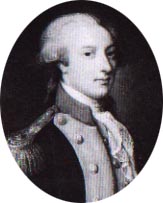
WARRENTON, VIRGINIA SALUTES THE MARQUIS DE LAFAYETTE


Richard Gookin and Maxwell Harway, organizers of the Salute to Lafayette in Warrenton, Virginia.
General Lafayette -- Neither time, nor titles, nor dungeons, have abated the love of the patriot for the liberty of nations. -- Toast given by President James Monroe, Warrenton, Virginia, August 23, 1825
On September 16, 2000, roughtly one hundred seventy-five years after he arrived on the last stop of his American tour, the town of Warrenton, Virginia will re-enact the visit of the Marquis de Lafayette. Sponsored by the Fauquier County Historical Society and hosted by Today Show weatherman Willard Scott, the historic pageant is based on original newspaper accounts (specifically Washington, D.C.'s Daily National Intelligencer, the Washington Post of that era).
In 1825, the event drew some 6000 spectators to a village of some 900 souls. The Marquis' reputation has somewhat diminished in recent years. For example, a March Washington Post article about the planned Salute referred to Lafayette as "some French general with a rich wife who has faded into obscurity" (contemporary French intellectuals likewise downplay Lafayette's contributions, Marc Fumaroli, for example, calls him "profoundly ridiculous").
To counter such attitudes, Warrenton is pulling out all the stops for the occasion. The event is chaired by Richard Gookin, retired associate chief of protocol for the State Department, who grew up in Washington, DC. not far from Lafayette Park. "I grew up in a town house on 16th Street, a few blocks from the White House and Lafayette Square," he told the Idler. "The latter was my playground." Gookin has mobilized the county on behalf of Lafayette, enlisting everyone from schoolchildren to retirees.
Festivities begin at 11:00 Saturday morning with a parade featuring costumed townspeople, high school bands, the Old Guard fife and drum corps from Ft. Myer, Revolutionary-era re-enactors, and contemporary military and civic organizations, including the Masons and local African-American society (Lafayette was an active Freemason and abolitionist). Adding military might to the parade will be a delegation of Veterans of Foreign Wars, American Legion Rifles, Navy Marching Units and United States Marines from Quantico, Virginia.
Re-enactors portraying Lafayette and his contemporaries will ride in antique carriages, including one previously owned by the King of Belgium, donated for the parade by Sandy Lerner, a founder of Cisco Systems. (Lerner, a resident of nearby Upperville, founded Urban Decay cosmetics after leaving Cisco, and is well-known for her work in restoring the home of Jane Austen's brother in England).
The parade will end at the steps of the Faurquier County Courthouse, where ,based on the historical records of the period, Willard Scott will emcee the speeches of President Monroe, Chief Justice John Marshall, and Lafayette himself, among others. Additional dignitaries including a representative from the French Embassy -- M. Gilles Montagnier -- will take part in recreating the hoopla surrounding the return of the Marquis to American soil in 1825.
That evening, at private homes throughout Hunt Country, and at restaurants in Old Town Warrenton, diners will honor Lafayette in their own way. After dinner, a "French Ball" featuring music and dances of the 1820's will be given, for Ball-goers wearing either period costumes or Black Tie.
An exhibit of Lafayette-related items will be on display in the former Warrenton public library. The exhibit, sort of a Lafayette-themed "Antiques Roadshow," will feature paintings, vases, swords, furniture -- many from local families connected to Lafayette by some historical tie -- as well as the very stone upon which Lafayette stood when he visited Warrenton in 1825. Gookin also has obtained the loan of some rare Lafayette-related items from the State Department collection, as well as from the Society of the Cincinnati (a hereditary organization of the descendants of French and American Revolutionary officers founded by Lafayette and George Washington).
"I find tremendous enthusiasm for the Salute to Lafayette everywhere I go in Fauquier County," says Gookin.
While Gookin is responsible for the nuts-and-bolts of the celebration, the event was the brainchild of Fauquier County Historical Society President Maxwell Harway, a youthful-looking 80-something retired State Department economist with an Errol Flynn moustache.
In a sense his life has been almost as colorful as Lafayette's. A native New Yorker, Harway served in the Office of Price Administration during the New Deal alongside John Kenneth Galbraith and Richard Milhous Nixon (whom he says he did not know personally). After Pearl Harbor, Harway joined the Army, was stationed in Casablanca with the Air Force, where he met and married a Frenchwoman. He lived in Paris while working on the Marshall Plan, among other postings, and completed his career at State Department headquarters in Washington dealing with critical issues related to Vietnam and the 1967 Arab-Israeli war.
He came to Warrenton when he retired, because he thought the countryside was the most beautiful he had seen. Once settled, he realized that his country home was full of historic importance, scene not only of Civil War battles, but also of the American Revolution.
Harway thought of the Salute to Lafayette about five years ago. He realized that he lived in a town where Lafayette had spent the night in 1825, and that he would not be around for the 200th anniversary -- but would probably still be around for the 175th. A local booster active in county politics, Harway thought the Salute might help put Warrenton on the map as a destination for historic tourism appealing to more than Confederate shrine-seekers following Mosby's Raiders (several years ago the Walt Disney Company considered building a historic theme park near Warrenton, but pulled out after vocal opposition to the project).
"If Hannibal had marched through Warrenton, we'd have a Salute to Hannibal!" Harway maintains. But it is clear that Lafayette has potential national -- and international -- appeal in a way that Mosby does not. In addition to his role in the American Revolution and the French Revolution, the Marquis was a supporter of Polish, Greek, and Latin American liberation movements as well anti-slavery activities, including Fanny Wright's asylum for freed slaves in Tennesee.
It is obvious from talking with Harway for even a few minutes that his personal affection for France's role in the American Revolution is also a factor in Warrenton's Salute to Lafayette.
"After all, he arranged for French financial and military aid to the American Revolution, he paid for food, clothing and ammunition for American soldiers at Valley Forge out of his own pocket, and led American and French troops to victory over the British at the Battle of Yorktown -- as a 24-year old Major General under George Washington. Without French recognition and support of American independence, the Revolution would surely have failed."
Harway speaks eloquently about the role of the French, led by the young Lafayette, in securing American Independence, noting that "a good portion of the American population were Loyalists, they were not supporters of Washington."
Harway points out that the British controlled the American coastline, and all the major port cities: Boston, Newport, New York, Philadelphia, and Charleston. "Washington had to fight a guerrilla campaign. He retreated from Long Island. He retreated from New York. He retreated from New Jersey. He kept fighting a rearguard action from Trenton to Brandywine," a battle in which Lafayette was wounded.
"The Revolutionists were up against the best army in the world," he points out. "The American Army was in the interior. Victory was not a sure thing. The odds were against them. It was the French intervention that gave America some international standing. It was Lafayette who secured this French intervention after the Battle of Saratoga. Only the participation of the French fleet under Admiral De Grasse made the victory at Yorktown possible."
And, Harway notes, French support of the United States led to the bankruptcy of the government of Louis XVI and the subsequent French Revolution, a revolution led by the Marquis de Lafayette, who as commander of the National Guard led the troops that stormed the Bastille. He later presented a key from the Bastille to George Washington. It hangs in the entrance hall to Mt. Vernon to this day. "The importance of French help in our winning the Revolutionary War is something that so few Americans understand today," he says.
The program for the Salute to Lafayette is emblazoned with a quotation from the Marquis which seems to reflect Harway's sentiments:
The first time I heard the name of America uttered, I loved it. As soon as I discovered that it was fighting for its freedom, I burned with the longing to shed my blood for it; for me the days when I could serve it will be the happiest of my life in all times and all places.
Lafayette is buried in the Picpus cemetery in Paris in a plot filled with American soil collected on his 1824-1825 tour. An American flag has flown over his grave since his death, where it was the only American flag to fly in Nazi-occupied France during the Second World War, until the Liberation.
More information on the Salute to Lafayette can be found at their website by clicking here.
