Click Here To Download
The Idler's Mobile Version

The Idler's Home Page and Table of Contents
The Idler's email list
To advertise in The Idler
Write a letter to the editor

(www.the-idler.com)
Volume II, Number 166






"1900: Art at the Crossroads," Twilight or Dawn?
by James F. Cooper
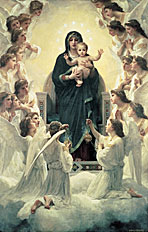
William-Adolphe Bouguereau, Regina
Angelorum, 1900 (from the Guggenheim Museum website).
“1900:
Art at the Crossroads,” a major exhibition at the Solomon R. Guggenheim Museum
in New York, begins with a ground-floor display of nineteenth-century Salon art
calculated to draw an emotional response from modern audiences. To the uninitiated eye, or rather to an eye
programmed by modernist tastes, these paintings seem strange, even alien. They represent sensibilities and ideas,
however, that were considered mainstream from the Renaissance to the Great War
of 1914. Indeed, the Salon works that
open the exhibition at the Guggenheim are among those proudly displayed at the
Décennale des Beaux-Arts, at the Grand Palais, Paris, part of the 1900
Exposition Universelle.
Welcoming over forty countries from six continents
in a celebration of national achievements, labor, and agriculture, the
Exposition was installed in 220 pavilions, occupying almost five million square
feet of space. Each nation created
pavilions that reflected an indigenous architectural style. The incandescent glow of the first electric
lights in the Palais de l’Électricité enhanced the Parisian skyline with
permanent reminders of the period’s technological breakthroughs. The Exposition Décennale was the largest
international contemporary art exhibition held to date. Encompassing art from twenty-nine countries,
the exhibition featured several thousand paintings and sculptures that had been
created since the previous Exposition Universelle in 1889.
France, as host nation, constructed some seventy
pavilions and grabbed almost two-thirds of all gallery space allocated for fine
arts. Many of the French buildings
became permanent edifices, including the Grand Palais, Petit Palais, and the
wonderful Gare d’Orsay, now a home for nineteenth-century French art. Several journalists groused that French
artists believed that “they alone possess genius.”1 This view was part of the popular
consensus. One group of prominent
French artists and critics debating the question, “Who in a hundred years, will
be thought to have been the greatest painter of the nineteenth century?”
unanimously selected William-Adolphe Bouguereau.2
Bouguereau’s magnificent Regina Angelorum
(1900) dominates the entrance to the Guggenheim exhibition, where paintings are
hung “salon” style, stacked above one another on scarlet walls, complemented
with a scarlet rug and sofa. How far we
have come since our grandparents’ time: now a Madonna and Christ Child attended
by adoring angels, painted by the “greatest” artist of the nineteenth century,
is likely to be mocked by today’s critics and curators. This view is not shared by the curator
of “1900: Art at the Crossroads,” art
historian Robert Rosenblum (author of Transformations in Late
Eighteenth-Century Art and Modern Painting and the Northern Romantic
Tradition: From Friedrich to Rothko).
Indeed, Rosenblum, to give a more accurate picture of the cultural
milieu a century ago, has created an installation of 240 paintings and sculptures
that juxtaposes works by nineteenth-century academic masters such as Bouguereau
with those by burgeoning avant-garde artists such as Picasso.
Working with colleagues from the Royal Academy of
Arts, London, and the Solomon R. Guggenheim Museum, New York, Rosenblum sorted
through several thousand works from the Exposition Décennale. Eventually, he whittled the list down to
just 78 paintings and sculptures from the original exhibition. To achieve a more pluralistic representation
of the artistic crosscurrents of the year 1900, Rosenblum decided to add works
that were unknown or unacceptable to the art world of a hundred years ago. In his introduction to the massive
catalogue, Rosenblum claims that the additional 170 works not from the original
Décennale provide “fresh evidence” that “redefines” the Salon of 1900
and the “rebellious isms” of
Impressionism, Post-Impressionism, Fauvism, Expressionism, Symbolism,
Dada, and Surrealism.
Subsequent research unearthed the remaining 170
works, some of them good and some motley, by the well-known and the obscure,
created between 1897 and 1903. These
Rosenblum has organized into eleven thematic groupings, which include “Bathers
and Nudes,” “Woman-Man,” “Triptychs,” “The City,” “Religion,” “Interiors and
Still-lifes.” “Twilight or Dawn?”
Rosenblum asks in his provocative catalogue essay. Was this art representative of a cultural “twilight” or a new
“dawn”? Rather than answer this
question directly, Rosenblum introduces themes and sub-themes guaranteed to
challenge any conclusion. He sidesteps
criteria normally employed to evaluate progress and quality. It is a question, properly framed, which
might challenge not only the idea of modern twentieth-century culture, as it
has evolved from its roots in conservative nineteenth-century culture, but the
historical overview of those Western democracies that created and shaped
contemporary society.
Some art critics who reviewed “1900: Art at the
Crossroads” are outraged because the exhibition places modern and traditional
art on an equal playing field, and leaves it up to the viewer to decide which
is best. New York Times critic
Michael Kimmelman writes: the
“weak-hearted…may never get past the shock of confronting so much of the [bad]
art that the abstractionists were rebelling against in a great museum created
as a shrine to 20th-century abstraction. Heathens have taken over the temple again,” he warns. “Could
there be any further blasphemy?”3
The organizers of the original Décennale were very
conscious of the cultural and political conflicts in their own time. One French pavilion offered a chronological
overview of French nineteenth-century art from the pompier
Neoclassicists to the moderne Impressionists. The exhibition began with Jacques-Louis David, J.A.D. Ingres,
Théodore Géricault, Alexandre Cabanel, Jean-Léon Gérôme, Jean-Baptiste-Camille
Corot, Gustave Courbet, and Bouguereau;
it concluded with Edouard Manet, Edgar
Degas, Henri Fantin-Latour, Camille Pissarro, Paul Gauguin and Claude Monet.
The Impressionists and Post-Impressionists were not so much on the
fringes of official art at the Salon as against
the historical, moral and religious stance of official art. Or, to be more precise, they were against
the criteria and standards of official art sanctioned by the government of the Third Republic. Academy artists studied draftsmanship,
history, religion, mythology and traditional iconology before they learned how
to paint. To know what to paint,
they must first be schooled in the hierarchical priorities of society and the
arts that serve society. These official
ateliers were guided in principle by the founder of French Neoclassicism,
Jacques-Louis David, who wrote: “We seek to imitate the ancient artists of the
past …the purity of their design, and the grace of their forms…[so that] we
might help to bring the arts nearer to their true destination which is to serve
morality and to elevate the soul.” 4
As late as 1900 the French government still controlled cultural
standards, writes Patricia Mainardi in The End of the Salon. Government-sponsored Décennales were
conceived as “major schools of visual information demonstrating the most
serious influence on public taste and on the development of a national art.” Gustave Ollendorrff, Director of Museum
Administration, wrote: “Art is a religion…. It should remain the patrimony of a
small elite.” 5
The Ministry of Public Instruction believed that modernists were
decadent and blamed them for instigating the riots of the Paris Commune in
1870─71 and for France’s defeat in the Franco-Prussian War. The modernists believed that the Academy and
pompier art were out of step with the times. They advocated personal freedom and the supremacy of “art for
art’s sake.” The French government’s
heavy-handed sponsorship of the Exposition Universelle of 1900 was propelled by
the fear that a newly unified Germany had overtaken France not only
economically and militarily but culturally.
Through the arts France determined to prevail by supporting a strong
conservative element in French culture.
Rosenblum, in an unusual stance for a major contemporary curator,
argues neither for conservative nor for avant-garde. Instead, he deliberately softens and blurs their
differences. The effect is disquieting
for today’s modernists. Rosenblum’s sly
but thorough scholarship has lowered aesthetic standards for academic and
modernist alike, to the point that Salon kitsch and Fauve excess are presented
on an equal playing field. In this exhibition, quality is not the criterion, an
observation barely acknowledged by some art critics.
Rosenblum
selects a “proto-Dadaist” advertisement of a spectacled dog painted by the
arch-academician Jean-Léon Gérôme, while ignoring Gérôme’s popular Orientalist and
history paintings. He includes Léon
Frédéric’s incredibly tasteless triptych of hundreds of small children
cavorting nude in The Stream
(1890─99), surrounded by swans.
Brennus and his Loot (1893) by Paul Joseph Jamin is a licentious
aberration likely to embarrass those who claim academic painting has
merit. The “loot” are helplessly bound,
voluptuous nude women at the mercy of a Viking-horned conquerer. The composition lacks the draftsmanship or
credibility of a Marvel comic book.
The
modernists fare slightly better, although Rosenblum dumbs down their
accomplishments. Edvard Munch, the
Norwegian expressionist, is represented by a series of flawed paintings preceding his nervous
breakdown. Inheritance (1905), a crude depiction of a mother nursing a sick
baby covered with red blotches, possibly a venereal disease, is an ugly work
that reflects little of the quality of Munch’s visionary woodcuts and
lithographs. Matisse’s dour Studio Interior (1902) is so gloomy as
to be unrecognizable, while Toulouse-Lautrec is represented by an
uncharacteristically awkward sketch of an opera singer. Eighteen-year-old Pablo Picasso’s attempt to
copy Lautrec’s style in a derivative Moulin
de la Galette (1900) gives little hint of his genius. With few exceptions,
the modern masters rarely appear fully formed. Even Henri Rousseau’s Happy Quartet (1902) is mediocre.
Nowhere
does Rosenblum introduce the idea that the seemingly irreconcilable schools of
the Academy and modernism embraced
beauty or aesthetics in their formal and contextual criteria. Degas and Picasso, for instance, both
collected works by the most conservative artist of the nineteenth-century
Academy, Jean-Auguste-Dominique Ingres.
Degas’s estate listed over fifty works by Ingres, and Picasso was still
painting variations on Ingres’s
exquisite linear style well into the twentieth century. It would be safe to say, after viewing this
exhibition, that many of these works deserved to be excluded from the Décennale
because they lack quality. Other
paintings culled by Rosenblum from the original exposition are not
representative of the high standards expected one hundred years ago.
Peter Schjeldahl, art critic of The New Yorker, argues that
having a “judgmental attitiude” about the low quality of artworks in this
exhibition “is absurd.” “It is the
greatest-hits fallacy,” he reasons. “An unaesthetic, educational spirit
[properly] rules” the art world of today .6
Michael Duncan, writing for Art in America, is half-correct when
he observes that “1900: Art at the Crossroads” is an “evenhanded presentation
of avant-garde rebels, salon bigwigs and mainstream favorites [that]…recaptures
the breadth and variety of visual expression at the dawn of the last century.”7
Missing is an objective, critical eye that can discriminate between good
and bad art, avant-garde or Salon.
Duncan, like many critics today, is overly concerned with politically
correct “strategies of socially conscious artists.” Thus Cézanne’s Les Grandes Baigneuses (1898) is held superior
to the “coy Beaux-Arts splashers of Paul Chabas’s Joyous Frolics
(1899).” The “prescient protofeminism” of
Gustav Klimt’s Pallas Athene (1898) is held superior to “Bougeuereau’s syrupy Madonnas and
Alma-Tadema’s white-bread virgins.”8 Times critic Michael Kimmelman leaves
no doubt that the term “kitsch” is reserved for Salon painters, not the
avant-garde. “This (‘wacky’) show no
doubt will be popular in New York as it was in London. There is no underestimating the public’s
taste for kitsch.”9 It is “laughably easy,” he writes, to decide
who are the better painters, the avant-garde or the modernists. Rosenblum’s crowning achievement in this
exhibit is to reopen this question.
One
thing this show does suggest, to some extent, is that the nineteenth century
was a golden age for conservatism.
There were great accomplishments by English Victorian, German Romantic,
French Beaux-Arts and American landscape artists. English artists of the
Victorian era created a unique fusion of Christianity and pagan mythology in
works such as Lancelot at the Chapel of the Holy Grail (1896) by Sir
Edward Burne-Jones. Lord Leighton’s Clytie
(1895) portrays the unrequited love of the nymph for Apollo, who watches his
daily ride across the sky until her limbs metamorphose into the stems of a
sunflower that forever follows the movement of the sun. Two bronzes, The Virgin (1899) by Sir
Alfred Gilbert and The Joy of Life (1896) by Sir Hamo Thornycroft,
evidence the strong connections between spirituality and English civic virtue.
Still,
these are far from the best works available.
Instead of Thornycroft’s
sculpture The Joy of Life, I would
have preferred his magnificent Courage. I think Frederic, Lord Leighton’s painting Clytie pales next to Flaming June, painted the same
year. Why Bouguereau’s cloying Admiration (1897), rather than a
powerful Pieta? While many consider Sir Alfred Gilbert’s
overly worked The Virgin (1899) an
Art Nouveau masterpiece, I think Perseus
Arming is a greater work.
Rosenblum
stretches credulity by focusing attention on Noonday Heat (1903), Henry Scott Tuke’s academic treatment of an
overtly erotic encounter between two male youths on a beach. This is just bad painting. The suggestion that Thomas Eakins’s
straightforward depiction of The
Wrestlers (1899) is similarly oriented can be justified only by using
today’s fractured scholarship. If
Rosenblum really wanted to properly address the issue of homoeroticism on the
highest artistic level, he would have included those paintings and sculptures
by Lord Leighton which clearly do evidence a subtle androgynous quality.
There
are wonderful works of art in this exhibition, of course, among them Matisse’s
brut pre-Cubist bronze The Serf
(1903), Winslow Homer’s Eastern Point,
Prout’s Neck (1900) and John Singer
Sargent’s Mrs. Carl Meyer and Her
Children (1895), seemingly effortless in its bravura brushwork. Thomas Moran’s last journey to Yellowstone
and the Grand Canyon produced the
extraterrestrial landscape of prehistoric Cliff Dwellers (1899). A surprising number, eighty percent, of all
Americans featured in the original 1900 Exposition received their art training
in conservative French ateliers.
Many
of the works in the exhibition’s Religion section reflect the short-lived
spiritual revival at the turn of the century, which sparked major contributions
by Christian artists reacting against the growing secularism of Darwinism. Some adopted a contemporary approach to
traditional religious motifs, recasting Biblical subjects in a more accessible
fashion. Scenes from Christ’s life are
located in modern rural settings. In
their quest to invest modern-life subjects with the authority derived from
traditional religious values, artists turned to the medieval format of the triptych,
as in Constantin Meunier’s epic The Mine: Descent, Calvary, Return (1900). In addition to Bougeureau’s Regina
Angelorum, the exhibition includes another genuine religious
masterpiece. Sad Inheritance (1899), by the Spanish genre painter Joaquin Sorolla
y Bastida, depicts a group of crippled boys being shepherded into the ocean by
an attentive priest. The artist was
justly awarded a first-class medal at the 1900 Exposition.
Rosenblum’s
essay “Art in 1900: Twilight or Dawn?” asks the right question. By the year 1900 many of the great works of
modernism had already been created.
Many of the seminal artists were already dead: Manet, van Gogh, Courbet,
and Corot. Bouguereau, the last genius
produced by the 400-year-old school of Raphael, died in 1905 at the age of
eighty. It remained only for the last
seminal modernist, Picasso, in one Nietzschian blow to split asunder Western
culture into Cubist rubble and let the abstractionists play with the chips and
splinters.
Much
of this exhibition’s “new evidence” turns out to be just bad art. As presented, “1900” is neither “twilight”
or “dawn,” but a grey haze that obscures distinguishing marks. Conservative artists, such as Bougeureau,
Gérôme and Gilbert, can hold their own with avant-garde artists such as Degas,
Manet and Monet. Moreover, there is the
intriguing question of “crossover” artists in this exhibition, such as Klimt,
Sargent, Rodin and Leighton, whose work incorporates both modern and conservative
elements. Indeed, Klimt, a very
successful classical painter in the 1880s, became the revolutionary leader of
mythological and allegorical Art Nouveau of fin-de-siècle Vienna. Pallas Athene is a modernist
invocation of the archetypal goddess.
Ferdinand Keller’s The Tomb of Böcklin (1902) serves as a pallid
reminder of the powerful, haunting Nordic mythology created by
nineteenth-century German artists Arnold Böcklin, Caspar David Friedrich and
Anselm Feuerbach. This potential
dawning of a new spiritual age was brutally ground under the wheels of the
military-industrial buildup in the decades preceding the Great War. The Great War remains the singular
de-embarkation point when artists and poets broke away from what they perceived
as a hypocritical manipulation of traditional values in the service of
empirical Western ambitions.
A
single museum exhibition is not the place or time to proselytize how to heal
the fracture between art and society, between traditional and postmodern
values. By eliminating the differences
between traditional art forms and modernism, by focusing primarily on content
and context, by eschewing aesthetics, Rosenblum undercuts the original argument
of “art for art’s sake” and the raison
d’être of nineteenth-century modernism.
For a more objective overview of high-quality modernism, visit The
Thannhauser Collection of Impressionist and Post-Impressionist art, located in
the Guggenheim galleries in the adjoining tower building. Almost every one of these paintings by Cézanne,
Degas, Manet, Pissarro and Vincent van Gogh is a masterpiece. I would gladly exchange half of the works in
Rosenblum’s clever melange for Pissarro’s beautiful landscape The Hermitage at Pontoise (1867).
The
role of critic─to separate the good from the bad and to explain
why─has been abandoned today.
Rosenblum has created a clever exhibition that reflects our own
skewered standards, rather than the standards of 1900. What is the biggest difference between 1900
and 2000? A hundred years ago Western
artists were straining to break free of
“stale” traditional values; today we yearn to renew them. “1900” offers a tantalizing glimpse of the
passionate beauty and spirituality of the conservative tradition, which mirrors
our own longings today for cultural renewal in the twenty-first century.
1 Robert Rosenblum, “Art in 1900: Twilight or Dawn?” 1900: Art at the Crossroads (New York: Harry N. Abrams, Inc., 2000), p. 62.
2 Modern French Masters, ed. by John C. Van Dyke (1896), quoted by Lorenz Eitner, An Outline of 19th Century European Painting: From David to Cezanne (New York: HarperCollins Publishers, Inc., 1992), p. 271.
3 Michael Kimmelman, “Kitsch in Sync with Treasures,” The New York Times (May 19, 2000), p. 29.
4 From the Classicists to the Impressionists: Art and Architecture in the Nineteenth Century, edited by Elizabeth Gilmore Holt (New York: Doubleday & Co., Inc., 1966), Volume 3, p. 6.
5 Patricia Mainardi, The End of the Salon: Art and the State in the Early Third Republic (New York: Cambridge University Press, 1993), p. 133.
6 Peter Schjeldahl, “The Pleasure Principle: The Case for Promiscuity at the Guggenheim,” The New Yorker (August 7, 2000), pp. 79–80.
7 Michael Duncan, “1900 Rediscovered,” Art in America (September 2000), p. 119.
8 Michael Duncan, “1900 Rediscovered,” Art in America (September 2000), p. 121.
9 Michael Kimmelman, “Kitsch in Sync with Treasures,” The New York Times (May 19, 2000), p. 29.
