Click Here To Download
The Idler's Mobile Version

The Idler's Home Page and Table of Contents
The Idler's email list
To advertise in The Idler
Write a letter to the editor

(www.the-idler.com)
Volume II, Number 163






SHOWING OFF: Exhibitionism:
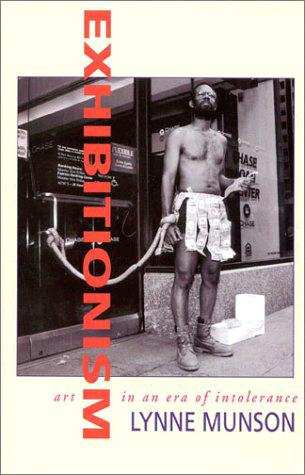
Art in an Era of Intolerance by Lynne Munson
 Reviewed by Alice Goldfarb Marquis
The complex of political notions that invaded the realm of the visual in the final two decades of the 20th century huddle under the umbrella of Postmodernism. This rabble of artists, their mentors, their collectors, and their promoters, parades itself as avant-garde, indeed, the avant-garde, heirs to the pioneers of Modernism.
Any cultivated individual must recoil, and sympathize with Lynne Munson in Exhibitionism: Art in an Era of Intolerance, as she tries to describe the undoing of art by theory. This high-minded exercise has unleashed masses of schlock: piss, vomit, and shit at the center of a creative work, sensational sex, deliberate mockery of skill, flaunting of self in masochistic displays. Munson deserve sympathy and support for her attempt to deal with this difficult subject.
But the sympathy begins to fade as Munson presents her case.
Without ever examining the basic premise underlying the system of grants to individual artists from the National Endowment for the Arts, this author claims to discern a Golden Age early in the federal art agency's life, from which it descended into the current cesspool.
Thus, Henry Geldzahler, the first director of the visual art program, appears in Exhibitionism as an even-handed connoisseur, diligently handing small grants to worthy artists in need.
In fact, Geldzahler, the son of a wealthy diamond tycoon, deemed it beneath him to write checks, or do any paperwork, during his tenure at the NEA; he breezed into Washington only sporadically, to collect his own paycheck -- while maintaining his second job as curator of modern art at New York's Metropolitan Museum of Art.
There was, in reality, scant contrast between Munson's purportedly admirable white-hatted, cigar-puffing Henry, and his supposedly evil successor Brian O'Doherty. Both of them assiduously sought out The Next Thing, and gave hardly a fig for the artist's skill, or, indeed, whether the artist had anything to say beyond: "Lookee! Here I am!"
Likewise, Munson's list of Golden Age grant recipients from 1967 looks just as capricious as the 1995 list, included in her book as an example of the agency gone wrong. For example, well-known names overlooked by Geldzhaler in 1967 include Carl Andre, Emilio Cruz, Walter di Maria, Alan Kaprow, Loren MacIver, Richard Tuttle, and Bruce Nauman.
Exhibitionism deplores the way in which 1995 grantees represent the imposition of a particular sensibility. But she then proceeds to impose her own sensibility on the arts. Page after page, Munson goes on, in a roll call of names just as inconsistent as those chosen by Geldzahler and O'Doherty.
Perhaps Munson is attempting to parade her own expertise as an art critic. But to a skeptical reader, her crowd is just as tough a sell as anybody else's list of favorite artists.
Taste is fugitive; response to an artist's work is not in the head, but in the gut. Does this person have something to say? Does this work draw me back to look again? Is there coherence in a body of work that shows development? Can the artist handle the materials?
Munson is correct to complain about biased or incestuous peer panels awarding grants, but the history of government selection of favored artists is fraught with special pleading or outright graft.
Whether we look at the French Academy, the Soviet art czars, or the kind-hearted Dutch government effort to buy all art -- not to mention the dramatic cases of Hitler's Germany and Mussolini's Italy -- things tend to go drastically wrong, and fairly fast. After all, even the French ended up with a fusty dead-end, the Soviets persecuted their best artists, and the Dutch ended up with bulging warehouses of junk.
The best system continues to be what prevailed in the first half of the 20th century, an anarchic market in which thousands of individuals simply bought what they liked.
These people fell in love with the likes of Van Gogh's Starry Night, Rousseau's Sleeping Gypsy, Duchamp's Nude Descending the Staircase, and Matisse's Red Studio, and their heirs -- or their favorite museums -- are the richer for it.
Munson seems surprised that paint and canvas still challenge lots of artists, that many still like to draw, and that some pleasant, decorative works result.
Of course such art deserves attention and respect, but Munson does not engage with many other forms using newly available materials: lasers, computers, film, digital cameras, plastics.
Instead, Exhibitionism appears fixated on some late 19th century concept of order on the art scene -- the artist in his (yes, his) studio, the work displayed in its correct place in the museum, the audience properly intimidated by Masterpieces, the moral value of Art interpreted by beady-eyed critics -- perhaps the unhappy author of this book.
But much has changed since the 19th century, not all for the worse.
A reviewer must draw conclusions about a book and its author when she carries on for thirteen pages about painters associated with the obscure Bowery Gallery in New York, while devoting less than one page to crudely trashing a landmark National Gallery exhibition, About 1492, which gloriously presented the global implications of Columbus' voyage.
The author flogs many a horse already staggering from previous beatings by others. For example, Arnold Lehman, who was thoroughly trounced over the "Sensation" show at the Brooklyn Museum of Art is here battered once more for abandoning a grim Greek temple entry to the Baltimore Museum (which he directed before Brooklyn) in favor of something more visitor-friendly and accessible to the disabled.
The museum "blockbuster" target has been repeatedly pounded by heavier intellectual artillery than Munson can bring to bear.
So has the phenomenon of the adjoining gift shop with its tawdry trinkets, especially convenient for Holiday shoppers.
It seems that the author of Exhibitionism wants museums only to display art the way they did in the 19th century -- chronologically, didactically. But juxtaposing works from different periods and places often jogs the visitor toward considering similarities and differences, forming artistic insights, or even making a bold judgment: which one do I like better?
Nothing in this book prepares the reader for a lengthy, detailed chapter on the convoluted fracas at the Harvard department of art history involving the Fogg Museum. One professor told a graduate student that he/she would have to toe his line; another professor tried to keep a colleague from getting tenure; professors criticize of each others' teaching style. Yet how is this particular case any different from the multitudes of such disputes roiling most American campuses, most of the time? (A wise observer once said that the reason academic fights are so bitter is that the stakes are so small.)
Exhibitionism's argument raises serious questions about its author's background in the historiography of art. Its subtitle refers to "an era of intolerance," but every recent era has been intolerant: the Fauves were "wild beasts," and Picasso and Braque's seminal works were minimized as "des petites cubes."
And who was more intolerant than Clement Greenberg in the 40s and 50s as he lauded the Abstract statementists and deplored some other "kitsch?"
Munson complains (p. 94) that outsider artists became valued in the 1990s; in fact, Henri Rousseau was a Sunday painter, the Cubists adored African sculptures, Haitian paintings were "discovered during the 1930s, and Grandma Moses made handsome prices in the 1950s. She argues that "at the beginning of the 20th century, Picasso, Matisse and Derain were the leading figures of the School of Paris" (p. 105). In fact, many others -- the Futurists, Jacques Villon, Robert Delaunay, and Jean Metzinger, for example -- were also leading figures, and the School of Paris emerged in the ten years after the Second World War.
Munson regrets that Seurat never had a one-man show and that Cezanne had his first solo show at age 56 (p. 197), but seems unaware that one-man shows were extremely rare in the late 19th or early 20th century; such shows usually were held only posthumously.
Finally, Munson calls the traditionalist William Bouguereau "a footnote" (p. 202). In fact this 19th century academic artist was the teacher of many modernists and his works today sell for far more than footnote prices: a good-size painting went for more than $500,000 this year, more than four times what a comparable work fetched ten years ago.
Exhibitionism reminds us that theory of any kind should be balanced by connoisseurship in the teaching of art history, in museums, and in the choice of artists for recognition. But it offers no alternative except a return to a mythical Golden Age. Postmodernist theory is as destructive to the teaching and appreciation of art, as its very name is infelicitous. But in substituting the caprice of its partially-informed author, Exhibitionism does not display a serious intellectual or artistic alternative to a deeply flawed movement.
A frequent contributor to The Idler and author of the novel Brushstroke!, Alice Goldfarb Marquis is the author of The Art Biz, Art Lessons: Learning from the Rise and Fall of Public Arts Funding, Alfred H. Barr, Jr.: Missionary for the Modern, and a forthcoming biography of Marcel Duchamp.
