Click Here To Download
The Idler's Mobile Version

The Idler's Home Page and Table of Contents
The Idler's email list
To advertise in The Idler
Write a letter to the editor

(www.the-idler.com)
Volume II, Number 161






INDONESIA'S YEAR OF THE BLUE CARPET:
Plus Several Pathologies and Five Personalities
by Theodore Friend
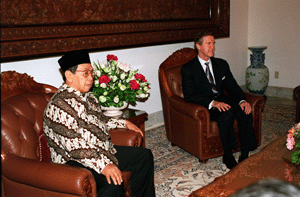
President Abdurrahman Wahid and Secretary of Defense William S. Cohen prior to their meeting at the Presidential Palace in Jakarta, Republic of Indonesia, on Sept. 18, 2000. (Department of Defense photo by Helene C. Stikkel.)
Last June, my first time in the Presidential Palace, I was impressed by the sheer size of the main reception room: bigger, I reckoned, then a basketball court. Two giant chandeliers toward the middle. I doubted whether even Michael Jordan, leaping, could touch their clustered crystals. For sure he could not dribble well on the thick dark red wall-to-wall carpet.
My second time at the Istana Merdeka, early in the morning on November 8th, I saw that the carpet was different. While passing toward Gus Dur's study, I wondered why is the carpet now blue? I grew up a bourgeois Protestant of industrial Pittsburgh. In what was then the smokiest city in the world, we bought dark rugs and we kept them. Indonesian government faces too many big problems to waste time and money on superficial change.
We were there to spend two hours with Abdurrahman Wahid, watching the American election returns. My anonymous friend managed the monitor, lowering the volume when we needed to converse, while I told the President when something significant happened. "Gus Dur, they've just switched Florida from 'Gore' to 'Undecided.'" As I write one month later, the U.S. is still undecided. If America currently offers any lessons to the world, they are not high on statesmanship or heavy punditry, but on the patient trust of its citizens that the system -- not singular figures or stealthy fingers -- will resolve the matter. We will proceed transparently, if not always serenely.
We were there to provide an oasis in the president's schedule, in which no plea or cause could be urged upon him. His own manner was diplomatically impeccable with regard to George W. Bush or Albert Gore, neither of whom he mentioned by name. He recalled Theodore White's book on the Nixon- Kennedy election, not for Mayor Daley's shenanigans in Illinois, but for White's own assessment of leadership styles. In a storm, Nixon would bail out the boat, bucket by bucket. Kennedy would set the course, give orders to trim sail, and then go below to sleep.
Sleep must mean a lot to Wahid, who has suffered one ischemic and two hemorrhagic strokes. Sleep apnea, in which irregular breathing cuts off oxygen, could cause another. A physically fragile man who works long hours and gets his clues by ear, is necessarily an opportunist about sleep. Sometimes in company, or even in public. Why not?
One danger: this president does not have an intellect geared toward economics, or constructed to analyze financial policy options. So economic advisers have to keep hand-held recordings of discussions for the record and use tapes as reminders to their principal. Even so, economics is a proven soporific for Gus Dur. At least he doesn't show Sukarno's utter contempt for it. But his drowsy disinterest is still unfortunate, in that Indonesia's public debt load requires constant servicing, thereby diminishing revenue needed for social and educational needs of a higher order. Government debt has risen to 99 percent of annual GDP, more than four times its ratio before the money-drought hit in 1997. Private debt is just as large. And, in July, the Supreme Audit Agency reported that almost half of Indonesia's national budget was missing or affected by "irregularities." How do you climb out of a black hole? Very slowly, if at all. It's not only dark in there. It is also slippery.
Another great burden Gus Dur bears is his military. In his first year he aimed to reform it. He failed. The sacking of General Wiranto was prolonged, maladroit, and humiliating. Even if Wiranto's defenders concede that discharging a man so encumbered with failed policy and flawed practice was necessary, Wiranto's critics acknowledge that the task should have been done with less private distress and public fluster. Then elevate whom? General Agus Wirahadikusumo may have deserved promotion, but not so fast. He proved too abruptly confrontational in exposing corruption in Kostrad (the army strategic reserve) and lacked the pivotal allies to make his housecleaning stick. He now faces a military honor court, last convoked to review a general responsible for kidnapping, torture, disappearance, and possible murder of dissidents against his father-in-law's regime. Use of that court in the present circumstances is grotesquely revealing of military self-interest.
General, then President, Fidel Ramos took nine years (1986- 95) to depoliticize the Philippine army, clearing away former autocrat Ferdinand Marcos's corrupted appointees. President Jiang Zemin took eight years (1990-98) to decommercialize the Chinese People's Liberation Army and get its mission back on professional track. For decades the upper ranks of the Indonesian armed forces have owed promotions to Suharto. With 75 percent of military income from off-budget enterprises, how can the system be made loyal to reform government through command structure, or by budget allocation, or by both at once? Only steady increments of change across two to four presidential terms can do the job, if it is doable at all, and if reform survives as a term with meaning.
With such financial anchors about his neck and praetorian shackles on his ankles, it did not help in the year 2000 that Gus Dur evolved so slowly from the style that suited him as leader of the NU. The Bulog and Brunei misadventures apparently taught him that paternalistic fund management had to yield to audit. Wahid needed to understand -- from listening to his critics -- that he was now president of a republic, not doyen of a pesantren. But even if he has responded in part, he continues to behave less as a modern president than as an abrupt and antique Javanese king. His arrogant challenge to the MPR (itself an institution in an awkward learning process) almost precipitated impeachment. Wahid does not deserve the fate of an Erap Estrada. He merits the support that should be due a compromise choice, but a democratic choice, to renew Indonesia. Political maneuvering may nonetheless initiate impeachment proceedings within the next year. Although his only real route into history is the high road, Wahid seems to be choosing the byway of behaving too nakedly as the leader of PKB, accumulating funds toward a stronger party in 2004. Meanwhile the hungry people of his nation look up and ask to be fed -- spiritual nutrition notably included.
How can Abdurrahman Wahid better focus his ingenuity and his great human warmth upon his opportunities? As an accomplished Sufi he has access to the wisdom of the ages, and to the spirits of the wali (Islamic saints) beyond him. As a natural comic, he has gained more ground by jesting than by jousting. He can lift up the temper of his people in adversity by his own courageous example, as the paraplegic Franklin Roosevelt did during the Great Depression by the jut of his chin and theatrical up-tilt of his cigarette holder. America was not a rich country then. Its annual per capita income was measured in hundreds of dollars.
Outside Jakarta, the bicker-center of the nation, what has happened this year? Some experts in community development saw regional "social hysteria" following the 1997 crisis, deepening into late 1998. It has somewhat abated. From an immediate pre-crisis low of 7.6 percent, the proportion of the population below the poverty line soared to over 20.0 percent in late 1998, before receding to 11.4 percent in late 1999. The very volatility of the rate shows the many millions who are defined as "near-poor" are vulnerable to the faintest touch of recession. Levels of nutrition and health, and achieved levels of education, have suffered. Nonetheless, if Sukarno built a nation and Suharto built a state, Wahid can still build a society. Indonesia now is a fractious nation with a malcoordinated state. Uncivil behavior belies earnest efforts to build a "civil society". Wahid's opportunity is to make the parts more coordinate. That requires not only integrity from himself at the center, but reforming the system of justice. Those who care about it have not yet found a point of leverage within which to begin effective change.
If a sociable nation-state can indeed be woven together, what must it address and relieve? A realistic reckoning will take account of several major political pathologies, all evident or intensified in the year 2000. Separatisms grew worse in Aceh and Irian Jaya. "Humanitarian pause" in the former achieved little. Huge communication gaps in the latter were leaped by incendiary sparks. Violence between Muslims and Christians continued in Ambon and Halmahera, and spread to Poso in North Sulawesi. Dyak-Madurese antagonism exploded again around Pontianak. Memories of injury in 1996- 98 kept Chinese-Indonesian individuals and their capital from returning with the volume needed to help accelerate the economy. To those hostilities and suspicions were recently added Java-wide outbreaks between Banser, the NU's paramilitary arm, and HMI, Muslim youth of contrary orientation, and differing aspirations for Indonesia. Playing throughout these stories is a public mood, running from suspicion to conviction, that law and order have broken down. That the police are criminalized. That the military are a parasitic army of occupation. Hence eruptions of mob rage: murdering of pickpockets because the mega-thieves live in luxury.
Yet provincial separatism is not quite epidemic. Inter- religious warfare is not likely to become pandemic. Inter- tribal propensity to violence is merely endemic, which is to say local, by definition. The vulnerability of Sino- Indonesians, regrettably, may be enduring. But that long history would be likely to feel relief through the values of Gus Dur, as would other social schisms, if he could manage to make his beliefs penetrate the political by-play. If he could only grasp military loyalty and dissolve the slowdown in efficacy, which casts the shadow of a semi-mutiny. Intra-religious strife among Muslims does not help. It proclaims, in fact, the relationship between Amien Rais and Wahid himself. In confrontation, neither of them seems able to remember the universalism of Islam; and Rais, in cultivating an avid following, is clearly susceptible to impulsive demagoguery.
A variety of things are amiss, and more can still go awry. But on the whole, Indonesia's young experiment with freedom of the press looks like a modest triumph. Proportioned truths are discernible in the choque des opinions. Factuality is salvageable from the subjective and bizarre. Other aspects of a civil society are also taking on form: especially non-governmental organizations doing for individuals, groups, professions, and causes what the government cannot or should not do for them.
But the long-term future of Indonesia may best be discerned through the lives of individuals. The center of gravity of history is neither state, nor nation, nor society. It is not to be found in the theater of the presidency, the stats of the bureaucrats, the headlines of one day, the headaches of the next. Individuals are central. I therefore supply a handful of ordinary people to think about: sketches of their conditions, their possible destinies.
Ibu W. is a Minangkabau matriarch, a source on adat (traditional) law, an exemplar of Muslim life, an affably peremptory rule-giver in any conversation. In her matrifocal society, the male must go elsewhere -- must merantau (travel in search of a living) -- to prove that he is up to scratch before coming back to receive a marriage proposal. Wahidar in her life time has seen this merantau- pipit (flight and return of the swallow) become merantau- Tionghoa (male settlement elsewhere, like a Chinese, with remittances home), now threatening to lapse into merantau kosong (a tradition with no return). Be that as it may, women of South Holland and North Michigan like to hear about the Minangkabau, the world's largest matrilineal society. However they may change, neither the Minangs, nor the Bataks, nor the Bugis are going to secede from Indonesia.
Dr. N. is from Palembang, with a doctorate from the Sorbonne. A successful businessman, he is taking a fresh look in his early forties at the components of his identity: Lampung, Malay, Indonesian, Muslim, and cosmopolitan. He likes all the elements. He is an Indonesian for life, for passport, for sense of larger nativity. But he is also excited at a renaissance among Malays -- gatherings of scholars and connoisseurs of Malayness from Hawaii to Malagasy, a great crescent of belonging that gives him a "homesea" as well as a homeland.
Ary K. is ill, but holding on bravely. In her early twenties, her pre-medical studies were interrupted in 1996 by kidney disease. A kidney transplant from her father, a retired public health officer south of Yogyakarta, saved her life. Fiscal crisis has meant that she can barely obtain from family, priest, and other donors enough money to keep her alive. But she has learned to sew for a little income, and gives her free time to an orphanage for abandoned children. She feels diayomi, the emotionally sheltering protection of the Sultan. She often questions God, "Why me? Why this?" But a combination of Javanese fatalism, Christian love, and a well-knit family have sustained her thus far.
Aras P. is young, vigorous, handsome, just past thirty. The buffalo head tattoos on his bicep and shoulder blade show his special faith in alukta, the traditional religion of Toraja. His profession as tour guide, hiking the hills of Tanah Toraja, got clobbered by CNN's turbulent picture of Indonesia, despite peace in Aras's own region. He came to Jakarta, fell in love with a Javanese girl in the automobile parts business; was initially rejected by her parents; prevailed to marry her; sickened of the big city; returned home. Aras would seem to want to deglobalize himself. The question is whether he can satisfy his Jakartan wife with living in his beautiful province.
On Pe'u is a grizzled West Timorese, nearing fifty. The central figure in an extended family who farm with simple tools their convoluting hills. There is more than enough mountain between him and the border of East Timor so that tumult from there is inaudible. But the modern world has been arriving. The first Australian missionary thirty years ago was synonymous for him with "free market." Corporate prospectors for marble, backed by government troops, have shown him the hungry teeth of capitalism and endangered traditional land rights in his region. A conference of indigenous peoples recently brought Om Pe'u to Jakarta for the first time, where he saw hotel lobbies full of palm trees and experimented with flush toilets. He prefers home. His land and his cycle of crops. His handful of semi-wild horses.
In light of lives like these, why should we care about the trivial celebrity Tommy Suharto, justly convicted of fraud, and at this writing, a fugitive? Instead let us praise ordinary men and women. Let us be inspired by their stamina and hope.
Gus Dur, just the same, must have Tommy found and jailed as he must also pursue his father to trial in absentia if Suharto's ill-health makes that necessary. And he must launch further prosecutions, of family, cronies, and other corruptors. Otherwise, democracy-with-justice will have no meaning in Indonesia. Indeed, by dining with Tutut and Tommy at the Hotel Borobudur, Gus Dur has already behaved disturbingly like a fixer. A better posture would be hygienic distance. Tough cops, tough prosecutor, tough negotiator should do the job, without a kiai getting in the act, especially if it looks to some as if he is raising funds for NU/PKB.
Many trails in Indonesia lead us back to the presidency. But to overdo such a focus would be to conspire in augmenting a Javanese suction upon Indonesian history. Archipelagic links ought now to be repaired and strengthened with balanced arrangements toward regional autonomy. Even a degree of confederate anarchy would be preferable to continued Javanese imperialism. But neither extreme is desirable, and awakened men and women can fashion median solutions. Overseas money will return to more balanced conditions. S&P has recently upgraded Indonesia from "selective default" to "triple B." Meanwhile, Gus Dur should not spook investors by a foreign policy that looks too wide, and ignores ASEAN neighbors for the Middle East and the West Pacific. Indonesia's destiny lies neither with Suleiman the Magnificent nor with the Solomon Islands.
Democracy is an ongoing experiment. Suharto shut down the lab. With many others, Gus Dur has opened it up. Yes, this year it has been in a sloppy condition. But that does not definitively categorize Indonesia as a "Messy State." It is an evolving republic, its future a mystery, its citizens its greatest resource. The incarcerations, surveillances, repressions, and squalid greedy preferences of the Suharto era are being slowly brushed away. New procedures are being sought, new precedents set, by Indonesian self-liberation and Indonesian ingenuity.
Perhaps the dark red rug of the Istana had to go; too nearly the color of blood spilled with authoritative sanction, conceivably a reminder of official terror. But I hope a foreigner may be forgiven for observing that five thousand square feet of replacement, custom-made, is expensive. On guard, Indonesia, against huge new royal blue carpets.
Theodore Friend is Senior Fellow at the Foreign Policy Research Institute, former president of Swarthmore College, and President Emeritus of Eisenhower Exchange Fellowships. Among his books is The Blue-Eyed Enemy, a comparative history of Indonesia before, during, and immediately after the Japanese occupation. For Harvard University Press, he is now working on a history of Indonesia as a nation-state, 1950-2000.
Dr. Friend will be speaking on "Indonesia: Democratic Advances and Anarchic Disorder" on Thursday, January 11, 2001, under the joint auspices of FPRI and the World Affairs Council of Greater Valley Forge, at the Waynesborough Country Club (Route 252 just south of Paoli, PA). The program begins with a reception at 11:30, luncheon at 12:00. Admission is $30 for FPRI members and $35 for non-members. RSVP: [email protected]
This essay is a lead article in the imminent year-end "bonus-Issue" of the Van Zorge Report, the leading Indonesian politico-economic biweekly with an international orientation. This article originally appeared in FPRI's E-Notes. Reprinted by permission.
