Click Here To Download
The Idler's Mobile Version

The Idler's Home Page and Table of Contents
The Idler's email list
To advertise in The Idler
Write a letter to the editor

(www.the-idler.com)
Volume II, Number 157






IN SEARCH OF THE HISTORICAL CARIBBEAN: An Interview With Desmond Nicholson
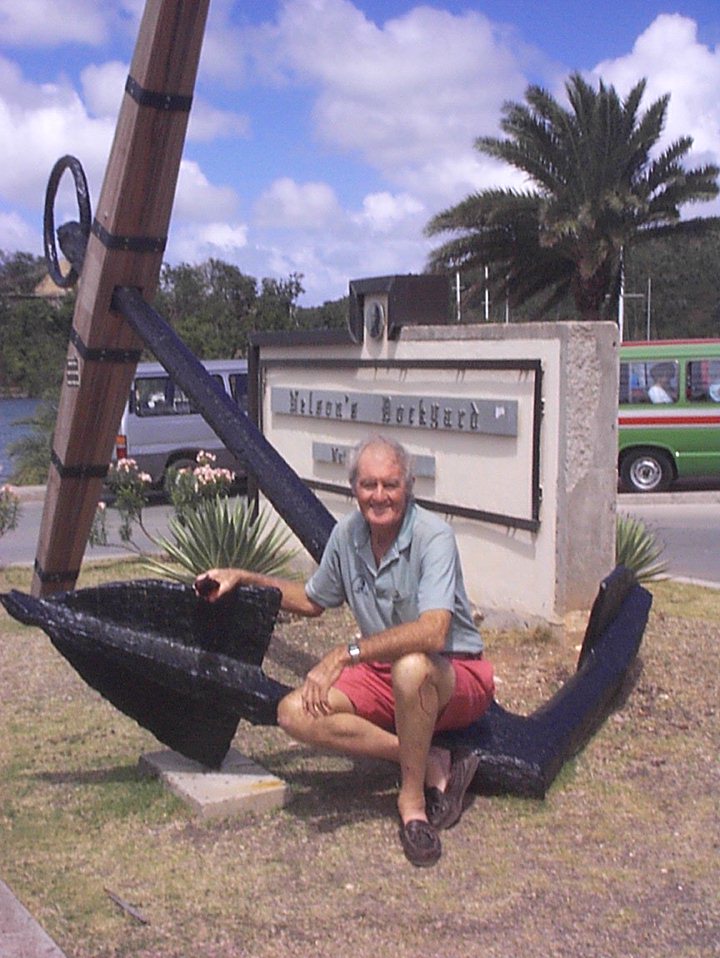
Winter is when many Northerners head south to the Caribbean for rest and recreation on a cruise ship or at a beachfront hotel.
Desmond Nicholson, past president of the International Association for Caribbean Archeology, says that a holiday can offer a great deal of intellectual as well as physical relaxation. This 51-year resident of Antigua, West Indies -- an island known to readers of novelist Jamaica Kincaid as A Small Place, to cricketers as the native soil of Sir Viv Richards, to Old Money as the winter haven of the Mellon family (and visitors like Jackie Kennedy) at the Mill Reef club, and to recovering drug and alcohol abusers as the location of Eric Clapton's Crossroads Centre rehab clinic -- has spent a lifetime trying to bring attention to the historical and cultural significance of Antigua in particular, and the Caribbean in general (for example, Antigua is mentioned in Jane Austen's Mansfield Park, Napoleon's Josephine was from the French West Indies, and American Founding Father Alexander Hamilton was born on Antigua's neigboring island of Nevis).
A yachtsman turned naturalist and archaeologist, Nicholson has been instrumental promoting historic discovery in the Caribbean. He was a founder of the historical museum in Nelson's Dockyard National Park in Antigua, a re-creation of Lord Nelson's Navy yard -- established in 1725 -- that should gladden the hearts of Patrick O'Brian fans. (It is also home base for the annual Antigua Sailing Week catering to more contemporary sailors.)
In addition to the Nelson's Dockyard museum, in 1985 Nicholson established the Museum of Antigua and Barbuda in a restored 1750 St. John's courthouse, only a few blocks from the cruise ship terminal downtown.
To hear Desmond Nicholson tell it, tourists interested in history don't neet to go to Europe to explore the past, they can find plenty of it closer to home, and with better weather, in the Caribbean.
THE IDLER: Why do you say Antigua has more history than almost any other island?
DESMOND NICHOLSON: Because Antigua has a smaller area of high hills (most of the others are mountainous), and in the old days, Antigua was more thoroughly planted with sugar cane. Thus we still have 111 sugar mill towers standing. We also have the remains of two large central sugar factories. All these old mill towers dotted over our landscape adds interest for the tourist.
The Eastern Caribbean Islands were heavily fought over like pawns in a game of chess. Antigua has many bays ind inlets and these all had to be fortified. At one time there were at least 40 forts, guardhouses and earthworks; quite a few of these remain today. We also have a few estate houses left.
We must sidetrack a little here.
Barbuda is our sister island, so we should include it on an article on Antigua & Barbuda, for that is the name of our nation. No sugar was grown there -- too rocky, flat and dry. It was leased to a planter family (the Codringtons) that had five estates in Antigua. Barbuda was used to supply their estates with leather goods, provisions for slaves, seafood, and many other items made by the Codrington's slaves, who led quite an ideal life compared with the cane-cutting slaves in Antigua. The Barbuda slaves salvaged shipwreck cargoes for the Codringtons which amounted to a considerable income. Barbuda is very flat 10 ft above sealevel (highest point is 200 ft.) and is surrounded with dangerous reefs. The Museum has recorded historically 164 wrecks for Barbuda and 184 for Antigua. More in Antigua as it was a destination for sugar & other ships.
In times befor Christ, another valuable resource for Antigua was flint. This was was used for stone tool making. It was also used as a trade item. Thus we have recorded 67 archaic sites for Antigua and 4 for Barbuda. Ceramic sites (Arawaks and Carib Sites) number 62 +14. We have more Archaic sites (preceramic) because of the flint as well as the conch shell that made beautiful hand tools, for hollowing out canoes, for instance.
IDLER: What are some of the key historical sites in Antigua?
NICHOLSON: Nelson's Dockyard, maintenance HQ of the Eastern Caribbean. Betty's Hope, a semi-restored sugar factory. Gunthorpe's Central Sugar Factory of 1902 (Now falling apart, as is also Montpelier Sugar Factory), Shirley Heights Military Complex. Fort George, on Monk's Hill. Fort Berkeley guarding the English Harbor entrance. Fort James, ditto. St. John's. Fort Barrington, Deep Bay. The Anglican Cathedral, St. John's St. Georges & St. Philip's Churches The'Andes' shipwreck (1903) The Indian Creek Amerindian site known Caribbean-wide, Jolly Beach site oldest known in Antigua (1776 BC) and there are several other prehistorical sites of value.
THE IDLER: How did you become interested in the history of the island?
NICHOLSON: I was taking my yacht charter guests for a swim at English Harbour and while waiting for them I saw some Amerindian pottery in a building sandpit by the sea. So I investigated from there, and it was not long before I became president of the International Association for Caribbean Archeology.
THE IDLER: What activities have you engaged in to share your interest in this history?
NICHOLSON: I started the Museum of Antigua & Barbuda in 1985, almost single-handed, in the Court House of 1750 and gave my library and artifacts. I also lectured to tourists and schoolchildren every Thursday for seven years (until I built the Museum.)
In 1994 I started re-interpreting the Dock Yard Museum.
THE IDLER: How long have you lived in Antigua?
NICHOLSON: 51 years, and don't forget that one year!!!
THE IDLER: What challenges did you face with your historical projects?
Getting born Antiguans to understand the value of a museum, and of having a Museum for education and tourism. I made the Museum simple for children, and that's what a tourist also likes. It also attracted the Ministry of Education to present some input (funding).
THE IDLER: What were your greatest satisfactions?
The success of the Museum, and the interesting entries in the Visitor's Book. And having created a new learning institution for Antigua & Barbuda.
THE IDLER: Why is this satisfying to you?
NICHOLSON: The war interupted my education, so I sort of started up my own college many years later!
THE IDLER: Why should people who live elsewhere care about the history of a small island like Antigua?
NICHOLSON: We have almost the same history as the other islands, so it is interesting in that respect.
THE IDLER: How does the history of the island relate to its climate, geography, flora, and fauna?
NICHOLSON: I think I have covered this -- climate for sugar growing -- geography, the distribution of sugar and forts. Flora & fauna -- the distribution of Amerindian sites, most sites are found near present day natural resources. Beaches, reefs and cassava growing valleys.
THE IDLER: How does the history of Antigua relate to the Caribbean, and other regions?
NICHOLSON: Its all really the same history -- the larger islands imported Coolies and Chinese to help out in the sugar fields, as the African slaves had disappeared into the hills on emancipation, but Antigua was too small to vanish into!
THE IDLER: How have social and political changes on the island over the years affected your work relating to its history? Were some topics -- such as slavery and colonialism -- too emotional to deal with in past years?
NICHOLSON: I suppose it has, but couldn't relate anything. The young lap up the history of the times of slavery, the middle-aged people do show some interest, while the older fellows romp around and say 'What is this?" -- and walk out quickly!
THE IDLER: Does the internet make a difference for your work?
NICHOLSON: We use it. I suppose it makes some difference in research. Cable & Wireless Ltd gives us free time.
THE IDLER: Do you think there will be more historical tourism in the future of Antigua?
NICHOLSON: Yes, deinitely, but it is lack of funding that holds us back .....
