Click Here To Download
The Idler's Mobile Version

The Idler's Home Page and Table of Contents
The Idler's email list
To advertise in The Idler
Write a letter to the editor

(www.the-idler.com)
Volume II, Number 155






AN ICONOCLAST'S BOOK LIST
by Alice Goldfarb Marquis
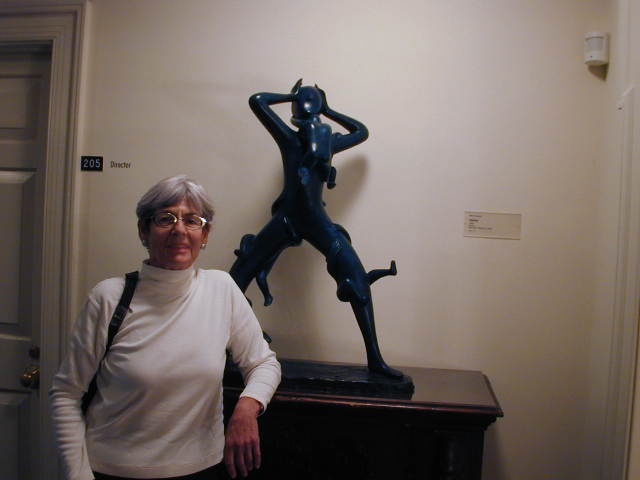
Alice Goldfarb Marquis with a sculpture by Mark Kostabi at the Duke University Museum of Art, Durham, NC.
Boring books. Ever since I was force-fed a book a day during grad school, I have hated them. Sadly, this includes most academic tomes, and all too many novels that flaunt their writing-program origins, daring us to find the trace of a story within the dense text. Maybe I'm jaded; maybe I've used up all my empathy genes. But puhleeze! Don't give me any more novels that deal with losers, addicts, sexual adventurers, sensitive artists, or the very young.
The e-book may be on the horizon. It may even rule ... some day. Someone may figure out how this flimsy bundle of plastic and chips will survive an upside-down burial in a sandy beach or a dunk, oops, into your warm bath. But not yet. And, of course, the e-book will inherit all the flaws of p(aper) books. But no matter how sand-resistant or waterproof it becomes, it can l never replace the real paper and ink volumes that line the walls of my writerly workshop.
Dinosaurs or doorstops, here are the denizens of my own private Jurassic Park that have kept me turning the pages in the last few years:
Barzun, Jacques, From Dawn to Decadence: 500 years of Western Cultural Life: a blockbuster packed with people and ideas, accessible, witty, opinionated, and addictive. The author is 93 years old.
Katchor, Ben, Julius Knipl Real Estate Photographer: an urban historian and philosopher trudges through the panels of a comic book. Katchor shamelessly plucks your nostalgia nerve, and gives new meaning to the words "inner city decay." The other Knipl books also intrigue.
Chernow, Ron, The Warburgs: the many generations of an international banking dynasty described in all their achievements and foibles. His House of Morgan is also good, but I haven't read his more recent biography of John D. Rockefeller.
Ambrose, Stephen, Undaunted Courage: This prolific historian takes us along as Lewis and Clarke paddle and trek toward the setting sun. A terrific adventure story, and a tribute to the man who sent them West, Thomas Jefferson.
Rhodes, Richard, The Making of the Atomic Bomb: This scientifically challenged reader followed eagerly as Oppenheimer and company built the bomb. It still hangs over us.
Morris, Edmund, The Rise of Theodore Roosevelt: Gets behind the bully charging up San Juan Hill to introduce us to the intellectual, the writer, the loving father, and energetic leader. No need here for Morris to fictionalize, as he did with Reagan; TR is a saga in himself.
Tommasini, Anthony, Virgil Thomson: Composer on the Aisle: the portrait of a grand curmudgeon, arguably the best American music critic of the 20th century is carefully painted by a music critic for the New York Times.
Remnick, David, Lenin's Tomb: still indispensable for insight into what's going on in Russia. When, oh when will Remnick quit trying to breathe life into the corpse of The New Yorker and go back to reporting?
Mattingly, Garrett, The Armada: there's a good reason this classic, first published in 1959, is still in print. It's gripping. You can't understand Spain (or even Latin America) without it.
Guralnick, Peter, Last Train to Memphis: The Rise of Elvis Presley: a fascinating story of a time, a place, and the poor boy who profoundly changed American culture. The sequel, Careless Love, is all too depressing.
Fowles, Jib, The Case for Television Violence: an offbeat and thoroughly researched challenge to the received truth that violent crime is related to television mayhem. T'ain't so, sez Fowles, a professor of communication at U. of Houston.
Dizikes, John, Opera in America: A Cultural HIstory: a lively trip through the dramatic career of European opera in the U.S. Did you know that New Orleans had at least two opera companies in the 1830s?
Naipaul, V. S., A Bend in the River: Published in 1979, this beautifully written novel is still a key to understanding what's happening in Africa.
Vanderwood, Paul, The Power of God Against the Guns of Government: this ghastly title conceals a most original work of history. The story of an obscure Mexican insurrection at the turn of the 20th century, it includes faith healers and religious zealots, and reads like a novel.
Goodwin, Jason, Lords of the Horizons: A History of the Ottoman Empire: the bizarre entity described here rode roughshod from the Black Sea to the gates of Vienna, then maintained itself virtually unchanged for more than 500 years. We're still picking up the pieces it left behind, in the Balkans and in the Middle East.
Finally, I discovered several engaging -- and, fortunately, prolific -- writers this year: John Lescroart, whose courtroom thrillers are set in San Francisco; Patrick O'Brian, whose sea dogs, Capt. Aubrey and Dr. Maturin, bestride the world of sailing ships; and Gore Vidal, whose memoir, Palimpsest illuminates darkest Washington DC of another day.
Has anything changed?
A frequent contributor to The Idler, Alice Goldfarb Marquis is the author of The Art Biz, Art Lessons: Learning from the Rise and Fall of Public Arts Funding, Alfred H. Barr, Jr.: Missionary for the Modern, and a forthcoming biography of Marcel Duchamp.
