The Idler's email list
To advertise in The Idler
Write a letter to the editor

(www.the-idler.com)
Volume II, Number 149






LETTER FROM JERUSALEM: Israel's Museum of Islamic Art
by Arlynn Nellhaus
Palestinians ensconced in Beit Jalla were shooting into apartments of Israelis in nearby Gilo again the other night.
In the morning, a few miles farther north in Jerusalem, I walked to the Museum of Islamic Art (the L. A. Mayer Memorial), located in the heart of an old, established Jewish neighborhood.
Such are the contrasts in Israel. Despite the microscopic view of Israel on TV, the over-all situation is far different. In downtown Jerusalem, Arabs, including groups of Arab youths, go about their business side by side with Jewish Israelis doing the same thing, as usual.
Yesterday, when I passed a community center in which intensive Hebrew classes had just ended, several Arab young women, their hair uncovered, left the building laughing amongst themselves and calling back and forth as they separated.
Later, at a health center, an Arab woman, a scarf over her head, sat on a bench waiting for her turn with the doctor, and chatted in Arabic with an elderly Jewish woman from Iraq.
This afternoon, I picked up fresh produce at the outdoor market with its Arab and Jewish workers, Arab and Jewish stand owners and Arab and Jewish shoppers.
This is the reality of life here. This you won't see on television. Television shows only exceptional events or events that take place for the benefit of TV, especially Palestinian boys throwing stones. When TV cameras leave, they leave. None of them wants to risk dying off screen.
And this particular morning, I was at the Museum of Islamic Art. I hadn't been to this museum since it was remodeled recently. I wanted to see the changes and a temporary exhibit of Damascus-style furniture.
On my earlier visits, among the visitors, I would see Arab youngsters with their teacher, as well as Israeli soldiers with their lecturer. This time, just as the museum opened for the day, I saw only an Israeli man and his 7-year-old son and three academics, one, a woman who spoke English with an Arabic accent.
Always an enlightening and particularly enjoyable museum, it now is stunningly beautiful. Walk in, and a small, tiled fountain greets you in the foyer. Straight ahead in the main hall is a gorgeous, tall, intricately painted blue-tiled prayer niche from a mosque in Isfahan, Iran.
I rushed to inspect this thrilling sight. It is a life-sized photograph. A brilliant idea. That is one of the surprises in the redesigned museum.
To reach the special exhibit, I had to go downstairs and through the room of War and Weaponry in Islam. And there was another entrancing concept as this room's centerpiece.
To show a charging Moslem warrior on his galloping horse, the two simply were outlined in heavy black wrought iron. Overlaying the warrior's frame was chain mail from the 15th and 16th centuries of Ottoman Turkey. Even the horse had his decoration – a shining brass faceplate that lit up the display.
Then came the room of Damascus-style inlaid furniture. The intricate artistry is dazzling. Among it is mother-of-pearl cut like filigree silver work and tiny inlaid pieces of wood of myriad colors used as if in a non-objective painting.
Armoires, chests of drawers, chairs, tables, mirrors, knives and guns exhibited variations of this delicate artistic craftsmanship.
One of the great attractions throughout this museum is its detailed description of how the different arts developed in Moslem countries.
The Museum of Islamic Art landed in this solidly Jewish neighborhood because of Vera Frances Bryce Salomons, daughter of London's first Jewish mayor, Sir David Salomons.
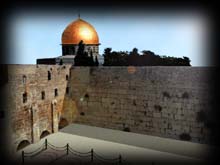
She tried to buy the Western Wall, first from the Turks, then from the British. But neither was selling. When Jordan captured Jerusalem's Old City in 1948, it now, illegally, was in another country.
Salomons turned her philanthropic interests and resources toward her very dear friend, Leon Arie Mayer, a Hebrew University professor of Islamic studies. She built the museum for him. He was to be director, but he died in 1959, before it opened.
Next door she built a home for retired academics. Both buildings were tastefully designed and still add class to the neighborhood, which also has the Israeli president's official home.
The museum has another claim to fame. In 1983, it was the scene of Israel's biggest heist, when $7.5 million worth of antique time pieces was hauled away. The collection came from Sir Salomons.
To date, the burglary hasn't been solved. Mention it to a Jerusalemite and first come the raised eyebrows, then the declaration, "That was an inside job." The burglars had so much time to do their deed that they stopped to eat lunch, leaving their trash behind.
The current exhibit of Damascus-inspired furniture continues through the winter. In the intertwining of Jews and Arabs in Israel, something not recognized by those whose impression of the area comes from the nightly news, the items in the furniture exhibit were supplied ecumenically.
Jewish and Arab families, primarily one each from Ramallah in the Palestinian Authority, Jerusalem and New York, are lending their treasures to the exhibit.
And shooting from Beit Jalla continues.
Arlynn Nellhaus is a former Denver Post reporter now based in Jerusalem and the author of Into the Heart of Jerusalem.
