The Idler's email list
To advertise in The Idler
Write a letter to the editor

(www.the-idler.com)
Volume II, Number 147






Vote Counting By Machines -- And People
by W. L. Paterson
The credit card in your wallet is trusted to guide the debiting of your account for a purchase that has been identified by a scanner reading a bar code on a slightly dirty package. In both phases of the transaction, a machine successfully interpreted the data. Why then is there such a fuss over the presumed differences in the abilities of machines and humans to read and count ballots?
All media readers make errors. The hard disk of a computer lives its entire life in a cleanroom environment without being touched, allowing a raw error rate far below all other media we consider. Movable media are read with raw error rates in the range 1 to 300 per 10,000. Media marked and handled by humans have raw error rates toward the top of that range.
Computers and the commercial applications mentioned correct the raw error rate through the use of redundant information interpreted as an error-correction-detection code. These ECDCs mask the raw error rate, by reporting only the corrected values. When the raw data is too obscure, the ECDC reports failure, which triggers manual intervention. When the consumer purchases a tail-lamp bulb for his auto, his credit card company does not debit his account for the price of a limousine. Consumer experience, then, is not a reliable guide for the intuition of those concerned with the accuracy of ballot counting. The voter creates a single mark or aperture to indicate his choice. There is no redundant encoding. Vote counting is to be judged by the raw error rates, which may be up to 3%.
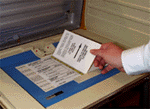
Today's voting systems use cardboard media, with the choices indicated by either a dark mark or an aperture. Photosensors detect a change in either reflection or transmission of light. Accuracy depends jointly on the illumination system, the sensitivity of the photosensors, and the alteration of reflectivity or transmission by the voter's action, whether by choice or accident. Depending on the design and state of maintenance of the equipment, the performance of the illumination system and photosensors may depend on the line voltage, room temperature, time since turned on, and air flow. The voter's effect on the reflectivity or transmission of his ballot depends on his instructions and the nature of the card stock. Card stock varies by manufacturer, batch, and storage conditions.
Consider the problem of certifying a ballot counting machine. The machine's salesman will be aware of the variables and will control them during his demonstration to state purchasing authorities. But will the purchaser be aware of the care which has been required? More likely, the full list of operating restrictions will not be in either the sales literature or the maintenance manual. If the caveats are not revealed at the outset, how effective will the machine maintenance be? Will the machine, after storage and shipping to a polling place, be able to reproduce its sales-floor accuracy?
The traditional role of the good people who volunteer their time to be election judges in polling places is to assure that election laws are followed. They are competent to judge whether a voter is properly identified and whether he is physically able to cast his ballot without assistance. They are not trained in the multiple disciplines required to determine certify a ballot-tabulating machine, nor do they control the resources as needed to mitigate its shortcomings.
By this point in the discussion, one should have a healthy skepticism regarding the applicability of machine counting in elections where the margin between choices is comparable to the raw error rate of the machines. A mandatory recount in close contests is clearly a good idea.
What exactly is a recount? One position recently stated is that a recount has been effected if the ballots are run through the tabulating machine a second time. The most that this can establish is that the same ballots were fed in and that the machine is running as it did the first time. Any errors of the type enumerated herein will, at best, be repeated. The general public expects that a recount will expose errors made in the initial count. Clearly, a mechanical repetition of the same criteria does not satisfy that expectation. If agreement between machine runs does not assure accuracy, then what is the significance of a disagreement? The machine will not yield the answer to which is the better count. A manual recount will be required in either case.
I have consulted on the design and evaluation of vote counting machines. The gold standard of "what the machine should have registered" was the opinion of persons recruited from the available staff, doing just what used to be done in all polling places, eyeballing the ballots. The consistency of interpretation by pairs of humans is much better than that of the machine.
Personal experience as an official observer at a contested election leads to another generalization: errors due to partisan enthusiasm occur on election day, not during the recount. This is easy to understand. On election day, the judges in the polling place are the absolute authority. An abuse of authority cannot be meaningfully challenged. Too vigorous protest does not effect a remedy but only brings the police with instructions to eject the observer. The observers are not allowed to interact with the voters. Privacy requirements keep everyone except the judges at a distance. Any protest, which would delay the voting, is ruled out of order. Even the protester will agree that harm would be done to the democratic process if their action prevented voters from exercising their franchise.
Contrast this with the setting of a true manual recount. Counts must be agreed to by representatives of both major parties. The work is done in public. The criteria used can be discussed and challenged. Honest differences of opinion do arise, and some errors will be made. Even the most partisan participants will be reluctant to skew the result in full public view and knowing that their decisions are subject to review. This kind of recount is probably one of the most earnestly conducted and honest parts of the democratic process.
Clever politicians know about recounts and the honesty that appears. In order to magnify particular issues in the public mind, they may claim bias in a recount. That is part of the legerdemain of politics, what the stage magician calls "misdirection." The reality is that the best opportunity for fraud is on election day. Manual recounts in public should be mandatory whenever margins of less than one per cent are significant.
Chaff, chad, dimples, and blackness
The simplest aperture ballots are those which are simply impaled by a sharp instrument. Chaff, a fringing of the hole at its edges, may spring back with time toward its original position, partially occluding the aperture. Not a common problem with the introduction of die-cut ballots.
Aperture ballots may have die-cut regions retained only by a portion of their periphery. Suspension by the four corners of a rectangle is common. The voter is supposed to break out the rectangle with a pick or punch. The part which breaks out is chad. Chad that doesn't break free cleanly is debated. Reasonable quality control of the die-cutting of the ballots would allow recount criteria to allow as valid any chad which has a broken point of suspension. If you don't see hanging chad from a stack of unused ballots as you riffle through them, then the breaking of any suspension should constitute a vote.
If you agreed with the last paragraph, then you already know that a dimple is an even smaller expression of voter intent. If the chad is still attached but has been attacked with a pick, it has a dimple. If no other candidate's chad has a dimple, then a dimple might well be taken as voter intent. Any rule allowing dimples as votes should, however, require that there not be dimples in the other candidates' chad. Multiple dimples for one office suggests that the voter was trying out the pick rather than expressing intent.
Blackness is a notion that applies only to the dark-mark ballots; it has no meaning in connection with aperture ballots. If one is required to "fill in the circle" with a pencil or other device, the voter intent will be judged by the amount of reflected light from the specified area and will be compared with the light reflected by unmarked card stock. If the card stock reflectivity is exceptionally uniform, then partial markings such as x's and dots may be registered. Commonly, stock variability requires substantial filling of the indicated space. There is a particular danger in the case of machines which read by means of light which is incident at the same angle to the ballot as the photosensor but on the other side of vertical. Graphite pencil marks reflect specularly. With bad enough luck, a machine can be designed with reads graphite marks as totally unmarked (they reflect specularly more brightly than the card stock). Given such a machine, the devious election judge can simply hand a graphite pencil to every black voter and an ink-based marker to every white voter. Disenfranchisement by technology is one of the miracles of our age.
Good machines, better machines
A few voting machines in use today use a paper or cardboard ballot, but incorporate a reader and computer checker. When voting is completed, the machine announces to the voter that that he has made illegal choices such as two candidates for president or too many judges in a vote for any three situation. With that announcement, the voter is directed to obtain a replacement ballot and begin again.
As advanced as that may be, one could go a bit further in protecting privacy and auditability. Use the same concept as described above, but put the information onto a magnetic striped card as magnetic encoding. This allows the physical ballot to be handled without compromising privacy. A strong magnetic field could lose the data. For the next step, let the voting machine encode the vote in material like that of writeable CD-ROMS used in computers. Redundancy would be built in, the data unreadable by the eye, and magnetic fields would not affect it. Is that the ultimate solution? No, because the ballot can no longer be read by human auditors. A recount is perfectly possible and perfectly accurate and perfectly dependent on the computer code which interprets the marks. The focus shifts to securing and auditing the computer code of the voting machine and the counter. In the end, democracy requires the full attention of those who would be free to exercise it.
W. L. Paterson is retired from The Aerospace Corporation where, among other assignments, he headed the Systems Integration Section of the Computer Systems Department. After working to implement the first military contracts with quantitative reliability requirements in the 1950s, he developed semiconductor devices and manufacturing technology, and was then a consultant in related areas for a decade before joining Aerospace. He holds B.S. and M.S. degrees in Electrical Engineering and the Ph.D. in Materials Science.
