Click Here To Download
The Idler's Mobile Version

The Idler's Home Page and Table of Contents
The Idler's email list
To advertise in The Idler
Write a letter to the editor

(www.the-idler.com)
Volume II, Number 124






JEWISH PROBLEMS
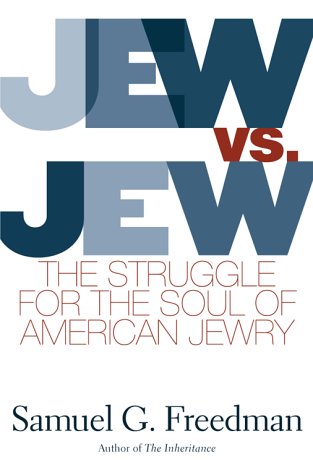
JEW VS. JEW: THE STRUGGLE FOR THE SOUL OF AMERICAN JEWRY
by Samuel G. Freedman
Reviewed by Milton Goldin
To prepare his tour de horizon of contemporary American Jewry, Jew vs. Jew: The Struggle for the Soul of American Jewry, Samuel Freedman, a former New York Times reporter and current Columbia University professor, interviewed hundreds of people and read dozens of articles and books. Briefly put, he discovered no new sociological trends, and readers will be as perplexed after they read this book as before why a People so ambivalent about remaining a People continues its struggle to survive as a People.
What Freedman does in depth, however, is describe how Jewish communities cope with mind-boggling discord and the startling uniqueness of today's Jewish situation in America, especially when it is compared to what was thought by and about American Jews immediately after World War II.
Who would have believed, then, that a time would come when Gentiles were less upset by the prospect of a Jewish Vice President than Jews who feared possible anti-Semitic repercussions should he win?
Or, that disputes about the nature of Judaism, about what identifies a Jew as a Jew, about how much assimilation is acceptable and tolerable, and about the State of Israel's purpose vis-a-vis world Jewry, would tear the fabric of communal cohesion?
How American Jewry got from there to here is both complicated and important to the story that Freedman tells. But he devotes little space to this aspect of American Jewish history, which is understandable in this instance, given that his interest is overwhelmingly the here and now. Or, more specifically, his interest is five Jewish communities facing communal issues in Denver, Los Angeles, Jacksonville, New Haven, and Beachwood, Ohio. He also considers Camp Kinderwelt, a Labor-Zionist facility, and Kiryas Joel, a Hasidic community in Rockland County, New York, and intersperses these reports from the trenches with essays on Jewish identity, Orthodoxy, and Israel and America.
One aspect of the there-to-here story is critical in setting the current scene, however, and a summary account may be useful in this review.
Until the 1950s and with few exceptions, WASP Establishments barred Jews from Ivy League educations, positions in executive suites at major corporations, and partnerships at law firms and banks.
Jews were not barred from clothing trades and wholesale and retail operations, fields in which they had been traditionally prominent. During post-World War II expansions of mass markets, it was precisely these fields that flourished, along with communications fields in which Jews had pioneered. Many non-Jews then came to a belief that, although Jews had defects, mainly on account of their not being Christians, Jewish money in the form of charitable donations and financing, and Jewish power in the form of solid voting blocs, could be useful.
In fact, far more useful than anti-Semitism.
Jews reacted with startling alacrity to the new acceptance. Conversion to a Christian faith never became popular, but the mass- circulation magazine, Look, published a major article on "The Vanishing American Jew," based on intermarriage rates, as early as 1964. In the early 1950s, the intermarriage rate was thought to be about six percent, but in 1970, the first National Jewish Population survey indicated an intermarriage rate about five times higher, 31 percent. The next such survey put the figure at 52 percent. Only 28 percent of intermarried couples raised their children solely as Jews, and only 13 percent affiliated with a branch of Judaism.
Jewish religious and secular organizations were well aware what was happening, but Freedman tells us that almost every measure they undertook to stem disintegration brought on by assimilation and intermarriage came to nothing. Far from serving as a rallying point, Israel divided Jews on both political and religious grounds. Worse, Israel's schism over the peace process was soon mirrored in America, provoking endless debates and bitter disputes over philanthropic turfs. The issue of Who is a Jew? became more contentious than ever as Israel's Labor and Likud parties both relied on Orthodox parties to deliver pivotal votes. By accepting continued Orthodox dominion over Jewish religious life in exchange for support on political issues, both Labor and Likud finally managed to antagonize the 90 percent of American Jewry that is non- Orthodox.
How did these issues play out in local American communities? Camp Kinderwelt was a sort of summa of the world of our fathers with its Yiddishkeit, its Zionism, and its sense of Jewishness without religion. Its hero was David Ben-Gurion, who once issued a press statement announcing that he had not fasted on Yom Kippur, and who taunted a convention of American Orthodox rabbis with the revelation that he had been married by a justice of the peace.
When the camp went out of business in 1971, Kiryas Joel, a village populated by Satmar Hasidim stood just 2 miles away. Yiddish was the lingua franca here, Satmarers flouted zoning laws by converting private homes into places of worship, and purchases of tv sets, radios, home videos, and English newspapers, were forbidden. Satmarers boasted, "you can live in the way you lived in Europe a hundred years ago."
In Denver, where the intermarriage rate reached 72 percent, local Reform, Conservative, and Orthodox rabbis rented a conference room and vowed to forge the framework of a conversion program for non-Jewish spouses. After ten hours of negotiation they emerged with a plan: Each prospective convert would take a 20-week course in Basic Judaism taught by rabbis from all three branches. A sponsoring rabbi for each prospective convert would conduct personal instruction and counseling. Then, a panel of three rabbis, one from each branch, would re-evaluate the applicant. Finally, three Orthodox rabbis would convene as a religious court, a "bet din", to make a formal decision on whether the applicant should be accepted.
In December 1982, the president of the national association of Reform temples, aware of the development, arrived in Denver to announce that that city would serve as a trial location for Project Outreach, a $5 million campaign to educate Gentiles and invite their conversion to Judaism. Proselytizing has always been anathema to Jewish tradition, and Conservative and Orthodox rabbis reacted with anger to the Reform intrusion. Unity in the effort to deal with intermarriage dissolved. Nor were many Gentiles converted.
Nothing better epitomized the intractability of the gender issue in Judaism than the publication of a new Conservative prayer book in late 1998, after seven years of deliberation that included two versions of the "Amidah" (a series of benedictions essential to Jewish observance) without the Matriarchs on page 3a and with them on page 3b. Rabbi Jules Harlow, who had edited an earlier edition, expressed the indignation of traditionalists when he wrote in an essay that "changes based upon gender language referring to God disrupt the integrity of the classic texts of Jewish prayer, drive a wedge between the language of the Bible and the language of the prayer book, and often misrepresent biblical and rabbinic tradition." In Los Angeles, where feminism and liberalism were articles of faith among Jews, Rabbi Harlow's view provoked utter dismay and even diverted attention from the Peace Now movement in Israel and Mel Brooks movies at home.
On the other side of the continent, a large part of Brooklyn's population believed that enemies of Israel included not only Palestinians but Israel's own leaders. A commuter from Jacksonville named Harry Shapiro began to wonder how Yitzhak Rabin, "forcing the Oslo Agreement down Israel's throat," could be the same person who had earlier come to Jacksonville to declare that he would never negotiate with the PLO. For Shapiro, Shimon Peres's visit to the city was the last straw. What were this Israeli traitor's purposes, after all, than to seek money and support for extending the Oslo Agreement?
Shapiro decided his best hope was to wreck the visit by placing a bomb in the Jacksonville Jewish Center where Peres would speak. When the device was discovered (it was rigged not to go off), he would place a call to the police announcing that he was an Arab terrorist. Later, however, after the police ascertained who he was, Shapiro insisted that he had just wanted to make a point, not to blow up anyone.
In New Haven, five Orthodox Yale students protested housing policies according to which they were compelled to live in dorms where immorality did not just occasionally occur but turned out to be a way of life. Yale's position was that for decades it had structured undergraduate life around its residential colleges, each of which consisted of a dormitory, commons, classrooms, and faculty apartments. If Orthodox students did not care for Yale mores, perhaps they should look elsewhere for their education. The Orthodox Union's president hailed the students for fighting to "lead a moral life that's prescribed by the Bible, that was accepted before MTV came along," and they received support from the Catholic League for Religious and Civil Right. The students took the issue to a federal court, which ruled in Yale's favor. Among organizations that had filed amicus briefs on Yale's behalf were the American Jewish Congress and the Anti-Defamation League.
In Beachwood, Ohio, a Cleveland suburb that was 83 per cent Jewish, fifteen years of strife between Reform, Conservative, and Orthodox adherents led to the evening of March 27, 1997, when a decision had to be made whether to change zoning laws and thus allow the Orthodox to construct several religious buildings. A few days before the meeting, a national association of Orthodox rabbis denounced the Reform and Conservative movements as "not Judaism at all." As it developed, non-Orthodox Beachwood residents quashed possible zoning-law changes.
A few months after the publication of Jew vs. Jew, three well-known Jewish philanthropists ventured into the area of communal healing. Edgar M. Bronfman, Sr., chairman of the Joseph E. Seagram Co., Charles Schusterman, chairman of an international oil and gas company headquartered in Oklahoma, and Michael Steinhardt, a retired Wall Street financier and founder of the Jewish Life Network, held a meeting in Chicago to jointly announce that they would donate $18 million over five years to programs aimed at "creating a renaissance" in American synagogue life. "The synagogue is perhaps the most important institution in Jewish life," said Steinhardt. "The synagogue has a great deal to do to stay ahead of the curve and [to] be resonant and relevant to the bulk of Jews in the 21st Century."
So far, so good. But Bronfman and Steinhardt then reached tragicomic heights upsetting Reform and Conservative rabbis. According to an account in the Jewish newspaper, Forward (September 8, 2000), Steinhardt "suggested" that Reform and Conservative movements were "accidents of history." Bronfman observed that "rabbis do not own the synagogue" and added that his own distaste for synagogues had grown so strong that he felt compelled to hold High Holy Day services in his Upper East Side apartment building.
A Reform rabbi opined that it was very troubling that people who sit in such positions of power should have so little knowledge about what was happening in non-Orthodox circles. Taken aback, the hosts explained that their outpourings were motivated by the belief that American Jewry was in crisis, and Steinhardt added that synagogues had been slow to respond to dramatic changes in American Jewish life during the past half century.
At a meeting session on new synagogues, participants then heard from leaders of three "successful operations." One was New York City's Congregation B'nai Jeshurun, said to "regularly" attract "thousands of worshipers" to its Friday night services. When asked what accounted for this phenomenon, one of the synagogue's rabbis observed, "Within our own establishment, within our own tradition, there is the permission to experiment. It's not about that particular technique or this particular trick but it's about having the willingness in the congregation and within ourselves to be open to the possibility of change in whatever area."
Yes, that was how specific the issue got.
Milton Goldin is a businessman and author of Why They Give: American Jews and Their Philanthropies and The Music Merchants. He is a member of the National Coalition of Independent Scholars.
