Click Here To Download
The Idler's Mobile Version

The Idler's Home Page and Table of Contents
The Idler's email list
To advertise in The Idler
Write a letter to the editor

(www.the-idler.com)
Volume II, Number 116






THE TRUTH AND EDWARD SAID
By Jeff Jacoby
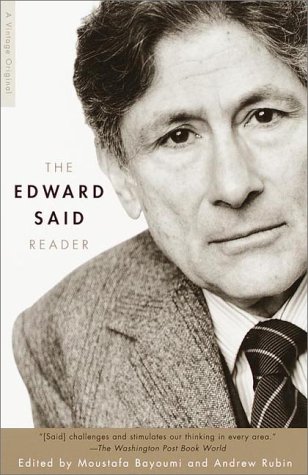
Edward Said, the world's most renowned Palestinian intellectual, was exposed as a fraud last summer. The experience apparently taught him nothing.
For decades Said had passed himself off as an exile -- an Arab born and raised in Jerusalem only to be driven out by the Jews in the runup to the Arab-Israeli war of 1948. He had told the story often, lacing his narrative with poignant detail.
"I feel even more depressed," he reminisced in March 1998, "when I remember my beautiful old house surrounded by pine and orange trees in Al-Talbiyeh in east Jerusalem." In a BBC documentary he recalled his years at St. George's, an Anglican prep school in Jerusalem; he and a boy named David Ezra, Said recollected, used to sit together in the back of the classroom. He told another interviewer in 1997 that he could still identify the rooms in his family's former house "where as a boy he read 'Sherlock Holmes' and 'Tarzan,' and where he and his mother read Shakespeare to each other." All this was lost when his family fled from Talbiyeh in December 1947, driven out, as he explained, by the "Jewish-forces sound truck [that] warned Arabs to leave the neighborhood."
But as Justus Reid Weiner showed in Commentary, the influential journal of opinion, Said's tragic tale was largely a fabrication. The Saids, it turned out, had lived in Egypt, not Palestine. Edward Said grew up and went to school in a posh neighborhood in Cairo, where his father had a thriving business. Now and then the family would visit cousins in Jerusalem; Edward was born during one such visit in 1935. But on his birth certificate, the Saids' place of residence was listed as Cairo; the space for indicating a local address in Palestine was left blank.
Weiner looked into the expulsion of Talbiyeh's Arabs in 1947. It never happened. He checked the student registries at St. George's. There was no mention of Edward Said. He even interviewed David Ezra, the student with whom Said sat in the back of the room. Because of his bad eyesight, Ezra told Weiner, he had always sat up front.
Said occupies a lofty perch in the world of letters: He holds an endowed chair in English and literature at Columbia University, he is a highly sought-after lecturer, and he has served, at various times, as president of the Modern Language Association, a member of the Council on Foreign Relations, and a fellow of the American Academy of Arts and Sciences.
But he is known above all as a zealous champion of the Palestinian cause. For many years he sat on the Palestine National Council, the PLO's "parliament in exile," and was a close advisor to Yasser Arafat. He has savaged Israel and pressed the Palestinians' case in every forum imaginable, from op-ed columns to radio broadcasts to congressional testimony.
And his words were accorded great moral force, for wasn't Said himself a victim of Zionist usurpation? Hadn't he himself suffered displacement and exile?
When the world learned that he wasn't and he hadn't, his moral authority shriveled. It was as if, one observer put it, "we found out that Elie Wiesel spent the war in Geneva, not Auschwitz."
One might have thought that the embarrassment of it all would convince Said to stop lying about himself. And yet his fabrications continue. During a visit to Lebanon in July, Said was seen hurling rocks over the border into Israel. Throwing stones at Israelis has been a popular pastime among Arab tourists in southern Lebanon ever since Israel withdrew in May.
This stoning has drawn little international attention, even though several Israelis have been wounded, some permanently. But when Agence France Press released a photo of the world's most famous Palestinian intellectual joining in the violence, it made the papers everywhere.
Said was sharply condemned, even in quarters where he is normally only praised.
The Beirut Daily Star was appalled that a man "who has labored . . . to dispel stereotypes about Arabs being 'violent'" would let himself "be swayed by a crowd into picking up a stone and lofting it across the international border." On Said's own campus, the Columbia Daily Spectator blasted his "hypocritical violent action" as "alien to this or any other institution of learning."
His response was to shrug off the incident as merely "a symbolic gesture of joy" -- and to lie. His rock, he said, had been "tossed into an empty place." Witnesses told a different story. London's Daily Telegraph reported that Said "stood less than 10 yards from Israeli soldiers in a two-story, blue-and-white watchtower from which flew five Israeli flags."
As for the damning AFP photograph, Said professed surprise: "I had no idea that media people were there, or that I was the object of attention." But AFP had a very different explanation -- as two Columbia professors, Awi Federgruen and Robert Pollack, found out when they contacted the press agency. What they learned, they wrote in the Spectator, was that "the photograph of [Said] throwing the rock was in fact delivered to this news agency by none other than Professor Said himself."
For a man who has written that intellectuals are bound "to speak the truth, as plainly, directly, and as honestly as possible," Said seems to have a hard time sticking to the facts about himself. Perhaps that is because he knows that there is no professional price to pay for his deceptions.
When Weiner exposed Said's elaborate falsehoods last year, Columbia responded by doing -- nothing.
"Amazingly, Professor Said was not sanctioned or reprimanded by the [university's] president,'' writes Weiner in a new essay in Academic Questions, the journal of the National Association of Scholars. "Nor has the dean, the board of trustees, or the university senate publicly addressed Said's dissimulation."
To anyone familiar with Columbia's history, this lack of interest in a professor's deceit is remarkable. For Said is not the first famous member of the English Department to be caught in a series of public lies. In the 1950s, a junior instructor named Charles Van Doren won national acclaim for his brilliant run on the NBC quiz show "Twenty-One" That acclaim turned to scorn when it emerged that the show was rigged, and Columbia made it clear at once that it would not keep a known liar on its faculty.
"The issue is the moral one of honesty and integrity of teaching," said Dean John G. Palfrey, and "if these principles are to continue to have meaning at Columbia," Van Doren could not remain. The young teacher was contrite, but to no avail. He left Columbia and never taught again. No such punishment -- indeed, no punishment at all -- was meted out to Said, even though his fraud was clearly worse. (As Weiner points out, "while Van Doren had to be coaxed by the producers of the program to compete dishonestly, Said initiated and carried out his deceit by himself.")
Why the double standard?
When it comes to mere mortals, Columbia still insists on honesty. Just a few months ago a 19-year-old Columbia student who falsely told a professor that he had been in a car crash (in order to get more time on an assignment) was suspended for two years.
Yet Said, whose concocted tale of exile and dispossession was far more elaborate and misled far more people, has faced no discipline whatsoever.
A professor who spreads untruths is like a doctor who administers poison or a judge who takes bribes. Each betrays his calling. Each is a menace to society. Doctors who kill can be stripped of their license; corrupt judges can be impeached. But a professor who deceives -- at Columbia, at any rate -- is free to go on deceiving. Is it any wonder that Edward Said is still telling lies?
Idler contributor Jeff Jacoby wrote this article September 28, 2000, prior to the latest outbreak of hostilities in the Middle East.
