The Idler's email list
To advertise in The Idler
Write a letter to the editor

(www.the-idler.com)
Volume II, Number 112






CHAPTERS:THE GOSPEL ACCORDING TO THE NEW YORK TIMES
By William Proctor
By William Proctor
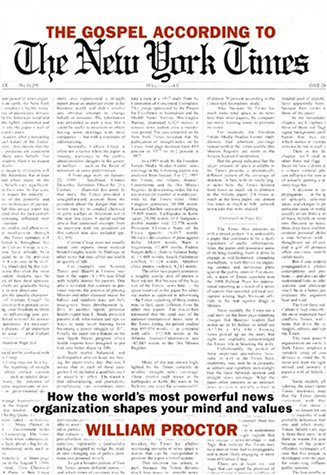
Chapter Two: Thus Saith The Times . . .
You may envy New York City. You may mock it. You may even hate it. But you ignore it at your peril, for the bible of contemporary American culture -- the holy scripture that canonizes the values and beliefs that control much of your life -- is published there. And its name is The New York Times.
As this story of the Times' influence unfolds, you will encounter a comprehensive worldview that may seem familiar -- and rightly so. Most likely, you are exposed to the Times' values-laden messages every single day in the news reports that reach you through your own newspaper, local television, radio outlets, and the Internet.
If you take time to analyze those messages, you will soon surmise that you are dealing with a well-designed belief system, which touches every aspect of life. In effect, you are being exposed to a gospel, but one that is a far cry from the traditional good news of Matthew, Mark, Luke, and John. Rather, this gospel is rooted in a kind of secular theology that purports to convey infallible social, moral, and political truth -- a truth that the paper fervently promotes with all the zeal of the fieriest proselytizer.
Although the gospel according to the New York Times encompasses many specific beliefs and doctrines -- which we'll discuss in some detail in the ensuing pages -- all point to a basic and absolute tenet, which can be summed up in this statement of faith:
To be a good person and a productive member of society -- and to attain maximum self-realization -- I must believe in the values, rights, and standards of behavior established by the Times.
Conversely, the more I deviate from the Times' worldview, the greater the danger that I'll become a bad person and a drag on society -- and never realize my full potential as a human being.
Another way of phrasing this statement of faith might go like this: The highest aspiration anyone can harbor in life is to be conformed to the image of the Times.
Now, if you happen to live outside Manhattan, all this may sound like irrelevant drivel or New York poppycock. But in fact, no matter who you are or where you live, you are touched by the Times in more ways than you may realize.
Are You Touched by the Times?
Those who live and work outside the city usually have little idea of the far-reaching power that the Times wields over their cultural, political, and personal values. The influence impacts the average non-New Yorker -- who may never have bought or read a copy of the Times -- through a complex of media tentacles that originate in the paper's editorial and business offices on West 43rd Street, just off Times Square in Manhattan.
Well-orchestrated news, editorial, and op-ed pieces from the Times slither out to other media organizations, including the major broadcast stations and networks. No responsible news anchor, editor, or producer can allow a day to go by without a substantial dose of the Times.
Every politician, scholar, or other opinion leader who operates on the national or international stage -- from U.S. presidents . . . to cabinet members . . . to senators . . . to corporate CEOs . . . to university professors -- must know what is in the Times. Furthermore, if they are called to account by the paper for their behavior, they must be prepared to respond to pertinent findings or charges, or suffer the consequences.
What are the implications for you when one news media behemoth becomes the virtually infallible cultural bible for movers and shakers on the national and international scene?
Here's one way of understanding your personal challenge. If you analyze the Times' coverage of particular political or social issues -- including relevant editorials, strategically placed and written news stories, op-ed pieces, and pictures -- you may find, as I have, that certain of your personal beliefs conform rather closely to the messages conveyed by the newspaper. But on other issues, you may discover that you part company radically with the Times.
Unfortunately, most of us don't always read analytically -- and that's where our problems begin. You may be in such a hurry in the morning that you feel you have time only to skim headlines, editorials, the "leads"of a few major stories, and some prominent pictures. Or if you typically settle down with the paper in the evening, you probably just want to relax and enjoy yourself. You don't feel like thinking too deeply after a hard day at work.
In other words, day after day, year after year, you move passively through news reports, for the most part accepting the words and concepts on each page at face value. In effect, you become an uncritical literalist as you absorb the information, opinions, and underlying belief system that emerge on the newsprint before you.
So what's the problem with this seemingly innocuous practice of enjoying the paper every day?
The danger is that the Times, perhaps more than any other media leader, has developed extremely potent and effective mechanisms to stamp its views and basic assumptions about life on our minds. Even more ominous is the evidence that this subtle process of proselytizing is changing our basic attitudes and beliefs, and most of us don't ever know it.
More specifically, what enables the Times to shape American social, political, and cultural values? The beginning of an answer lies at the very source of the paper's power -- the Times' premier position in the world of journalism.
Words from on High
Leading journalism scholars and other news organs and institutions consistently place the Times at the top in any newspaper ranking. Columbia University's Melvin Mencher, author of the classic textbook, News Reporting and Writing, which has been used in many college and university journalism courses, sums up the feeling this way:
"Some newspapers regularly figure in lists of the country's best newspapers. At the head of the list, invariably, is the New York Times, the nation's newspaper of record".
Mencher's sentiments about the superior status of the Times are echoed in the results of a 1995 study on newspapers from The Freedom Forum Media Studies Center: "the New York Times has long been considered America's paper of record."
Interestingly, the Freedom Forum is a foundation established by one of the Times' arch-competitors, Allen H. Neuharth, former chief executive officer of Gannett Company, the news media conglomerate. Neuharth also founded USA Today, the national newspaper that vies directly with the Times for circulation supremacy in the United States.
History speaks
Certainly, solid achievements support the Times' top billing among its peers and competitors. These are apparent after even a cursory look at the historic record.
The Times has been publishing definitive, award-winning, policy-shaping national and international stories under the ownership of the Ochs-Sulzberger family for more than 100 years. Actually, the paper's immediate ancestor, the New-York Daily Times, published its first issue on September 17, 1851, but the modern-day powerhouse didn't emerge until nearly fifty years later.
The newspaper was effectively bankrupt when Adolph S. Ochs bought it in 1896. He immediately placed the soon-to-be-legendary implied promise on the editorial page: "All the News That's Fit to Print."Then, in February 1897, apparently thoroughly taken with the slogan, he moved it to a box on the front page -- called in newspaper parlance, the "ear"-- where it remains to this day. With that gesture, one of the most remarkable turnarounds in news media history began.
Today -- after decades of strong family leadership culminating with that of the present chairman and publisher, Arthur Ochs Sulzberger Jr., Adolph Och's great grandson -- the paper has become financially healthy and profitable and has ascended to the very zenith of American journalism. By 1999, the Times' stories and reporters had accumulated seventy-nine of the coveted Pulitzer prizes, a number that far exceeded that of any other newspaper.
In 1998, when the Times reached seventy-seven Pulitzers, Editor & Publisher, the main organ of the newspaper industry, trumpeted the achievement this way:
"Casting its shadow over journalism the way a swaggering Babe Ruth used to dominate baseball, the New York Times has won three 1998 Pulitzer Prizes, raising its record to 77, more than double the awards of any other newspaper".
Newsweek magazine has gone as far as any competitor in singing the praises and acknowledging the quasi-religious status of the Times. A September 15, 1997, article begins with the observation that the Times "is printed on sacred parchment paper".
Later in the article, the writer becomes more specific in his reverence -- as he recognizes the power of the Times not only over competitive newspapers, but also over network TV news organizations:
"The Times is special, not so much for the paper itself as for its effect on everybody else. Preeminent among a tiny handful of papers including the Wall Street Journal and the Washington Post (Newsweek's sister publication), the Times sets the agenda for what the network-news divisions and a host of other news outlets do".
In this same vein, Joseph C. Goulden, in his otherwise critical Fit to Print: A. M. Rosenthal and His Times, states that, like good students, the other media outlets follow the lead of the Times. Furthermore, he says, the nation's leaders and scholars regard the paper as so influential that for them, a Times report is the same as "certifiable historical fact".
To symbolize the spiritual ascendancy of the Times in our culture, Ellis Cose gives the third part of his book, The Press, a telling title: "The Cathedral: The New York Times."Having thus identified the true temple of news worship, he goes on to pay proper homage:
"The New York Times ranks as the preeminent newspaper in the United States. It is not the oldest paper in the nation, or in New York, but it has the strongest sense of history and tradition. And -- as is the nature of preeminent institutions -- it is shrouded by the densest cloud of mystery; a change in its masthead is scrutinized by journalists in a manner usually reserved for leadership change at the Kremlin".
The Times' own staff has also been known to view the paper with near-religious fervor. Former reporter John Corry captured the in-house veneration this way: "The Times was the Times, as much myth as institution, and if you worked there, it was home, church, and family".
When seemingly responsible people begin to refer to a secular communications company as a "cathedral"and a "church,"which is "shrouded by mystery"and published on "sacred parchment paper,"the boundaries of mere newsgathering have been crossed.
But don't assume that such reverential views are limited to some remote Manhattan elite, or for that matter, that the main outreach of the Times is restricted to New York City. Far from it!
Instead, you can be certain that this preeminent paper is perched in some fashion on your very doorstep -- or in your TV or computer -- whether you live in California, Florida, Tennessee, Louisiana, or North Carolina.
Why You Can't Escape the Times
There are several important reasons why you can't escape the New York Times, and the first is the paper's vast circulation. The Times is in an extremely strong position to exploit its reputation as the most influential news institution in the United States -- if not on the entire earth -- because by some measures it is the most widely read newspaper in this country.
According to statistics released by the newspaper industry's Audit Bureau of Circulations (A.B.C.) in May of 1999, USA Today had the highest daily circulation in the United States with more than 1.8 million average weekday sales, and the financially oriented Wall Street Journal came in second. The New York Times placed third in weekday sales, with more than 1.1 million.
But even more impressive, the average circulation of the influential Sunday edition of the Times was almost 1.7 million according to the A.B.C. calculations. The combined weekday and Sunday total enable the Times to proclaim on its Web page that it is the "largest seven-day newspaper in the country."
The paper is also easily accessible through ordinary paper routes: the company advertises home delivery in 181 American cities and 43 states. In view of such outreach, don't be surprised if somebody in your office or on your block subscribes. Many others you know probably pick up the paper at their local 7-Eleven or newsstand.
Furthermore, contrary to the general decline in newspaper circulation across America, readership of both the daily and Sunday editions of the Times is still on the increase according to the 1999 A.B.C. report.
But wide circulation, steady growth, and an unrivaled top reputation in the journalistic community are only some of the reasons for the Times' influence. The pervasive power of the paper becomes even more evident when we consider how the Times permeates our entire culture, including the editorial content of other media both in the United States and abroad.
The Tentacles of the Times
As we have already seen, the "cathedral"of American journalism is centered in Manhattan at the headquarters of the flagship newspaper on West 43rd Street. What many don't realize, however, is that the Times also owns the Boston Globe, which is widely recognized as the leading newspaper in New England, with fifteen Pulitzer Prizes to its credit.
Furthermore, in July 1999, the Times strengthened its grip on New England by replacing the Globe's publisher -- who was a member of the family that had run the Boston paper for 126 years -- with the Times' own senior vice president from New York.
A Boston radio commentator who had written both for the Times and the Globe seemed less than happy about the change when he observed, "All the commercial media in Boston are owned or controlled by distant emperors".
But New England occupies only one corner of the Times' communications empire. The company also owns twenty-one regional newspapers, which can be found in such far-flung locations as Sarasota, Florida; Wilmington, North Carolina; Santa Barbara, California; Tuscaloosa, Alabama; and Thibodaux, Louisiana. Add to these the Times Broadcast Group, with CBS, NBC, and ABC television affiliates in Virginia, Tennessee, Alabama, Oklahoma, and Illinois.
Radio stations, magazines, and an extensive syndicate and news service also contribute to the Times' outreach from coast to coast.
The New York Times Syndicate, which disseminates the paper's news stories and opinion pieces, has more than two thousand clients on five continents. The New York Times News Service boasts six hundred fifty clients in more than fifty countries.
In fact, through reprinted articles in papers that subscribe to the Syndicate and News Service, the Manhattan "bible"has probably become part of your own daily diet of news.
To evaluate the extent to which you may have fallen under the spell of the "distant emperors"in New York City, check the small print under some of the articles you read today for some reference to the New York Times as the news source. Most likely, you'll find you're reading the "newspaper of record"more often than you think.
In researching this book, one of the papers I read regularly for a couple of years was the Palm Beach Post, a Cox Newspaper publication with wide readership in east central Florida. Though owned by an entirely different company -- which also publishes the Atlanta Journal-Constitution -- the Post sometimes ran so many reprints from the Times that on occasion I felt I was rereading the Times itself.
For example, during the first two weeks in early November 1996 -- a crucial news period that included the Clinton-Dole presidential election -- multiple Times articles were reprinted in the Post. Many, sometimes more than one at a time, appeared on the front page of the Palm Beach paper. Furthermore, not only did the Post give prominent play to many Times stories, but also, like the Times, it endorsed Bill Clinton for president.
The Internet is becoming another important medium through which the Times conveys its message. The organization's growing array of Internet offerings at its Web site, includes the New York Times on the Web, which provides the current day's major stories without charge. Other Internet efforts by the Times -- including a joint venture with the bookseller barnesandnoble.com and with TheStreet.com, an on-line financial news service -- are multiplying at disconcerting speed. So, it's reasonable to assume that the paper will be at the forefront of future technological media breakthroughs and that its influence will increase, even as the scope of the Internet increases.
The company even owns a half interest, with The Washington Post, in the International Herald Tribune, the English-language newspaper with circulation of more than two hundred thousand that is read by opinion leaders throughout the world.
To top off its sprawling influence, the Times company has developed an educational arm to pull in students ranging in age from middle school through college. The New York Times Learning Network provides quizzes and other activities based on the paper's daily content, and the New York Times College Program promotes the publication as a learning resource in colleges and universities. In other words, the next generation is already fast becoming a captive audience of the paper.
Of course, this description of the wide-ranging corporate power of the Times could easily describe many other major international companies. But when that company is a communications organization with the power to shape the opinions and beliefs of millions, special scrutiny seems to be in order.
Reflections on the Times from Another Manhattan Newsroom
I first became aware of the far-reaching power of the Times when I ran the Manhattan Criminal Courts Bureau and served as legal correspondent for the New York Daily News. Of course, the News, the New York Post, and Newsday all exerted considerable clout on the New York scene. Still, there was a subtle assumption and occasionally even a sense of deference that the Times was indeed what it claimed to be: the "newspaper of record."
An article in other papers might bestow fleeting fame or notoriety and could certainly go a long way toward promoting a local or statewide political campaign, or furthering a regional cause or issue. But coverage by the Times could project a story onto the national or international stage and might even make it a part of history.
The impact of the Times on television reporters was evident to me from the moment I started covering court cases for the News. I still recall television reporters crowding into the Manhattan Criminal Courts newsroom during major trials, which showcased such nationally renowned defense lawyers as F. Lee Bailey and the late William Kunstler. More often than not, the first step these TV journalists took to prepare for the interviews they had planned was to pore over the previous day's report in the Times.
More recently, I tried for a few weeks to keep track of the number of times that Ted Koppel of ABC's Nightline, Charlie Rose of PBS, Brian Williams of NBC, and other television and radio commentators mentioned a Times story. Some would even interview a Times reporter as the authority for the topic they were discussing. But the cases quickly became so numerous that I soon abandoned the exercise.
I've also witnessed in a close and personal way the impact that the Times can have on its readers when a product or service receives a favorable mention in the paper. A number of years ago, a specialized national newsletter I cofounded and edited was given a favorable review in a Times article. My partner and I enjoyed an immediate quadrupling of our subscriptions around the country.
Such a result wouldn't surprise the opinion leaders, upscale New Yorkers, and others who revere the words of the Times. During the twenty-plus years I lived in Manhattan -- as well as in the subsequent years that I have operated outside the city -- I have frequently heard friends or business associates offer one of these clinchers as definitive proof to end an argument:
"The Times says..." or
"The Times supports..." or
"The Times disagrees..."
With such a citation of authority, the discussion is usually closed.
The Power of the Self-serving Statement
The Times doesn't hesitate to sound its own horn -- just in case someone has missed the point. In a guest column called "Writers on Writing,"the writer Henry Bech began with this verbal obeisance:
"One . . . of the spiritual burdens of being a New Yorker is an undue reverence for the New York Times . . ."
In a similar vein, the novelist and journalist Ward Just, writing in the Times Book Review, referred to the publication as "the nation's most important newspaper".
Perhaps the most blatant adulation came in the Times' review of the book, The Trust: The Private and Powerful Family Behind The New York Times, written by Susan E. Tifft and Alex S. Jones, a former press reporter for the Times.
The guest reviewer, Christopher Ogden, wrote, "Presidents, nations, corporations, causes and citizens have all wanted something -- ideally approval or at least recognition -- from the world's most influential newspaper."Furthermore, "The authority of The Times remains unequalled today".
Even the paper's interns can't escape the implied imperative to kowtow at key moments. Writing a blurb on Monica Lewinsky in a Week in Review story, an unnamed editorial assistant began, "I have just completed my first week of work at the New York Times, the newspaper of record...."
It would be easy to dismiss such statements as mere self-serving twaddle by a publication obsessed with its own self-importance or by writers who want to ensure a regular flow of assignments from the temple on Times Square. But the philosophical authority of the Times can and does have immediate, practical impact -- such as by swaying readers' ballot decisions through strong editorial endorsements.
Nearly every time I encounter a voting line in Manhattan, I see many people perusing and underlining the Times recommendations for different offices. They are clearly ready to accept, without question, the paper's guidance in casting their ballots. (Typically, candidates anointed with the Times imprimatur are liberal Democrats.)
I must confess that I am not immune to the seductive pull of the "gray lady,"as the paper has been nicknamed -- not only for its traditionally somber black-and-white look and layout (though touches of color have been added), but also in honor of its serious reputation. Even today, operating from my editorial headquarters in Florida, I find that no morning is complete without my "Times fix."I have a deeply ingrained need to get the latest word on health and fitness from Jane Brody, science from John Noble Wilford, and medicine from Lawrence K. Altman. The "Beliefs"section, produced by religion writers Peter Steinfels and Gustav Niebuhr, usually fascinates me. Finally, I can't put the paper down without checking the page-one treatment of the current national or international crisis.
But over the years I have discovered a darker side to the all-encompassing influence of the Times. Any institution that wields such vast power over individual minds and attitudes, and by inference over cultural movements and political decisions, must be monitored closely. And if necessary, such an institution must also be called to account -- or even exposed -- when its influence over personal beliefs and values becomes excessive or inappropriate.
Exploring the Dark Side of the Gray Lady
As part of the research for the various articles and nearly eighty books I have written, I have closely followed the Times' coverage of current events for almost three decades -- through daily reading, studying, and filing of Times articles.
In preparing for this book, I've devoted more than four years to special analysis of thousands of Times news stories, editorials, op-ed pieces, columns, and reviews. As part of the study, I've also evaluated a significant number of references to the Times in other publications. The materials that form the main basis for this current inquiry were published mostly from the summer of 1995 through the summer of 1999. (For a more detailed explanation of my methodology, see the Preface and the Appendix.)
As a result of this investigation, I have moved inexorably to the conclusion that the Times is engaged in the ongoing promotion of its own well-defined, comprehensive "gospel."In other words, the Manhattan conglomerate -- especially at the highest administrative levels -- is not a bastion of unbiased, objective news coverage. Instead, all evidence points toward an organization that sees itself as the primary guardian of a great worldview and what the paper regards as a virtually infallible set of guiding truths that demand to be disseminated widely and promoted ardently.
The main vehicle through which the Times spreads its gospel involves a subtle but highly potent process of journalistic proselytizing that I call "Culture Creep."When accepted uncritically by those exposed to the Times' influence, Culture Creep has the potential to shape individual minds, alter personal beliefs, and produce broad-based social and political changes.
How the Times Shapes Minds and Movements Through Culture Creep
In a nutshell, Culture Creep works this way:
The process begins with the people who set editorial policy at the top of the Times' hierarchy. An in-depth examination of the paper's editorial choices over a four-year period suggests strongly that those in charge affirm a set of clear-cut beliefs, or doctrinal points about what is important and worthy of veneration in life and what is not. Specifically, the Times' doctrines include deep convictions about such matters as foreign relations, human rights, genocide, welfare, capital punishment, censorship, gun control, cosmology, human nature, political conservatism and liberalism, sexuality, education, abortion, and religion.
To be sure, over the years the Times' publisher, executive editor, and other executives have been known to disagree with one another about story assignments and editorial positions. But when all is said and done -- and the paper finally hits the streets and the Web site each day -- a remarkable consensus has emerged about basic values and beliefs. The Times' consistency in affirming a comprehensive and distinctive worldview is reminiscent of the unwavering allegiance to a common creed, or a specific statement of faith that one might expect in a fundamentalist religious body.
Also, much like an evangelical religious body, the Times has developed highly effective techniques for "spreading the gospel."The basic way the paper proselytizes is through headlines and pictures that implant a particular message in the reader's mind; the strategic selection of facts that support a particular viewpoint; subtly slanted writing; and placement (or "playî) of mind-shaping stories in prominent spots throughout the paper.
A story that the Times considers particularly important will usually be put on the front page or assigned to some other eye-catching position. The article will typically be introduced with a headline that leans toward the desired belief. A complementary "lead"(the first few sentences of the story) may be given a subtle slant or spin, which reinforces the headline. A "kicker"-- or dramatic concluding statement or quote for a story -- establishes the final impression with a memorable thought or viewpoint that the editor and writer want to fix in the reader's mind.
But words are only part of the story. An accompanying picture may promote the desired message even more powerfully than any text. In addition, a story containing a message that the paper wants to push will often be coordinated with editorials and op-ed pieces that reflect the Times' overriding viewpoint.
Finally, important stories and opinion pieces are disseminated through the Times Syndicate, the Times News Service, and other media outlets under the paper's control. At the same time, unrelated newspapers, talk shows, and television and radio networks will inevitably pick up on the story.
Nor is that the end of it. When the Times considers an issue or position to be particularly significant, it employs the Culture Creep technique in one form or another again and again, over a period of weeks, months, and even years. As the paper hammers away at favored issues, some opinion leaders may gradually begin to change and even experience full-blown "conversions"to the Times' positions. In addition, those university scholars, media moguls, and government leaders who already hold the "correct"views may be inclined to intensify their advocacy of Times-approved doctrines.
Finally, as the word spreads far and wide, the general public gets on board. Given enough time, a dominant media organization, operating through the irresistible force of Culture Creep, can shape a society -- and actually re-create the people in that society in the organization's own image.
William Proctor is a former reporter with the New York Daily News, and a graduate of Harvard Law School. The Gospel According To The New York Times is available from Amazon.com.
