Click Here To Download
The Idler's Mobile Version

The Idler's Home Page and Table of Contents
The Idler's email list
To advertise in The Idler
Write a letter to the editor

(www.the-idler.com)
Volume III, Number 95


Click here to download chapters from Finish High School At Home by Charlie Clark







ON THE BANKS OF THE WABASH
By Jefferson D. Dunbar Jr.
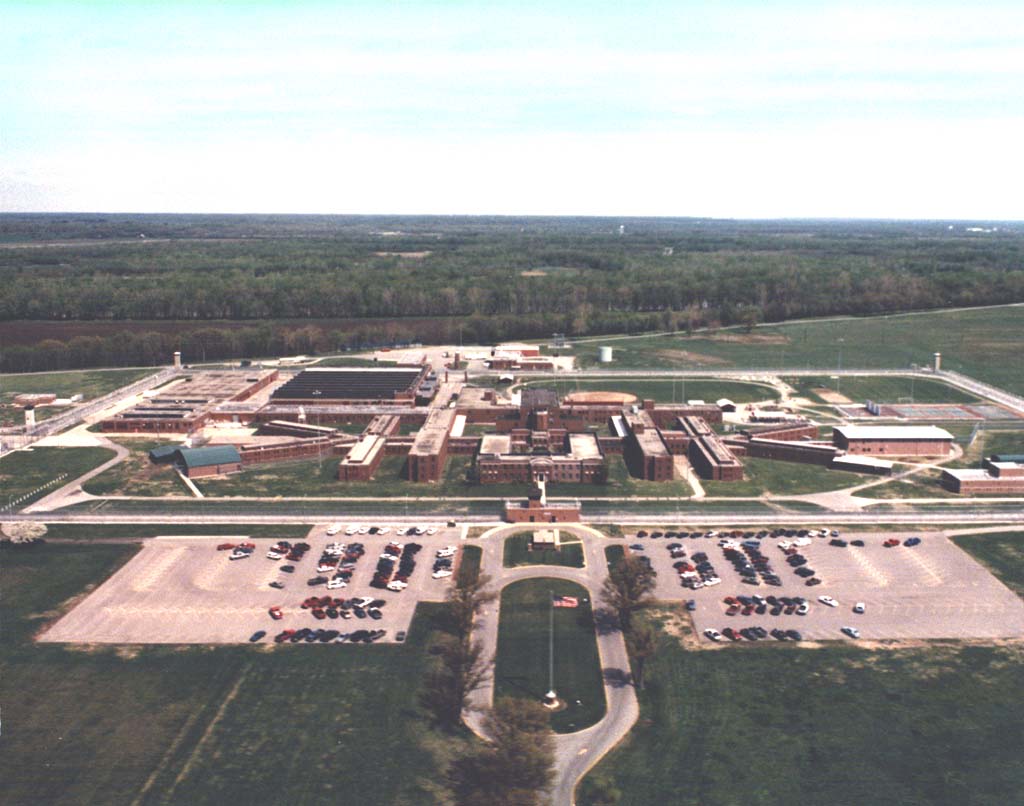
Aerial view of U.S. Penitentiary, Terre Haute, Indiana on May 7, 2001(Federal Bureau of Prisons Website photo)
Round my Indiana homestead wave the cornfields,
In the distance loom the woodlands clear and cool.
Oftentimes my thoughts revert to scenes of childhood,
Where I first received my lessons, nature's school.
But one thing there is missing in the picture,
Without her face it seems so incomplete.
I long to see my mother in the doorway,
As she stood there years ago, her boy to greet!
Still I'd give my future were she only here.
--from On The Banks Of The Wabash, Far Away, by Paul Dresser
The thing that will come to pass in just a matter of days is not what will be among my fondest memories of the town on the banks of the Wabash--Terre Haute, Indiana. Translated from French, Terre Haute means high ground.
It is populated by a little over 60,000 friendly, hard working, moderately conservative people. The Sony plant, Columbia Records--both on Fruitridge Avenue, and Indiana State University, are the three principle employers for a vast number of the town's residents.
Situated in Vigo County (population near 107,000) in the western section of Indiana, Terre Haute is some 75 miles west of Indianapolis and its 500 mile Motor Speedway.
Terre Haute came into existence in 1816 when a civil engineer by the name of William Hoggatt was hired by the Terre Haute Land Company to "lay out a site for a town."
After Mr. Hoggatt had selected a site, he was asked about his choice. He reportedly replied: "'Where I have selected the river runs straight, the land is high, a beautiful place for a town, if built here it will some day become a great city.'"
Whether Mr. Hoggatt's optimistic plans for Terre Haute to become a great city ever comes into fruition remains to be seen nearly 190 years after its inception. Though it is quite possible that it may well develop more of an infamous reputation for what is to occur there, south of town, in the early morning hours on May 16, 2001.
My memories are of a town that can be unrelentingly cold in winter with scorching summers accompanied by humidity soaring, at times, into the ninetieth percentile. Otherwise, it is a pleasant, uncomplicated place to live.
Although I didn't grow up in Terre Haute, my hometown is just a fifteen minute drive west on Highway 40, or Interstate 70. One can see more of how the land is laid out by taking Highway 40.
As a teenager, and without a drivers license or a car, my younger brother and a neighborhood friend of ours would spend an occasional summer's day in Terre Haute.
A Trailways Bus would take us there for fifty cents a piece round trip. This was circa 1964 or 1965. We would depart early on a week day morning, telling our parents that we'd planned to have hamburgers and french fries at the new McDonalds at Thirteenth and Poplar streets. That was only half of what we had in mind.
Afterwards, we would stroll another two or three blocks to the Indiana Theater on Seventh and Ohio street to see a movie we knew we would never be allowed to see had we sought permission from our respective parents. "The Amorous Adventures of Moll Flanders" and "Tom Jones" are two of the most memorable films we enjoyed there.
And I will always remember the first time I set eyes on the golden arch. Hamburgers were just fifteen cents then. With money earned from doing various chores at home, we could afford a lavish lunch of two hamburgers, french fries, and a milk shake each.
Terre Haute's bus station was the place I first had a hankering to see.
I once over heard my parents talking about the movie "Some Came Running", the 1958 film with Frank Sinatra, Dean Martin, and Shirley MacLaine. "Supposedly", my mother had said, "The bus station in Terre Haute is in the movie." While I'm still not altogether sure about that, Terre Haute is mentioned more than once during the course of the film. Dave Hirsh, Sinatra's character, goes there with Bama, Dean Martin, to play cards. Later, Hirsh's niece runs away from home and ends up in Terre Haute.
Hirsh finds her and sees her back home at the bus station. James Jones, the author of the novel of the same title that the film is based upon, grew up in neighboring Robinson, Illinois prior to enlisting in the army.
Robinson is just fifteen minutes west across the Wabash River. Just as I would later, James Jones most likely spent a lot of his youth on the streets of Terre Haute.
Though I was able to go and gawk at the almost famous movie location, my first experience there was not a pleasant one. On our first trip, my brother, our neighborhood friend, and I wanted to taste the chili dogs that the bus station was known for. Since it was still mid morning when we arrived, we were the only customers in the bus station's restaurant.
We decided to eat at the counter, where a careworn waitress, wearing a chili stained white uniform took our orders. I nearly lost my appetite at the sight of her, but our friend insisted we would miss out on a good thing if we left. I watched her wrap her stubby fingers around our hot dogs and drop them into boiling, hot water. I recall being thankful for the sterilizing capability of heat.
Once the waitress plopped our hot dogs, on buns buried in chili and onions, down on the viscous counter top, her demeanor changed. Before we could take our first bite, she gestured to the front and rear doors. Our friend asked what she meant by such a gesture. "I'm sorry, boys. But you can't eat 'em in here."
A harsh reminder of our African American heritage, to say the least.
Disconcerted, we had been too well brought up to be seen munching on the sidewalk out in front of the bus station like stray animals, so we reluctantly stepped outside at the rear where we were less likely to be discovered.
Our friend grew livid, hurling his chili dog slap up against a brick wall of the bus station. My brother and I were stunned by his reaction, though we understood. We sat with him and convinced him to consider not only the source of the insult, but the environment in which she inhabited.
Thereafter, with chuckles, my brother and I followed our friend's example and slammed our chili dogs into the same brick wall. Our signatures of protest, signed with chili and onions.
The foundation for the nonchalant attitude my brother and I maintained during our first visit to Terre Haute may be attributed not only to the wisdom of our parents, but by a man who came to the town on one hot, steamy Saturday morning in August, 1960.
He was on the Republican campaign trail for Richard M. Nixon, who was running for the presidency against the Democratic candidate, John F. Kennedy. He was somewhat an unlikely spokesperson for Mr. Nixon, since most African American voters were predominately Democrats and favored Mr. Kennedy.
My father had spent time with him at Fort Riley, Kansas in 1943. He described the man as being highly intelligent, competitive, generous, and kind. My father, along with the other African American army troops at Fort Riley, would play horseshoes, ping pong, and baseball with the man.
A natural athlete, he was always a winner in everything he competed in.
In April, 1947 this acquaintance of my father became the first African American to play baseball in the National League with the Brooklyn Dodgers. Needless to say, my entire family became loyal Dodger fans.
On that hot, humid Saturday morning in August, 1960, my father drove us to an African American church in Terre Haute to see and hear Jackie Robinson speak on behalf of Richard Nixon.
By that time, Mr. Robinson had been out of baseball for nearly three years. What I remember most about his speech was his emphasis on self reliance, perserverance, nonviolence, and the maintenance of a positive attitude even when confronted by what appear to be insurmountable obstacles.
He was the living example of all that he propounded.
Afterwards, his generosity still intact and prompted by my father, he signed autographs for my brother and me.
That particular moment that took place in Terre Haute over forty years ago shall always shine through any cloud that may threaten to hover over the town after May 16, 2001.
One need not see or meet a person of greatness in Terre Haute to think of it as a good place. But if it is necessary, one can, if a sports fan, recall that NBA basketball legend Larry Bird came into his own, playing for the Indiana State Sycamores. Otherwise, it was the birthplace of Theodore Dreiser, aka Dresser. He and his musically talented brother Paul Dresser were born in a house that still stands as a museum just off Third Street near Fairbanks Park.
Theodore is most notably remembered as the author of "An American Tragedy". It was made into the film "A Place in the Sun", starring Elizabeth Taylor and Montgomery Clift.
As times changed, I and all African Americans were able to patronize most eating establishments in Terre Haute: The Goodie Shop on Ohio Street being one of them. Long gone, my parents and I often ate Sunday dinner there after visiting a local church.
Honey Creek Square Mall is one of my favorite stops whenever I travel to Terre Haute these days. Two movie theater complexes are now located in the rear of the mall, across the street from one of its parking lots. Along with Indiana State University, there is Ivy Technical College.
Saint Mary-of-the-Woods College is a Roman Catholic college for women. Rose Hulman Institute, a private engineering college, is a few miles east of the town just off Highway 40.
In other words, Terre Haute is like any other Midwestern town, down to earth with plenty of decent places and people for those who are willing to seek them out.
As William Hoggatt, founder of the site of the town once said: "'...the river runs straight, the land is high, a beautiful place for a town.'"
Jefferson D. Dunbar, Jr. is a screenwriter in Los Angeles, California and a frequent contributor to The Idler.


