Click Here To Download
The Idler's Mobile Version

The Idler's Home Page and Table of Contents
The Idler's email list
To advertise in The Idler
Write a letter to the editor

(www.the-idler.com)
Volume III, Number 93

Click here to download chapters from Finish High School At Home by Charlie Clark





IN SEARCH OF LOST TIME WITH NICHOLSON BAKER
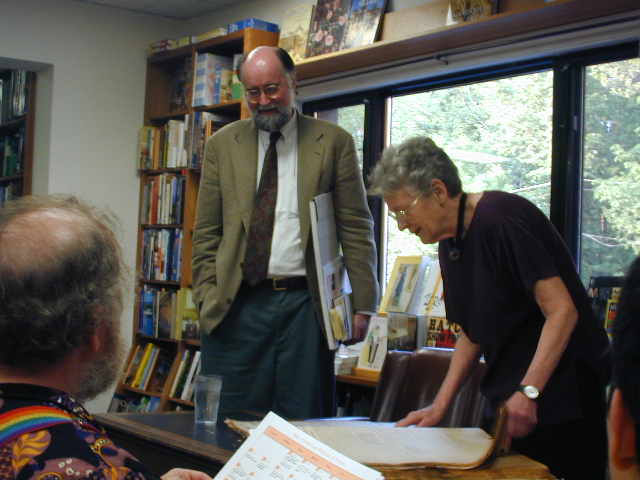
Nicholson Baker examines a 1917 San Francisco Chronicle volume, with Politics & Prose Bookstore co-owner Barbara Meade. (Idler photo)
May Day brought Nicholson Baker to Washington, DC, to read from Double Fold: Libraries and the Assault on Paper at the Politics and Prose Bookstore. In his new book, Baker argues that some two decades of federally-sponsored microfilm "preservation" have led to the widespread destruction of irreplacable, and historically significant, collections. In his remarks, Baker likened newspaper "preservation" to urban renewal programs of the 1960s. Expensive and doomed to failure, they were nevertheless unstoppable.
Andy Moursund, owner of the Georgetown Book Shop, was among the standing-room-only crowd. Two weeks earlier, Moursund had suggested Double Fold for a Pulitzer Prize on Amazon.com, concluding, "This book should be read, pondered, and discussed by everyone who cares about the future of books, and indeed about the future of memory."
Now, he presented Baker with a February, 1917 volume of the San Francisco Chronicle. An illustrated story about the then-new San Francisco Public Library building was marked with his business card, indicating a successful transfer of the entire collection.
An ironic reference to Baker's New Yorker article about the San Francisco library's contemporary move could not have been missed. Morsound's point was this: In 1917, at the end of World War I, San Francisco shifted all its books into a new building, with room to spare. Yet in the 1990s, as Baker documented, San Francisco librarians threw out thousands of titles while moving.
According to official reports, and a PBS documentary paid for in part by the Library of Congress and National Endowment for the Humanities, Slow Fires -- a film which was used to lobby Congress for millions of dollars (in violation of federal law and PBS guidelines) to support the shredding of books in the name of preservation -- the very newspaper Morsound gave to Baker should not have existed by the year 2001.
Yet, while the volume was yellowed, quite delicate, and its pages, some of them torn, needed to be turned carefully, it was eminently readable after eight decades. Reading the articles, one became drawn into a lost world, almost like exploring the remains of the Titanic.
So, silently on a table, stood an artifact which gave the lie to the claims of "preservationists" quoted in Baker's book.
Baker repeatedly said that he had nothing against microfilm or digitization -- he passed around some glossy digital photos of newspapers in his personal collection -- but thought that preservation of the past itself was worthwhile, as well as its other representations. He said he had established the American Newspaper Repository in the hopes that someone else would take over his collection in a few years.
Although Baker faced a friendly audience at Politics and Prose, there were a few critics in the crowd. Among them was a woman who said she worked in another branch of artifact preservation, at the Smithsonian. She at first suggested that Baker, perhaps best known for Vox, a novel about phone sex (that Monica Lewinsky purchased as a gift for President Clinton, according to the Starr Report), had fictionalized his new tale of book-shredding librarians.
Baker responded that everything he says in the book is true.
She then made another accusation, that Baker seemed "melancholy" about things being thrown away. Such emotion was clouding his judgment. Instead of protesting, Baker should realize that nothing lasts forever, all things disappear, that everything cannot be saved. The job of the preservationist is to discard the detritus, not to hoard artifacts.
Baker replied that he was not asking that every copy of a million-run edition of a newspaper be preserved, just that one copy be saved, somewhere.
The crossfire reflected an age-old conflict between those who use books and those who must maintain them, a professional deformation found among booksellers, librarians, and archivists. In Bookshop Memories, George Orwell concluded, from his part-time job in a bookstore, " . . . the real reason why I should not like to be in the book trade for life is that while I was in it I lost my love of books."
Orwell complained about "constantly dusting them and hauling them to and fro," grousing that "books give off more and nastier dust than any other class of objects yet invented, and the top of a book is the place where every bluebottle prefers to die."
So, when a federal program promised to pay librarians to take books off the shelves and replace them with microfilm -- they went for it with gusto. Even better, according to Baker's book, the mechanism of federal funding was enough to silence potential critics.
Apparently, based on Baker's interviews, it was understood -- though never stated explicitly -- that librarians who criticized the program might risk blacklisting. At least one witness went on the record, telling Baker that he kept his mouth shut, knowing the "preservation" program was a bad idea, because he did not want to risk his institution's ability to get grants. With any future support from federal agencies like the National Endowment for the Humanities, the Institute of Museum and Library Services, and the Library of Congress, not to mention cooperating private foundations at stake, no one dared rock the boat.
For example, George Farr, one of the apparent villians in Double Fold, is still an official at the National Endowment for the Humanities, responsible for dispensing millions of dollars in "preservation and access" grants to universities, libraries, and museums. In 1999, he served as acting deputy chairman for the entire agency. As of the date of this writing, he is still in charge of the "Brittle Books" program and "U.S. Newspaper Program," debunked so vividly by Baker, as well as the NEH's newer digitization programs.
But there is more to Double Fold than just muckraking, as became apparent in a discussion with the author, over dinner, following his book talk.
And what Baker is trying to do is far more ambitious than simply preserving old newspapers.
What he is up to, in a sense, is an attempt to recover lost time.
His memories are not just personal, like Proust's, they are also civilizational.
And in this regard, the yellowing newspapers Baker is saving are nothing more or less than the mummified remains of the American past. Reading old newspapers, in their original form, is a kind of time-travel that enables the participant to share almost the same kinaesthetic experience as an ancestor might have had upon opening a morning paper.(Jack Finney's stories of time travel such as the non-fiction Forgotten News: The Crime of the Century and Other Lost Stories and the novel Time and Again, were based on newspaper accounts [he is well-known as well for science fiction stories like The Body Snatchers, remade twice as a movie].)
Baker has written about the manipulation of time before, for example, in The Mezzanine, a book which takes place on a single escalator ride, and The Fermata, whose protagonist can actually stop time.
While Baker says he most enjoyed writing sections about the CIA and rocket scientists trying to preserve books with high-explosive chemicals, perhaps the most moving part of the book concerns Egyptian mummies.
Decades ago, there was a shortage of rag paper. To help satisfy demand, traders raided vast Egyptian necropolises, exhuming thousands of mummified corpses. Those that were not burned to provide fuel for steam engines were stripped of their cloth bandages. These wrappings, in turn, were made into paper which found its way, eventually, into American newspapers.
Now, it is pretty clear from the way Baker tells this tale that he thinks it a shame the cities of Egyptian dead were recycled into newsprint.
And it is also not very hard to see the parallels between the recycling of the mummies and the "disbinding" of old books and newspapers after they have been microfilmed.
Like mummies, old books and newspapers enable one to travel backwards through time. Just as a picture of a mummy does not convey the full experience of gazing at a human being who once lived, so looking at a microfilm of a newspaper does not capture the full lived experience of the time in which it was created.
And, among the mummified remains in old yellowing periodicals, can be found those of his Nicholson Baker's grandfather.
For Nicholson Baker is the direct descendant of Chicago newspaperman Ray Stannard Baker, who focused national attention on racial discrimination with his book Following the Color Line: An Account of Negro Citizenship in American Democracy. A legendary muckraker at the turn of the century, he worked with Lincoln Steffens and Ida Tarbell on McLure's Magazine -- as well as writing Adventures in Contentment, one of nine best-sellers, under the pen name "David Grayson." He later served as press secretary for President Woodrow Wilson at the Versailles Peace Conference, and authored the 8-volume Woodrow Wilson: Life and Letters , for which he won the Pulitzer Prize. He died in 1946.
On Amazon.com, John Cantrell from Aliso Viejo, CA, described how he came upon the works of the elder Baker:
"My first exposure to this book was ten years ago, when in the LSU library I stumbled upon some very old, very dusty books. Being intrigued by old books, I found his simple titles (Adventures in Contentment, Adventures in Friendship, Adventures in Solitude, etc.) irresistible. I read 5 David Grayson (Ray Stannard Baker's pseudonym) books in two days. I returned them to the library, then soon afterward moved to California. I could not remember Grayson's name, though I would tell stories about those wonderful books that influenced my life and my writing. 7 years later, I came across a 90-year-old copy of Adventures in Contentment, and found that it struck me as even more profound, having tasted a little of the cynical world that drove the main character from the city to the farm. This is the only book I have ever read that made me cry tears of human experience -- and then the very next chapter had me laughing out loud. (I was sitting at a coffee house with my friends when this happened, after which they wanted to borrow the book.)...Simply stated, this is the greatest literary work ever written. Unfortunately, modern literary critics refer to this type of work as unimportant, sentimental and preachy. So this book will probably never be placed in its rightful spot in the literary canon."
Since they are not in the "canon," students would not normally have been exposed to Ray Stannard Baker's works. Had these dusty volumes been "preserved" on microfilm alone, John Cantrell never would have found them -- by accident -- on the dusty shelves of his library.
That the works of Ray Stannard Baker came to life, for another reader in another generation, by happenstance alone, is due to the miracle of ink on paper -- and the traditional role of libraries as repositories for books.
As Nicholson Baker's Double Fold: Libraries and the Assault on Paper suggests, to wander from that path is perhaps to stray from civilization itself.


