Click Here To Download
The Idler's Mobile Version

The Idler's Home Page and Table of Contents
The Idler's email list
To advertise in The Idler
Write a letter to the editor

(www.the-idler.com)
Volume III, Number 84


Click here to download chapters from Finish High School At Home by Charlie Clark





WILL TED TURNER GET BACK TOGETHER WITH THE MOST IMPORTANT TELEVISION PIONEER WE'VE NEVER HEARD OF?: A Review of Me and Ted Against the World
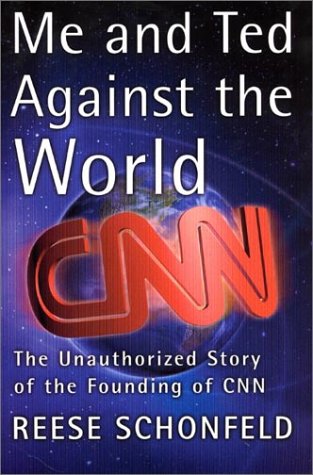
Reese Schonfeld is the man without whom there would be no CNN.
For that reason alone, he will go down in television history -- and due to CNN's influence on national and international affairs, probably world history as well. (After publishing this book, Schonfeld will also forever be known as the executive who turned down Oprah Winfrey for a job without looking at her videotape.)
How do we know that Schonfeld is the most important television pioneer we've never heard of? Not from his recent memoir, Me and Ted Against the World, alone.
His book gives the key that reveals why CNN is not just Ted Turner's baby.
And the clue is obvious once Schonfeld has pointed it out. Every other Turner network had Ted Turner's name on it: Turner Broadcasting System, Turner Movie Classics, WTBS. But even before Time-Warner eased Turner out, CNN stood for "Cable News Network."
Although Turner's explanation is that his was a marketing ploy to get cable operators to carry the signal, there is an overt similarity to the name of Reese Schonfeld's previous news operation: ITNA, the Independent Television News Association.
And that simple linguistic indication unlocks a fascinating story of Reese Schonfeld's little-heralded contribution to the evolution of television news.
Clearly Schonfeld was in the right place at the right time to take advantage of the growth of cable television and -- and the business genius of Ted Turner.
Schonfeld adopts a hard-news style for his book, written in some 93 short, to the point, no-fat, punchy, news-bulletin chapters -- recalling the original CNN style, just-the-facts-ma'am, no b.s. Just right for a man whose lifelong passion and profession has been hard news. (Schonfeld continued to update his chapters periodically on his website, MeandTed.com).
Like Ted Turner, Schonfeld is completely unpretentious. He says what he means, and means what he says. And he has a very simple moral to convey.
When CNN started, it was a rebellious, anti-establishment, tell-it-like-it-is kind of place. The two founders were both troublemakers who had been expelled from school. Turner had been kicked out of Brown for having a girl in his room, and Schonfeld was expelled from Harvard Law School for gambling (he later graduated from Columbia).
This attitude, this pugnacity, this chip-on-the-shoulder character gave CNN its edge in fighting every day to beat the networks at their own game. It helped stiffen the backbone of the two leaders, who never feared to sue the networks for things like access to the White House press pool, or for satellite transponders.
This pugnacious and competitive spirit enabled what the millionaire correspondents from the broadcast news operations called Chicken Noodle News to become the most authoritative and important news operation in the world. Indeed, CNN's credibility was so great that it was watched in newsrooms, government offices, and used to conduct international negotiations.
CNN would break the rules -- and eventually make the rules -- when it came to covering events all over the world. Among the more incredible feats was Rick Brown and his colleagues' international satellite network (based on Schonfeld's work at ITNA) that covered the globe 24-hours-a-day, bypassing network-controlled land lines. Truly, CNN created news for the global village.
But, according to Schonfeld's riveting account, CNN got in trouble when it strayed from its original mission of providing breaking news, in real-time, as it happened, from around the globe. The more the network tried to imitate the old media outlets like the Los Angeles Times, and broadcast dinosaurs like ABC News, the worse it got.
When Peter Arnett said he was going to write a book about CNN with Ed Turner (no relation to Ted), Schonfeld's successor, Schonfeld decided to publish his memoir.
In his introductory chapter, Schonfeld states his goal for the book. "I remember my plans for CNN and I would like to put on the record the difference between what CNN is now and what I dreamed it was going to be," he says.
Schonfeld never got the chance to realize his dream. Once CNN was up and running, Turner fired him. He went on to set up all-news local cable operations, as well as The Food Channel. But he kept an eye on his baby (and from reading this account, may have even kept a diary).
Turner comes across as a complex, fascinating, and sympathetic individual -- brilliant, eccentric, charismatic, but with some tragic flaws.
What went wrong seems simple: Turner decided he wanted to be loved by the establishment. As a result, he eventually got outfoxed in the Time-Warner-AOL merger, and pushed out from his own company, just as he had squeezed Schonfeld out of CNN years earlier.
While Schonfeld's story has lots of heroes, it is most interesting for its choice of villains. Two of the biggest appear to be Tom Johnson and Rick Kaplan, who appealed to Ted Turner's need for acceptance, after years of fighting the establishment -- at one point with allies such as Rev. Jerry Falwell (recalled as inspiring Turner to smoke a joint after a meeting).
Johnson, a former Democratic party operative and aide to Lyndon Johnson, came to CNN from his post as publisher of the Los Angeles Times -- a newspaper known as the "velvet coffin" by West Coast journalists, due to its dull content and suffocating corporate style. But he brought with him prestige and standing in national politics as well as the world of journalism.
Unlike Turner, Johnson appeared to be eminently respectable. Johnson comes across in Schonfeld's book as a smooth corporate operative, whose "company man" tactics lead to the demise of the original dream.
Kaplan, likewise, appears to be associated with CNN's decline in credibility. He pulls hard-news programs and replaces them with documentaries, he replaces CNN veterans with network types. Most significantly, he worked with Johnson on a documentary about Operation Tailwind, hosted by Peter Arnett, which accused the American military of using poison gas against deserters during the Vietnam War.
However, according to Schonfeld, when veterans and others protested the report, claiming that it was not true, Johnson and Kaplan fired the producers, Jack Smith and April Oliver, blaming them for decisions which they had approved, and forced out Peter Arnett as well (Arnett has risked his life for CNN during the bombing of Baghdad in the Gulf War).
When the military advisor sued CNN, they settled with him. Then, when Oliver sued, CNN settled with her. Jack Smith's suit is still pending.
To Schonfeld, himself a lawyer, such payoffs seem to be the end of the road. Not only did CNN air a report it could not stand behind, but then it apparently paid people off, to get them to go away.
There is a ray of hope at the end of this sad story. Schonfeld believes Turner has established a "government in exile" staffed by former CNN executives. With billions of dollars, Turner is in a position to try a new gamble. And in one sense, this book reads like a letter to Turner, asking for a piece of the action.
What else should one make of the concluding sentences of Me and Ted Against the World?
"I'd hate to see Ted left with a pile of money and nothing else. In 1999, Ted said he didn't care about money. It was only the way the world keeps score. The score doesn't count until the game is over, and Ted shouldn't give up the game."
Perhaps, once again, it might be Reese and Ted against the world.
Stay tuned.


