Click Here To Download
The Idler's Mobile Version

The Idler's Home Page and Table of Contents
The Idler's email list
To advertise in The Idler
Write a letter to the editor

(www.the-idler.com)
Volume III, Number 79

Click here to download chapters from Finish High School At Home by Charlie Clark






DANTE REDISCOVERED
By Dennis Loy Johnson
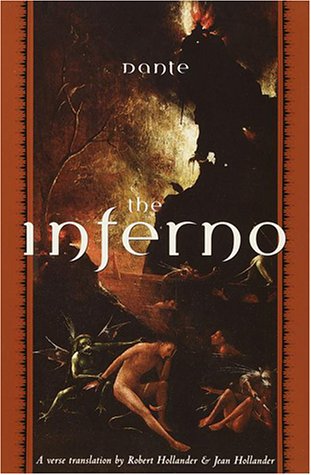
For a guy who's been dead for 700 years, Dante Alighieri is having a great spring. There are new books out about him, new translations of his work, even an expensive art book featuring illustrations for the entire Divine Comedy, his epic trilogy that begins on Good Friday with Inferno, progresses to Purgatorio, and ends on Easter with Paradiso.
None of which fuss would have surprised Dante. After all, in the fourth canto of the Inferno, he lists himself as one of the six greatest poets ever (alongside Virgil, Homer, Ovid, Horace and Lucan).
The poet's personality, on the other hand, is what often surprises readers, and makes Dante's work more accessible for the casual reader than they might expect. Not that Dante's an easy read — and who says good reading should be easy, anyway? — but he's not the formal, remote voice you'd expect in a Renaissance writer, either.
In fact, as a new translation of the Inferno shows, Dante's poetry is highly autobiographical, and revealing of his personality — he is at times angry, and sentimental; transparent in his grudges, and stirring in his allegiances. He often soars to inspiring heights, and on other occasions resorts to potty humor. (See canto XXI.)
Robert Hollander, co–translator of the newest Inferno, says Dante "can be as simple and straightforward as one's country neighbor, or as convoluted as the most arcane professor."
As translated by Hollander and his wife, poet Jean Hollander, Dante is, perhaps, less complicated than elsewhere — that is, they present the poem in only a simulation of its original terza rima (three–line stanzas interlocking in rhyme patterns of aba, bcb, cdc, and so on). The rhyme scheme is the greatest challenge to translators of Dante, and many have despaired of capturing simultaneously his meaning, meter and rhyme. In fact, one of the most esteemed translations, that of John D. Sinclair, is rendered in prose. And for his lively translation two years ago, Robert Pinsky explained that to avoid "bending the idiom ruthlessly" to provide exact rhymes, he used "Yeatsian" rhymes — rather than pursue "hard rhymes" such as "stone" and "bone," say, he sought line–endings that shared sounds, such as the shared "b" sound in "gibe" and "club."
The Hollanders' approach is to keep the three–line stanzas but abandon the rhyme entirely, and it seems a wise choice. They convey a keen sense of the narrative and of Dante's opinionated voice, and if they forfeit the rhyme, they nonetheless impart a strong sense of meter, and of a poetic shape both intimate and epic.
The scholarship here is also impressive, in both an illuminating introduction, and exhaustive annotations of the Italian political arcana that informs Dante's trip through Hades (where, as it turns out, he encounters most of his enemies). In those lush particulars lie the universal, made particularly gripping in this translation.
The universality of Dante's idiosyncratic observation is something that comes up often in The Poet's Dante, an essay collection edited by Peter Hawkins and Rachel Jacoff, wherein an amazing array of major poets discuss Dante's influence.
Ezra Pound compares him to Shakespeare, and so does Charles Wright ("one was deep," he writes, "the other wide"). T.S. Eliot gives insight into why his poem "The Wasteland" opens by quoting Dante. Robert Lowell suggests that Dante's genius "is that his chief characters are not heroically enlarged, but life–size." And James Merrill admits he never read Dante before he encountered the quote opening "The Wasteland." The compendium is a wonderful opportunity for both generalists and more focussed academics to enhance the poet's resonance by particiapting in a virtual workshop on his work.
Enlightening the text in another way is Sandro Botticelli: The Drawings for Dante's Divine Comedy, edited by Hein–Thomas Altcappenberg , a sumptuously–made book with numerous color plates and excellent accompanying essays. It's a remarkable accomplishment in itself — the first time in 500 years that all 91 of Botticelli's surviving Dante drawings have been brought together.
Originally commissioned by Italy's famous art patrons, the D'Medicis, to illustrate the Divine Comedy, Botticelli, one of the key figures of Renaissance art, abandoned the job when his patrons fled an Italian civil war. Individual drawings were subsequently sold into collections across Europe.
But what has survived to be gathered here — represented by a full–color plate and details of each drawing — is magnificent. Botticelli's fluid line, married to an astonishing narrative sense, gives the Divine Comedy a powerful visual form. Each illustration appears side–by–side with a summation of the canto it portrays, highlighting Botticelli's unique ability to represent the entire narrative of a canto in one picture.
Equally remarkable, albeit in a quieter way, is the single sonnet by Dante that appears in Sonnets: From Dante to the Present, edited, once again, by John Hollander. This small but elegant collection pays homage to the form of which Dante was one of the first practitioners, and reminds us that his talents were both lyric and epic.
And it reminds us, too, that each of these books represents another way to discover Dante . . . or to discover him anew.
Syndicated newspaper columnist Dennis Loy Johnson runs the literary Website MobyLives.com.


