Click Here To Download
The Idler's Mobile Version

The Idler's Home Page and Table of Contents
The Idler's email list
To advertise in The Idler
Write a letter to the editor

(www.the-idler.com)
Volume III, Number 69




PANNING FOR GOLD IN THE LETTERS TO THE EDITOR COLUMN By Charlie Clark
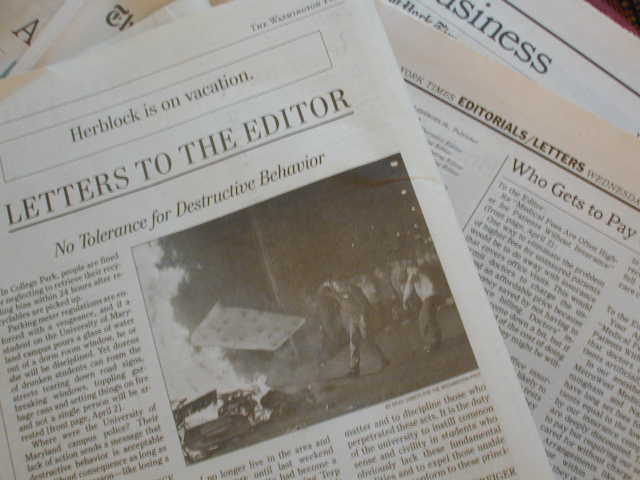
Before you finish this essay, you will be inspired (through my powers of hypnosis) to put fingertips to keyboard and participate in that civilized practice known as writing a letter to the editor.
Any publication will do, so long as you intend your words for public consumption.
The composing of such letters is therapeutic, it informs fellow citizens, and it provides free copy to hungry editors, be they pooh-bahs or peons in the hierarchy of publishing.
True, not all readers are dedicated enough to actually read your letters. But I believe that future historians looking back on our times will scan the letters columns to soak up the flavor of the vox populi.
Why miss out on this long-term opportunity to manipulate history to your ends?
Nothing has sprung open the centuries-old institution of the letters columns like the Internet. In the old days, newspapers allowed readers a leisurely two or three weeks to get it together and traverse the U.S. mail with a missive of argumentation.
Today, e-mailed letters to many newspapers appear as soon as a day after a thought-provoking article. (Advance posting of articles on daily newspaper Web sites has prompted a vow by one friend of mine to place a letter responding to a New York Times article in the same edition.)
At the Arlington Journal, for example, e-mailed letters are welcome because ``they can be put right into the system," says Opinion editor Barbara Hollingsworth. ``But we still get letters that are handwritten, typed, mailed and faxed." Though The Journal has no set time frame on letters, Hollingsworth said, it might reject those on subjects that have been ``done to death."
Her acceptance policy favors a geographical balance and the right of reply to someone who has been attacked. ``The selection is more art than science," she adds.
Fred Hiatt, editorial page editor of the Washington Post, told me that his team began accepting letters via e-mail ``because the convenience is helpful to them, and the immediacy is helpful to our readers. This is especially so when there's hot news breaking, as during the [recount] decisions in Florida."
The Post strives to give preference to Washington-area writers, though e-mail makes this easy to lose sight of. ``We try to save some space on the page for people who write the old-fashioned way," Hiatt adds.
Newspapers are most apt to print letters that rebut editorials or other opinion pieces, criticize public officials, or publicize a neglected cause or point of view.
Contrary to popular perception, editors are not ``scared" to print a letter that criticizes one of their articles. Conflict, in fact, is considered a good read.
My experience is that more readers are moved to write by articles that outrage or disgust than are moved by articles that please.
In the Washington Post, I've noted that readers who write in to point out the smallest of errors often use their rare public opportunity to vent general hostility toward the paper. A New Yorker cartoon once showed a man sitting at his typewriter with a lemon-sucking scowl on his face as the opening line of his letter began, ``I was amused to read...."
Such belligerence, however, pales next to The Arlington Journal's notorious SoundOff column, a daily graffiti wall of drive-by insults. In contrast with a thoughtful letter to the editor, some of these anonymous transcribed calls strike me as a disservice to the hometowns to which they're attributed.
Many of the Soundoff callers seem so daffy, they probably phone in the next day with the opposite opinion.
Yet, I read SoundOff. As a reader of letters, I've admired the nicknames publications give their letters columns: ``Backtalk," ``The Mail," and, in Rolling Stone magazine, ``Correspondence, Love Letters and Advice."
In my memory bank lives a letters-to-the-editor hall of fame. There was the determined Dr. Nestor who years ago wrote to area newspapers, announcing his efforts to thwart highway speeders by driving in the left lane at exactly the speed limit, giving traffic engineers the term ``Nestorism."
Then there was the letter to my high school paper that criticized some peculiarity of school dance policy before adding, ``P.S. The student government should be abolished."
And most recently, there was a charming stand-alone in the New York Times in which a guy, 20 years out of high school, described visiting his old English teacher in the hospital.
She was in bed wearing an oxygen mask when he greeted her with, ``Miss Sullivan, it's me, Dan Greenberg."
Without missing a beat she corrected him: ``It is I."
Charlie Clark is the author of Finish High School At Home, a columnist for the Arlington Journal, and a frequent contributor to The Idler.


