Click Here To Download
The Idler's Mobile Version

The Idler's Home Page and Table of Contents
The Idler's email list
To advertise in The Idler
Write a letter to the editor

(www.the-idler.com)
Volume III, Number 66






CARLO GOLDONI'S MIRANDOLINA: A Commedia of Errors
By Alexander C. Kafka
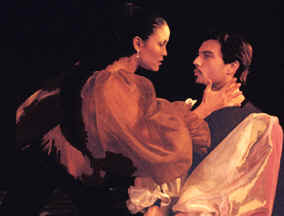
Arlington, Virginia's Classika Theatre's staging of Carlo Goldoni's Mirandolina will amaze and inspire you.
It will amaze you that people would actually spend precious time and energy mounting such an atrocious production, and it will inspire you to upgrade your cable programming options.
Goldoni was an 18th-century Italian dramatist who revolutionized his nation's theater, transcending the stock conventions of commedia dell'arte by imposing a multidimensional and witty realism of plot and character. The plays he wrote for the Teatro Sant'Angelo and the Teatro San Luca are tales of credible lives and manners instead of commedia's masked farce and clownishly stylized intrigue. Engaged in a rivalry with playwright Pietro Chiari, Goldoni was also ridiculed and satirized by Carlo Gozzi, the foremost proponent of the commedia style and the popular author of fairy dramas. Goldoni, disgusted, left his homeland for Paris, where he continued writing plays, as well as his well-received memoirs, and tutoring the French royalty in Italian. He became blind and, after the revolution, was stripped of his pension, and he died in abject poverty.
So how does Classika Theatre choose to honor the visionary writer who both overturned and built on the commedia tradition?
By mauling his script and presenting its remains in, what else, the style of commedia dell'arte!
In her program note, Inna Shapiro, the company's artistic director, and the production's script adaptor and director, explains that from the start, she wanted to present Mirandolina, the tale of an innkeeper and three male guests who have a romantic interest in her, in commedia style.
"The problem was," she says, "that I had quite a limited knowledge of that style...And this particular play was not written in this style anyway--Goldoni was the first Italian playwright who changed the Italian theater from Commedia Dell'Arte to 'realistic' theater. But I still wanted somehow to implement this style in our production. A few months and four huge books later, I've come to the conclusion that that style was not much more than the circus of our time, simply with some story underneath it."
Well, it's hard to argue with logic like that.
And it's hard to know who'd be more upset--Goldoni, for what Shapiro has done to his play, or Gozzi, for her interpretation of commedia. (You wonder which four big books she read.) In any case, those gentlemen really have nothing to do with Shapiro's bizarre project. For though the production is billed as Goldoni's play, once you get to the cramped black-box theater, you discover that the staging is in fact only "based on a play by Carlo Goldoni" and "originally adapted and directed by Inna Shapiro." Based on, that is, in the same sense that you'd be basing an evening on Romeo and Juliet if you took a copy of the script, threw it on your coffee table, and put your muddy hiking boots up on it while scarfing down malted milk balls and watching XFL football.
It gets worse, because her commedia is not only not commedia, but not even circuslike, at least not in the sense she intended.
Despite Harlequin outfits straight off the racks of the Acme Costume Shop, Shapiro's idea of commedia-cum-Barnum amounts to silly, endless pantomimes before each act that vaguely foreshadow the action to come.
Mirandolina (Amy Hard) is pursued by a Marquis (Stephen Shetler), who is boastful, snobbish, and stingy; a cocky Count (Robert Weinig), who flaunts his money by showering the innkeeper with extravagant gifts; and a Cavalier (Dave Baxter), who is a misogynist. "Women," he bellows, "...are a contagious disease, and once you have it, you can never get rid of it." Used to capturing the heart of any man she wants, Mirandolina considers the Cavalier a challenge and proceeds to hunt him by wit, wine, tears, seduction, and swooning, among other wiles. He, in turn, is in denial about the effectiveness of her efforts. Fabrizio (Josef Vilanasco), is Mirandolina's right hand and also, by the wishes of her late father, her intended. And played as pawns in the principals' sexual strategizing are Ortensia and Dejanira (Christine Herzog and Hanna Bondarewska, respectively), actresses masquerading as ladies of title.
It's a promising plot scheme, an enlightenment setup somewhat akin to Cheers, with Sam and Diane as the Cavalier and Mirandolina. And produced as originally intended, it probably would have bite and weight. The world can always use another considered commentary on pride vs. pleasure, faith vs. solitude, and appearance vs. reality in matters of class and romance. But you'd never glimpse such assets in Classika's chaos. With more preening and false gaiety than a puppet show for toddlers, it has not an ounce of sincerity. And the several micromoments polished enough to catch your eye--for instance, an intriguingly blocked tango dialogue between the Cavalier and Mirandolina--don't work anyway, because they are so ill-conceived. The tango is one of many anachronistic flourishes--which also include a wrestling match with a miked announcer, cheerleaders, a Vegas-style crooner, and so on--that we imagine Shapiro intended as savvy postmodern angles on the plot. But the plot, in her anorexically minimalistic and colloquial adaptation--is so skeletal to begin with that there's nothing to have an angle on.
With the cast members in form-hugging, shiny leggings and leotards, throwing themselves into pratfalls and more bumping and grinding than you'd see in an Alek Keshishian Madonna documentary, you'd think the show, at the least, would be a little sexy. But it's even less sexy than it is involving. Aiming for something like an Ally McBeal outrageous cutesiness, the players, one and all, seem so very pleased with themselves that there's no room, even were there cause, to be pleased for them. Accompanied by canned music--mostly hokey arrangements with balalaika--the production's like a dreadful high school talent show with a soundtrack of Russian Muzak.
By the end of the play, there's supposed to be some melancholy element in Mirandolina and the Cavalier's having duped themselves out of happiness, But at Classika, they never mattered enough to us to care. When all the characters' hearts sink down to earth and their unappetizing fates are sealed, the Marquis and the Count protest, one last time, their undying love for the innkeeper, and the fed-up Fabrizio chides, "For Pete's sake, cut it out." The phrase comes as a tremendous relief as we, at last, are allowed to bail from this amateur hour that has lasted, unfortunately, two hours.
Alexander C. Kafka is a contributing writer for Washington City Paper, where this review first appeared. Reprinted by permission.


