Click Here To Download
The Idler's Mobile Version

The Idler's Home Page and Table of Contents
The Idler's email list
To advertise in The Idler
Write a letter to the editor

(www.the-idler.com)
Volume III, Number 54






POLLOCK:A GUIDE FOR THE PERPLEXED
By Alice Goldfarb Marquis
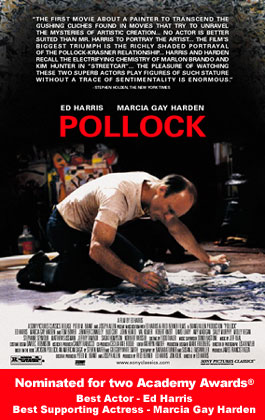
I. Pollock, The Movie
Is it worth sitting through Pollock, a two-hour downer, featuring a sullen, abusive drunk who dribbled paint for fame and fortune?
Yes, if only to admire the artistry of Ed Harris as he gracefully pirouettes, dripping paint, and equally adeptly smashes furniture.
He owns the persona of Jackson Pollock more than the real man: perhaps only a superb actor could master the violence that possessed the artist.
As Pollock's wife Lee Krasner, Marcia Gay Harden suffers admirably through a thankless role, humoring, coddling, protecting, cajoling, and promoting a viciously impulsive character who became America's first internationally known artist.
The only relief from Jackson and Lee's joyless dance of dependency and betrayal comes from the 40s New York art bashes re-created in the film.
Here the heiress Peggy Guggenheim cradles her beribboned lap dog as she minces imperiously around her gallery, Art of This Century. In the crowd, we find Howard Putzel, Peggy's effete talent scout, a rotund lap dog himself; James Thrall Soby, the Museum of Modern Art's outreach to the wild side; Willem de Kooning, the Pollock contemporary who may well outlast Pollock; and, most entertainingly, Clement Greenberg, who almost single-handedly puffed Pollock to the art summit.
The movie conflates the art dicta of "Clem," a hard-bitten New York intellectual, who favored this farmyard nickname. Many of his on-camera statements about what is or is not art were handed down long after Jackson Pollock self-destructed.
And while the movie could not help showing us the artist drinking himself senseless, it recoiled from showing the alcoholic's inevitable miasma of vomit, piss, and feces.
Clearly the people who struggled for ten years to produce this movie had enough on their plate without speculating on the deeper motivations of Jackson Pollock and those around him.
Nor is a movie an idea vehicle for an art critique. Furthermore, one demands too much of a movie by asking that it delve into the spirit of a moment in history, and tease out why a certain public of that time was enchanted by a particular art.
What follows is an effort to bring that sort of perspective to "Pollock."
II. Pollock, The Man
"I was born in Cody, Wyoming."
Jackson Pollock invariably opened every interview with this announcement. Then he would fall silent, seldom volunteering that his family left this picturesque paradigm of the Old West in 1913, when he was ten months old, for a hardscrabble odyssey through dusty farm towns in Arizona and California.
Though he never returned to Cody, his origin there was supposed to convey his identification with "the wildness & virility of the American frontier, even if it wasn't his real heritage," writes a biographer, Deborah Solomon.
At the age of sixteen, Pollock was expelled from Manual Arts High School in Los Angeles. A year later, he was permitted to return, only to be expelled again in 1929 for distributing leaflets critical of the school administration.
Turning briefly to another common stereotype of that time, Paul Jackson Pollock boasted to his brother that the school considered him "a rotten rebel from Russia."
In 1930, after crossing the country with his two older brothers in a $90 1924 Buick touring car, Pollock dropped Paul from his name. This emphasized the Jackson, with its frontier connotations of Jackson, Wyoming, not to mention the roughhewn association with Andrew Jackson.
He enrolled at the New York Art Students League, where he studied with Thomas Hart Benton, a Missouri-born muralist whose work romantically dwelled on the American Scene, especially the rural world of the west, its cowhands, its campfires, the silences of its people masked by the thin plaint of a harmonica.
Jackson Pollock could not draw, would never learn to draw and retreated often into glum silences, along with protracted drinking bouts. Still, his four older brothers, all aspiring artists, as well as the Bentons, protected him as though he were a disabled child.
Members of New York's tiny avant-garde art world during the 30s and into the 1940s naively looked at paintings, heatedly discussed styles, and struggled to float, artistically and financially, in a philistine sea. Through the WPA art projects, the American art community thrived as never before, as artists, including Jackson Pollock, received small stipends for producing what eventually became unmanageable mountains of paintings, murals, prints
However, no serious art critic or museum curator believed that the American artists so industriously churning out product were anywhere near the cutting edge of modernism. That, for almost a century, had been in Paris.
But suddenly, shortly after the Second World War ended, a few critics began to discern a new art movement, based in New York, which they found so original and dynamic as to replace Parisian supremacy.
A French critic, Serge Guilbaut, described the phenomenon with understandable rage. How New York Stole the Idea of Modern Art is the title of his diatribe. He argues that American post-war painters vaulted to international dominance because their loose, abstract style demonstrated the freedom of American artists and was a weapon in the Cold War. Most art historians, however, see the Abstract Expressionists, among whom Jackson Pollock was the most prominent, as part of the long history of modernism which began with the Impressionists and which embraces as well what today is called post-modernism.
The triumph of American painting, as Irving Sandler, the group's leading chronicler described it, was far more, however, than a new twist in the kinky skein of modern art. Nor was the shift of avant-garde art from Paris to New York a simple change of venue. Beyond a stylistic change, it meant a revolution in the ways art was marketed, in the kind of audience to which it appealed, and in the meaning of art within the national culture.
For, the Abstract Expressionists presented not only their art, but themselves as icons of creative imagination. Their paintings were said to be reports from an inner war zone, material traces of desperate struggle to bring inchoate emotions to sublime reality. Their subject, they proclaimed, was the picture itself, clawed and lashed with the frenzy of creative passions. While each artist's confrontation with the canvas was a lonely one, the practitioners of this painting style were pleased to share their solitary agonies with the rest of the world.
In fact, they invited the mass media to witness their travails with a zest that earlier American artists or Europeans would have shunned, but which more recent artists elaborated with even more inventive élan.
III. Pollock, The Myth
In May 1950, for example, the Metropolitan Museum of Art announced plans for a juried exhibition, "American Painting Today." The very next morning, The New York Times received a letter from eighteen avant-garde painters and ten sculptors, denouncing the museum's juries for being "notoriously hostile to advanced art."
The letter, embedded in an article about its signers appeared on the front page. The more conservative New York Herald-Tribune published an editorial chiding "The Irascible 18" for distorting facts -- but the names were all spelled right -- and Life magazine soon scheduled a photographer to snap a group portrait of "The Irascibles."
The magazine wanted the artists to pose on the steps of the Met, carrying their canvases. But Barnett Newman, who had organized the protest, decided this would be undignified and instead arranged for the irascible eighteen to be photographed in a rented studio, dressed "like bankers." The seventeen graying and balding middle-aged men, in dark suits and ties who soberly pose in Nina Leen's photograph reassured the magazine's 5 million subscribers that these folks were no threat to established values. The lone woman in the picture, Hedda Sterne, wore a decent black cloth coat for the photo; the only reminder that they were artists is her black beret.
In the very middle of the group stood Jackson Pollock.
"Gamely he turns his head over his shoulder and raises a cigarette," writes biographer Solomon. "He is as handsome as Gary Cooper." When Newman had telephoned for Pollock's backing of the original protest, his wife, Lee Krasner said he could not be disturbed; later he did send a telegram of support. Despite this marginal role, Pollock had no qualms about taking his place in the center of the group, for he was by far the most famous member of it.
A year earlier, Life magazine had ushered Jackson Pollock from underground notoriety into the spotlight of national celebrity. When Life's photographer, Arnold Newman, arrived at Pollock's ramshackle studio in The Springs, Long Island, the artist tried to borrow $150. Though Newman refused to loan him the money, Pollock allowed him to photograph what he had previously forbidden anyone even to witness -- his pirouettes of paint, his dribbles and slashes on a canvas-covered floor, the hallmark of his work.
As early as 1945, the critic Clement Greenberg had deemed Pollock "the strongest painter of his generation," rejoicing that "he is not afraid to look ugly. All profoundly original art looks ugly at first." But those comments went to the few thousand readers of The Nation.
Other avant-garde critics had been equally admiring, beginning with Pollock's first exhibition in 1943 at Peggy Guggenheim's Art of This Century Gallery in New York.
His talent was "volcanic, lavish, explosive," wrote James Johnson Sweeney in the catalog, reveling in the artist's "freedom to throw himself into the sea."
The more traditional critics either ignored or mocked Pollock's work. "What it means or intends I've no idea," wrote one experienced critic. Another suggested that his pictures resembled baked macaroni.
The Life article, however, was not so much about the art of Jackson Pollock as it was about his personality. His wife, Lee Krasner accompanied him to the magazine's offices, where an interviewer struggled to extract a text from this singularly taciturn man. He evasively twisted his hands and let Lee explain what he meant. "Is He the Greatest Living American Painter?" asked the magazine's headline. The text, even with Lee Krasner's eager elucidations, revealed little. In a style that hovered nervously between awe and derision, the anonymous author assembled two paragraphs which started out with, "Jackson Pollock was born in Cody, Wyoming," and included another often-quoted ambiguity: "When I am in my painting, I'm not aware of what I'm doing."
The photographs presented an anti-heroic figure reminiscent of James Dean or Marlon Brando. Jackson glowered before a great tangle of painted drips, his arms crossed, his brow furrowed, and the stump of a cigarette dangling from his lips. The caption noted that the painting behind him was three feet high and eighteen feet long, and added that "Critics have wondered why [Pollock] stopped when he did. The answer: his studio is only twenty-two feet long."
Other photos show him leaning athletically over the canvas, pouring paint with religious intensity, a noble savage engrossed in a ritual.
The photographs accomplished far more than simply conveying the content of Pollock's art. They hopelessly blended the image of the artist into the images he created. And because the image of the artist was so familiar, so powerfully and patently American, the bizarre, crude, violent, insolently baffling art slipped into public acceptance.
More than tolerance, the image of Jackson Pollock evoked affection through many of the same communal dreams and fantasies which underlie the stunning success of the Marlboro man, one of the most enduring icons in the pantheon of advertising.
The cowboy associated with Marlboro cigarettes was concocted to counter the effeminate image then attached to filter cigarettes. The campaign began in 1955 and, interestingly, was not developed on Madison Avenue, but by Leo Burnett in Chicago, where, some say, the West begins. T
he image purveyed by and for Jackson Pollock also countered a common perception of artists as sensitive, effete dabbers of paint.
An advertising image is, of course, a conscious, sophisticated manipulation of the public's fantasies and desires.
The image Jackson Pollock presented was a product of his own personality, augmented and amplified by his wife, by the critics who discovered him and, finally validated by the public -- not to mention the art market -- because of its close fit with the most enduring hero of the American imagination.
"The making of the illusions which flood our experience has become the business of America," Daniel J. Boorstin lamented in 1962 in a bitter tract deploring Americans' preference for image over substance. "We have willingly been misled into believing that fame -- well-knownness -- is still a hallmark of greatness," Boorstin went on. "The household names ... who populate our consciousness are with few exceptions not heroes at all, but an artificial new product -- a product of the Graphic Revolution in response to our exaggerated expectations."
The media image of Jackson Pollock was one of these artificial new products. The art lurked behind the presentation of the artist as a Marlboro Man, a stereotype borne out only superficially by the man himself.
The real Pollock's alcoholism was so severe that he was hospitalized many times, once for seven months.
He was treated for years by psychiatrists who diagnosed underlying schizophrenia but who were unable to break through his silent, self-pitying resistance.
His personality alternated madly between violent aggression and meek indecisiveness.
Thus, he would lurk at The Cedar Bar, where the Abstract Expressionist artist gathered, and greet important arrivals with, "Who the hell are you?"
To women, his favorite salutation was, "You're a fucking whore."
Yet when Peggy Guggenheim's chubby, truly effete factotum, Howard Putzel, created a mock interview to publicize Pollock's first one-man exhibition in 1944, the artist mildly allowed himself to be quoted: he was "very impressed with the plastic qualities of American Indian art."
Putzel ghost-wrote quotes for Pollock suggesting that his work contained "references to American Indian art and calligraphy," but modestly allowed that this "wasn't intentional; probably just the result of early memories and enthusiasms." In 1947, the critic Clement Greenberg helped Pollock to apply for a Guggenheim Fellowship. "I believe the easel picture to be a dying form," the critic wrote in the artist's name.
This was a notion Greenberg frequently expressed in his own name in the pages of The Nation.
When his analyst was Jungian, Pollock agreed that he found Jung helpful. At yet another interviewer's prompting, Jackson willingly agreed that "we were all Freudians."
These and other erudite statements purportedly emanating from Pollock have been widely quoted as evidence of the profundity lurking beneath the artist's loutish, narcissistic, foul-mouthed veneer.
Many observers have noted Lee Krasner's role in elaborating this myth of Pollock's sensitivity and cultivation, a diamond in the rough. She was the source for such statements attributed to him as, "I choose to veil the image," and "I am nature." She also portrayed her husband as a connoisseur of classical music as well as of jazz, and as an avid reader.
"I just don't think that was the scene," said B. H. Friedman, a friend and early biographer of Pollock. "Jackson was not involved with serious music and he was not a literary man and he was not an intellectual." Barnett Newman, the acknowledged ideologist of the Abstract Expressionists would often harangue Pollock with abstruse art theories. Jackson would gruffly interrupt, shouting "Barney, you know what I think? You're a horse's ass."
Clearly Pollock had little use for intellectual -- or even aesthetic -- rewards; rather, he worshiped at the altar of America's traditional god -- Mammon.
Robert Motherwell remarked that Pollock was the first artist he had met "who mostly talked not about art but about money."
After the Life article appeared, Pollock gave up his wheezing Model A Ford and spent $400 on a suitable symbol of his new status: a 1941 Cadillac.
Tony Smith, an artist whom Pollock consulted about the purchase commented that "Jackson was a straight American boy. He wanted what most people want." And a biographer adds, "He just wanted it more."
Beyond money, many of his colleagues remarked on his inordinate, childish passion for fame. He kept a stack of the Life articles in his kitchen and pressed them upon everyone he met.
In the summer of 1950, a Pollock painting was the sensation of the Venice Biennale. The artist received an Italian magazine containing a review on the day his family arrived for its first reunion in seventeen years. While his four brothers and his mother entertained themselves in the living room, Jackson pored over the article at the kitchen table grasping at the sleeve of anyone who came near to ask if they could translate it.
Time magazine did so in its next issue, quoting, "Chaos. Absolute lack of technique, however rudimentary. Once again, chaos."
To which Pollock angrily cabled: "Sir, no chaos, damn it. Damned busy painting as you can see by my show coming up Nov. 28."
The bright light of renown attracts its own buzzing satellites.
A young free-lance photographer, Hans Namuth, built his own reputation by gaining access to Pollock's studio. His poses of the artist ostensibly at work appeared in Harper's Bazaar, Art News, The New York Times Magazine, and Life.
Soon Pollock agreed to make a film, and Namuth appeared at the artist's studio every weekend and crouched under a large glass pane recording the artist's drips and spatters of paint upon it.
Something inside Pollock may have rebelled against this blatant self-exploitation, for this was when he broke more than two years of sobriety, his most productive period, by gulping down a tumbler-ful of whiskey.
Yet, Namuth's photography also fostered Pollock's crude desires for center stage.
He began to quiz visitors like Harold Rosenberg and Clement Greenberg on the "persona" of the modern artist, and modified his behavior to conform with the image the public might expect of him.
Those around him were treated to "long silences and enigmatic stares," wrote Steven Naifeh and Gregory White Smith in their revealing biography, Jackson Pollock: An American Saga (the book upon which the movie is loosely based).
He also stressed his roots in the American West, "lacing his rare comments with references to sheep ranchers, cattle rustling, city slickers, and Indian lore; ridiculing the privileged Eastern backgrounds and refined sensibilities of fans."
Within his alcohol fog, Pollock blended the movie version of the Old West with his own crippled personality into a charade of the alienated, misunderstood artist.
Thus began the artist's final, tragic, decline. His behavior became increasingly provocative and outrageous. At one Thanksgiving dinner, he ferociously tilted the festive table -- turkey, trimmings and all -- onto the floor.
Invited to a dinner party at the critic Harold Rosenberg's home, Pollock pugnaciously kept interrupting with shouts of "Ah, a lot of shit," and was ignominiously sent upstairs to bed.
One summer night in 1956, Jackson Pollock careened his convertible into a tree. His body flew out into the Long Island forest; he died instantly. A young woman, who had met him only a few hours earlier, was also killed. She was a friend of another passenger, Ruth Kligman, who was hospitalized for months by grievous injuries.
The drunken crash which catapulted Jackson Pollock to his death completed the transmutation of his story into myth, as his jagged life paralleled the oft-told tale of the Western hero.
In a penetrating study, Will Wright describes the repetitive structure of the classic Western film, as it developed during the years of Pollock's maturity, 1930 to 1955.
In movie after successful movie, Wright found the identical pattern. Its abbreviated form: 1. The hero, a stranger, enters a social group. 2. He is revealed to have an exceptional ability. 3. The society recognizes his talent and gives him a special status, while not completely accepting him. 4. Strong villains threaten the society. 5. The hero stands aloof, but eventually defeats the villains and is accepted, before riding off into the sunset.
This pattern strongly resembles Jackson Pollock's mercurial transit across the firmament of the American art world. A young artist among many, Pollock intuitively stressed his few strengths: a raw cowboy demeanor underlined by long silences, rough language, and drunken escapades; his birth in Cody, Wyoming, his professed love of certain rocks, and his spurious references to some special knowledge of Indian lore or Western spaces; his usual garb of blue jeans and white T-shirt stretched over a barrel chest and, by contrast, the single decent suit into which he squirmed for exhibition openings.
Fellow artists noticed, and were chagrined by his posturing. Mark Rothko described him, already in 1947, as "a self-contained and sustaining advertising concern."
The critics who early took up his cause, were enchanted by this noble savage, an exotic creature from the West, purveying an art whose subject, as best as could be discerned, was his inner struggle to express romantic notions of freedom and primitive spirituality. By his stoic silence, he appeared to be confronting the villains of the art world, the philistines.
Because Pollock expressed no ideas of his own, Clement Greenberg was free to make a virtue of Pollock's muddy colors and to call his drips and slashes assertions of the picture plane and a logical development of Cubism.
On the blank sheet of Pollock's silence, Harold Rosenberg sketched a crisis in society which drove the artist into doing away with subject matter, drawing, composition, color, texture. "In a fervor of subtraction," he wrote, "art was taken apart, element by element and the parts thrown away. As with diamond cutters, knowing where to make the split was the primary insight."
These and other early intellectual devotees of Jackson Pollock comprised the first cohort of serious American art critics who had minimal contact with Europe.
In Depression America, where nationalistic American Scene painting dominated, they hungered for native painting that could rival or surpass the European avant-garde. With Europe out of the picture during and immediately following the Second World War, they were free to spin theories of American innovation in art.
The art of Jackson Pollock was innovative indeed and may well be of lasting value, but the artist's resemblance to America's favorite cowboy myth reinforced its primitive enchantment.
The image represented by the Marlboro man especially appealed to Jewish New York intellectuals like Clement Greenberg and Harold Rosenberg. To an urban people whose ancestors were forbidden to own land, the limitless spaces of the West conveyed a promise of freedom. To the well-educated trained in indoor intellectual hairsplitting, the cowboy represented a broadly iconic antithesis: he was a man of action, not reflection; silent, not voluble; mobile in his vast spaces, not chained to a desk; dealing with physical challenge, even danger, not mental convolutions.
To the veterans of New York's radical wars of the 30s, the cowpuncher's calloused hands and grizzled face summed up working class virtues. The intellectual sons of Jewish immigrants scoffed at the Marlboro man and rudely dissected his synthetic innards, as constructed by advertising flacks, but they, too -- perhaps especially -- were beguiled by his quintessentially American stance.
Many years later, Harold Rosenberg would deplore what had been wrought by critics of the late 40s and 50s, including presumably his own too ready and enthusiastic embrace of the artist's persona instead of the artist's work.
"Breathing or moving one's arms and legs is equivalent to executing a fresco," Rosenberg wrote sadly in 1975. "Art has enmeshed itself in public relations ... The artist today is primarily a maker not of objects, but of a public image of himself ... the irreducible reminder of the idea of art has become the figure of the artist."
The life and death and myth of Jackson Pollock, I believe, comprise a key turning point in this baleful transformation.
Alice Goldfarb Marquis is a cultural historian visiting at University of California at San Diego. Her biography of Marcel Duchamp will be published by the Museum of Fine Arts, Boston. She is currently writing a biography of art critic Clement Greenberg, and is a frequent contributor to The Idler. A portion of this article appeared previously in The Journal of Unconventional History.


