Click Here To Download
The Idler's Mobile Version

The Idler's Home Page and Table of Contents
The Idler's email list
To advertise in The Idler
Write a letter to the editor

(www.the-idler.com)
Volume III, Number 52





BYE, BYE BIRDIE: A RECONSIDERATION
By Alexander C. Kafka
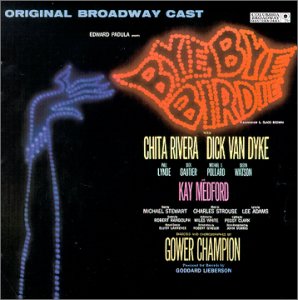
Bye Bye Birdie is the America that time forgot but high school drama departments somehow didn't. Let's face it. The very title triggers involuntary flashbacks to tone-deaf acne-plagued teens pitchlessly warbling "Put On a Happy Face."
But you know what? Though indisputably silly, this decidedly unhip valentine to rock 'n' roll's dawn is also strangely sturdy. It was lucky in its timing: It is young enough to smirk at the sex appeal of mass-marketed rockers. And it is old enough, at 40, to babble its Broadway inanities without feeling the need to address the melancholy preoccupations that befell a nation stripped of Kennedys and a King. It has the bluster of modernity, while still drawing on some classic Catskill schtick. And under the brisk, confident helming of director-choreographer Christopher Lane, the players at Olney Theatre Center are bringing it to perky, if not profound, life in an occasionally ragged but always engaging production.
The titular Elvoid rocker, Conrad Birdie (Cameron McNary), has been drafted into the Army, leaving his worrywart songwriter/manager, Albert Peterson (Tony Gudell), in financial jeopardy and Albert's longtime secretary and love interest, Rose Alvarez (Kristy Glass), in romantic limbo. That is, until Albert can cut himself free from the family music business, he seems unwilling, or maybe unable, to fully commit himself to Rose. Complicating matters is Albert's overbearing and obstructive mother, Mae (Ilona Dulaski), who doesn't cotton to Rose. Mae thinks of her as an opportunistic "fruit picker" from "South of the border"--never mind that Rose is anything but opportunistic (a therapist would wish her far more so), never did pick fruit, and comes from Allentown, Pa.
Rose has had enough and is ready to quit. She wants Albert and a wedding ring, and she wants a quieter, more meaningful life. Albert agrees to stop being "a music-business bum," go back to school, and become an English teacher if Rose will stick with him through the crisis of Birdie's flying the company coop. Deal, she says. Moreover, Rose has a way to cash Conrad into the Army with a ka-ching! that will rescue the music company as well as her prospects for happiness with Albert: She picks at random a girl from Conrad's fan club to receive a well-publicized goodbye kiss from him before he dons his uniform. Better yet, it's going to occur live on The Ed Sullivan Show.
The lucky girl, Kim MacAfee (Briana Zakszeski) of Sweet Apple, Ohio, has just been pinned by her beau, Hugo Peabody (Jason W. Gerace), and has renounced Birdie hysteria. Nonetheless, she can't quite live up to her new womanly standards of maturity ("I'm 15 years old and it's time I settled down," she says) in the hormone-hyping arms of her idol, even though his idea of sweet talk before a kiss is "Brace yourself, chick." And, as you might expect, the media machine leaves Sweet Apple a bit less sweet than it found it.
Gudell is nicely hangdog and henpecked as Albert--and proves endearingly handy with a ballad, too, in "Baby Talk to Me" and "Rosie." It's fun watching him make up his mind and find his spine. Dulaskie is a blast as Mae, making the most of, without overdoing, her guiltmonger-from-hell lines, of which there are some real gems: "Don't hire a limousine to take me to the final resting place," she says upon hearing Albert's plans to dissolve the family business and wed Rosie. "I'll walk." And, upon being told by Albert (at long last) that he doesn't need her anymore, she laments, "Throw me out with the used grapefruits and the empty cans of Bumble Bee tuna."
McNary's merely passable as a singer, but he brings verve to the teen-twitchy "A Lot of Livin' to Do." More important, he can strut and wiggle with the requisite Tutti-Frutti-Oh-Rudy cockiness, he can look like an idiot, and he can burp. That's pretty much the required skill set for this role.
But among the cast of two dozen, it's the women principals who carry the show. Though off to a musically rocky start with the interval-intensive opener, "An English Teacher," Glass quickly found her feet opening night and was radiant throughout the rest of the show, bringing off not only the love tunes, but the snarly "What Did I Ever See in Him" and even the snappy but pointless "Spanish Rose," surely one of the dumbest songs ever to afflict a Broadway stage. As she unsuccessfully tries to harden herself and revise the future she'd always imagined, Glass's Rose is a dreamy dreamer who has us rooting for her wholeheartedly. Zakszeski, too, has a lovely presence and a strong, pleasant voice. She makes both the pathos and the self-centeredness of Kim's adolescent insecurities real, especially in her fine solo number, "How Lovely to Be a Woman."
Harry A. Winter is also a standout for his fun, comic turn as dad Harry MacAfee, a crabby middle-aged middle-American whose home is invaded by the worst carnivorous entertainment-industry forces from both coasts. "Last night," he complains about Conrad, "I gave up my room to a guest who repeatedly called me Fats."
The airy ensemble songs are rock-solid and delightful. Lane and musical director Chris Youstra have coaxed the sonorous best from the "girls" who back Zakszeski in "One Boy" and the fellas who form the melodious and hilarious barbershop quartet accompanying "Baby Talk to Me," both of which are close-harmony Napoleon pastries for the ear. Those songs, along with the tongue-in-cheek company-ensemble prayer-anthem homage to Ed Sullivan, are where composer Charles Strouse really shines.
Lane's choreography is crisp and clean, with some clever broad-stroke bits, like Conrad's "slaying" his female listeners with a televangelist's authority, and his dipping Kim in anticipation of the big kiss, then, in a less-than-kind tease, letting her tumble. Jos. B Musumeci Jr.'s sets are marvelous, mobile, and versatile. With rolling platforms zooming on and offstage, at stage manager Cary Louise Duschl's deft command, Musumeci gives us town square one minute, and the MacAfee home the next, complete with living room, dining room and upstairs bedroom. Maja E. White's light projections are subtly and effectively used in conjunction with Ron Ursano's sound--the implied giant soundstage door in Act 2 is a characteristically impressive touch. The musicians are unobtrusively supportive, not just on the crowd-pleasing rompers, but in more intimate passages like the light-touch flute/piano precision of "How Lovely to Be a Woman." The problem with reliable live musicians is they remind you that you'd rather hear a couple fine fiddlers than the thin string program of a synthesizer. A quibbler could also ask for more voice, less orchestra in the talk-singing street numbers like that toward the show's beginning, but miking for such hustle-bustle fare is always a nightmare.
By keeping Mae's character from becoming out-and-out farcical and playing up the softer side of Rose and Kim, director Lane seems to be aiming, as he put it to a reporter from the Gazette newspapers, to get audience members to "think about what actually happened in 'Birdie' beyond the parking lot." He cites Rose's biological clock and Mae's loneliness in his effort to get beyond the high-school-production stereotypes and treat the characters as people. That may be too much to ask from a show with lines like this between Albert and his bombshell of a potential secretary who brags about her typing: "Do you use the touch system?" "Whenever possible." Ba-dum-dum.
With Birdie, better to aim for simple diversion. That's hard enough. And Olney hits the mark squarely.
Alexander C. Kafka is a contributing writer for Washington City Paper, where this review first appeared. Reprinted by permission.


