Click Here To Download
The Idler's Mobile Version

The Idler's Home Page and Table of Contents
The Idler's email list
To advertise in The Idler
Write a letter to the editor

(www.the-idler.com)
Volume III, Number 3





PINSKY AND THE PROFESSORS
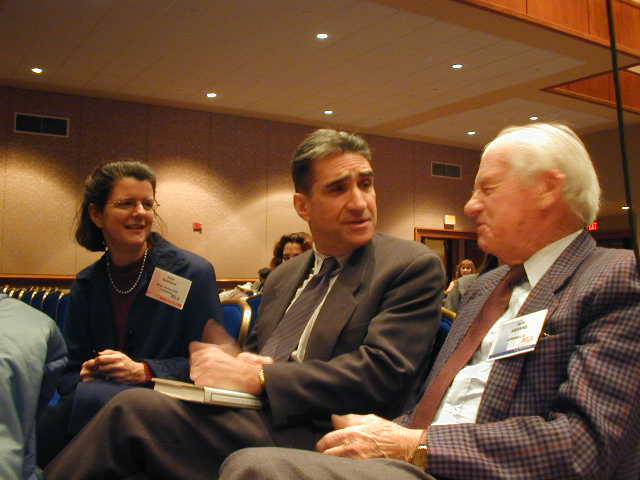
Robert Pinsky talking with M.H. Abrams at the MLA convention, Julia Reidhead on left (Idler photo)
Former three-term poet laureate Robert Pinsky broke new ground when he took his Favorite Poem Project to the Modern Language Association's annual convention in Washington, DC on Friday, December 29, 2000.
Although a tenured faculty member at Boston University, Pinsky has for years steered clear of English professors as he evangelized for poetry among the American people, assembling his collection of poems from some 25,000 submissions by ordinary citizens.
What Pinsky offers is something very old-fashioned: straightforward oral recitation of poetry, something not done in too many college classrooms today, but done frequently in elementary and secondary schools for generations.
And, instead of touring the conference circuit, soliciting recommendations from Ivy League faculty, and publishing with a university press, Pinsky has put out his patriotic, and old-fashioned-sounding American's Favorite Poems: The Favorite Poem Project Anthology with a commercial publisher, W.W. Norton (publishers of M.H. Abrams definitive Norton Anthology of English Literature).
He has preferred appearances on shows like PBS's Newshour with Jim Lehrer , community readings and town hall meetings around the country, even a White House affair where President Clinton read Emerson's "Concord Hymn" and the First Lady recited Nemerov's "The Makers."
So, his appearance at the annual convention of academic critics and scholars marked a turning point for Pinsky's project, a shift from the marketplace, towards the academy, from the public square, to the ivory tower, which might have contained a hint of intellectual danger in earlier days.
The lineup of participants in Pinsky's poetry reading was impressive, selected by the MLA leadership to represent the diversity of MLA members. And yet, there was the thought, perhaps, with such a disparate panel, might dissent erupt?
The anticipation was not a far-fetched fantasy.
In past years, the MLA had been a cauldron of political, ideological, and cultural conflict. In 1992, under fire for political correctness, the Modern Language Association hired Anne Lewis as its convention press agent. She went on to defend President Clinton during the Monica Lewinsky affair. And in 1994, after acrimonious disputes over deconstruction, racism, sexism, and homophobia, dissident professors led by former MLA president Roger Shattuck, among others, left the MLA to form a more conservative organization, The Association of Literary Scholars and Critics, which currently has some 2,000 members.
So, the appearance of Pinsky raised a question: Would political confrontations of past years reappear? Pinsky may be popular, and he may love poetry, but although he is politically astute and a beloved teacher, he is not reputed to be politically correct. And his panel put committed Marxists side-by-side with Romantics. Indeed, the very act of "privileging" some poems as "favorites" might be criticized as an exercise in "hegemony."
So, as The Idler waited, we wondered, would Pinsky be savaged for betraying the poetic avant-garde in his published collection long on Byron, Donne, Longfellow, Shakespeare, Whitman -- and short on revolutionary poets such as Brecht (who does not appear at all) and Neruda, represented only by his poem about socks? (No poetry at all from Zapatista leader Subcommandante Marcos can be found in Pinsky's book, for example.)
Perhaps Pinsky, himself a middle-aged, middle-class white male, would be chastised for favoring poetry written by Dead White Men, or attacked for tokenism, the appearance of only a small percentage of poets of color, gender, and sexual preference?
Or, would the former poet laureate be challenged on the grounds of methodology, that his sample might be unscientific, that his poems were not Americans' favorites at all, rather simply the overlap between the set of his favorites and the favorites of PBS viewers?
In any case, the MLA program looked like a hostile environment for Pinsky's project, at first glance not dissimilar from the 1992 event that led to the split in the organization.
But the confrontation was not to be. Perhaps the formation of a competing organization has had an effect on the rhetoric of the annual MLA meeting. Maybe the drastic cuts in funding for the NEH and NEA have caused academics to re-think their positions vis-a-vis the profession of literature (to gloss ALSC founder Roger Shattuck, in an essay reprinted in the PMLA's "Special Millenial Issue"). Or, perhaps, professors at the convention were simply exhausted by the dispute over the 2000 presidential election.
Whatever the reason, the tone of this MLA convention was extremely conciliatory.
Incoming MLA president Linda Hutcheon quoted from T.S. Eliot and Charles Dickens in her presidential address, reading a poem by Marge Piercy calling for an end to negative criticism, its replacement a form of creative collaboration. Recuperating poetry herself, Hutcheon announced the new approach:
...but we take a little here and give a little there
and we change...
To make her point, Hutcheon actually invited losers from her own MLA presidential campaign onstage in what could only be called a "gracious" gesture. Had Hutcheon declared that she was "a uniter, not a divider," no one would have been surprised.
Likewise, while there were politically correct panels in the listings, the most notable events appeared to spring from affinity groups motivated by enthusiasm for particular authors, such as the Mencken society, the Milton society, the Goethe society, and the Beckett society, the latter sponsoring a memorable evening performance of Stories and Texts for Nothing by Bill Irwin.
Equally non-political, and well-attended, were sessions devoted to the impact of the internet, including one featuring Motley Fool founder Tom Gardner -- himself a former graduate student in linguistics -- and Fathom.com CEO Anne Kirschner, a Princeton Ph.D. who once worked for the MLA, who recounted her terror and disappointment in the job marketplace when she could not obtain a permament position for two years in a row. (She gave up and went to work writing cable television franchise proposals).
So, when Pinsky opened himself for criticism, offering two sessions for protesters to take pot-shots, a strange thing happened for an MLA convention: nothing. No shouting, no hostile questions, no denuciations. Just applause.
At Pinsky's first session, he screened an hour of distinctly anti-elitist and anti-academic videos featuring schoolteachers, refugee students, and even a construction worker quoting Countee Cullen, Wordsworth, and Langston Hughes.
Each would say what the poem meant, personally, with nary a reference to Helen Vendler or Marjorie Perloff. Yet no one seemed insulted, slighted, or offended by this approach.
And Pinsky's exclusion of expert commentary has not only been no accident. For example, the book jacket for American's Favorite Poems: The Favorite Poem Project Anthology explicitly declares his exclusion of the professoriate, to wit,
Accompanying the poems are comments by people who speak not as professional critics, but as passionate raders of various ages, professions, and regions.
This anti-professional sentiment is not some accidental artifact of Pinsky's copywriter, but reflects Pinsky's own attitudes.
He declared to the MLA audience that he believed "schoolteachers have done more for poetry than professors." He added that he believed the "sensory experience" and "pleasure of a poem" should not be secondary to "identity politics," or the new critical imperative to "say something smart."
When he was asked how the 25,000 poems were winnowed down to the small number in his book and television segments, Pinsky responded straightforwardly that an initial selection was made by "graduate student slaves" at Boston University, reducing the list to some 700 items. Then came a cut by Favorite Poem Project Director Maggie Dietz, reducing the total to 500 semi-finalists. However, the final determination was made by Pinsky alone.
"You're looking at the committee," he explained to the audience. "I am the editor."
Instead of facing jeers and boos for his lively defense of bourgeois individualism, Pinsky was greeted with resounding applause from the assembled professors.
That times have changed was even more evident in the evening session.
Each scholar told a deeply personal story of what a poem meant, with little jargon, practically no "identity politics" and likewise barely perceptible "smart remarks." Instead, what came across was personal enthusiasm, the sensory experience of the poem, and the sound of each personality interpreting the words of someone else's experience, intermingling the speaker's life experience with that of the poet.
The poetics of Pinsky, poetics which would have been anathema in 1992, had been accepted by the professors of the MLA, who had followed Pinsky's direction in their performances.
And the applause was tumultuous.
Participants in the session: "MLA Members Read Their Favorite Poems"
M.H. Abrams, Cornell University -- "To Autumn," by John Keats
Terry J. Castle, Stanford University -- "Title Search," by John Ashberry
Anne Anlin Cheng, University of California, Berkeley -- "Saint Francis and the Sow," by Galway Kinnell
George Elliott Clarke, University of Toronto -- "Blind Man's Blues," by Frederick Ward
Sidra DeKoven Ezrahi, Hebrew University of Jerusalem -- Poem number 18 in Yehudi Amichai's poem cycle "the Bible and You, the Bible and You, and other Midrashim"
Geoffrey H. Hartman, Yale University -- "The Excursion," by William Wordsworth
Claire Kramsch, UC Berkeley -- "Vorfreuhling," by Hugo von Hofmannstahl
Elaine Marks, University of Wisconsin, Madison -- "L' invitation au voyage," by Charles Baudelaire
Aldon L. Nielsen, Loyola Marymount University -- "Crevecoeur," by Lorine Niedecker
Robert Pinsky, Boston University -- "Sailing to Byzantium," by William Butler Yeats
Balachandra Rajan, University of Western Ontario -- "Rig-Veda X, 129," author unknown
Michael Reder, University of Massachusetts, Amherst -- "Preface to a Twenty Volume Suicide Note," by Amiri Baraka
Doris Sommer, Harvard University -- "AmeriRican," by Tato Laviera
Hotense Spillers, Cornell University -- "Gay Chaps at the Bar," by Gwendolyn Brooks
Michael T.S. Thurston, Smith College -- "Lay your sleeping head, my love," by W.H. Auden
Robert Pinsky's American's Favorite Poems: The Favorite Poem Project Anthology from W.W. Norton is available from Amazon.com
