Click Here To Download
The Idler's Mobile Version

The Idler's Home Page and Table of Contents
The Idler's email list
To advertise in The Idler
Write a letter to the editor

(www.the-idler.com)
Volume III, Number 21






A REDACTION OF THE HERACLITAN
FRAGMENTS
By Harvey Wheeler
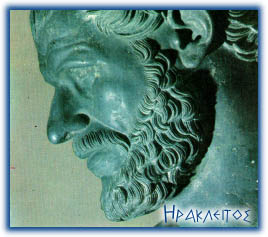
Heraclitus, from ForthNet, a Greek website.
When Heraclitus introduced the Logos to philosophy, a great light broke on Greece; a light that has guided, not only Plato, but the whole of the Occident, ever since. But, strange to say, the translations are mostly ludicrously bad and, in addition, unreadable, since they are in the “Nay, forsooth," "Wist ye not," mode. No possible translation could do justice to the simultaneous majesty and practicality of classical Greek, as is so clear with Plato. But, some attempt can be made to approach what was in essence already a concrete universal. Since the use of Latin particularisms, multitudinous in number, to translate the Greek vocabulary, both in philosophy and religion (that paradoxically was and always remained much larger than the Latin), it has seemed to me difficult, if not impossible, as I replied to a question put by John Cogley, to put back together again what, in the philosophy of the Logos and the dia-Logos, should never have been rent asunder. Even the most fugitive reading of the rather gnomic fragments of Heraclitus that have been preserved to us cannot fail to see in them all the "dialectic" apparatus that has been common to all such philosophies ever since. (The establishment of the Liberal Arts took place in the philosopher's kitchen, for as Heraclitus is reported to have said: The Gods are everywhere.)
Heraclitus lives after the invention of writing and of Pythagorean mathematics, but before the invention of grammar and logic. He comes after the conversion of myths from ritual narratives into dramatic contests but before the appearance of the special form of argumentative contest known as rhetoric. He lives after the discreditation of the Olympian gods but before they had been succeeded by philosophy; after the decline of the mystery cults but before the individuation of the Socratic diamon into a basis for ethics.
The Fragments contain the seeds of several notions that are destined for distinguished philosophic careers. In what follows, I shall first point out the overall structure of the Fragments, enumerate their leading notions and then give a loose interpretation of the argument and of the philosophy it represents. This is pretty much what all commentators have done since the Fragments first became known. Plato is said to have developed his doctrine of form out of dissatisfaction with the Heraclitan doctrine of change. Whitehead says that all Western philosphy is but a series of footnotes to Plato. As Plato was in some sense an extended footnote to Heraclitus, John Wilkinson's dictum follows, to wit, all Western philosopy is a series of footnotes to Heraclitus.
First, consider the overall structure of the Fragments. Heraclitus chooses to discuss a general and abstract topic, nature; not the seasons or "Mother" nature, as was traditional. He seeks to learn about the truth that is beyond nature, that is, metaphysics. We learn from him about nature, not in the accustomed vehicle of fable and narrative, but through apothegms. Apothegms had been used before, so it is not this alone that is new. Indeed, many of Heraclitus' apothegms follow the traditional form. But the larger part of the Fragments is in propositional form; propositions that invite deliberation. They are not presented to us as an overt dialogue, but there is a covert or implicit dialogue. Heraclitus is obviously engaging in an argument. He is revealing to us the results of his own interior dialogue. This is why he was known as "the obscure." Later attempts to unveil these obscurities led to more discursive and more overtly dialogical treatises, and hence to philosophy.
Next, consider the content. We find several terms that are at once post-mythical and pre-philosophic; Nature, logos, the nature of words and things, the universal, opposites, unity, agreement (symmetry), junction, harmony, discord, whole and not-whole (contradiction), the One, justice, world order, infinity, transformation, law, wisdom (philosophy), mind (soul),astronomy (as opposed to astrology), understanding, telos (that thought which directs things), invisible harmony, the conjunction of opposites, the government of the universe, homeostasis, conflict, necessity, change, sign, meaning, appearances, reality, controversy.
Consider now the propositions in which these terms are used. Heraclitus tells us that he is interested in explaining the "nature of words and things." This is the first meaning he gives for logos, the more fundamental reality lying behind appearances which takes the place of the Homeric gods. One understands the logos by pursuing what is "universal," rather than what is particular ("private.") If one considers only particular appearances there would be no way to distinguish the width of the sun from the width of a human foot; the contentment of a ruminant from the happiness of man, rightly understood. Understanding is to the logos as ritual is to the gods. Through true understanding we know things deeply rather than knowing merely our superficial experiences of them. For example, we see that things that appear to be opposed to each other are actually manifestations of a profound principle of unity. This applies to words as well as to things. Conflict provides the path to unity; controversy provides the path to the understanding of the One. Conflict, as it applies both to things and to words, leads to the One. The system of Heraclitus is to the realm of reason as the mystery cults are to the realm of the emotions. But most men are chained to pleasure and emotion -- to appearances -- hence they never arrive at the truth about either words or things.
The principle of conflict, or contradiction, tells us that we must proceed toward truth by way of rejection. For example, we cannot understand the true nature of justice by seeking it out directly. Rather, we proceed by way of rejecting its opposite. By the repetitive rejection of injustice we approach ever nearer to justice. Justice, when applied to world order, refers to what can be perceived as an eternal principle of cosmic harmony rather than as a regime that results merely from gods administering their special provinces. Nature, in all its manifestations, exhibits a fixed harmony which can be apprehended through an understanding of its processes, for process (change) rather than stasis, is the way the logos exhibits itself in nature. We see this in the cycle of births and deaths, in the processions of the heavenly bodies and in the transformations of the elements.
The logos is the principle according to which these transformations occur. Hence, in speaking of the universe -- the universal -- we speak of the One, not of Zeus. The laws of the universe are therefore to be expressed in universals; the "counsel(s) of One." If we understand the counsel of One about the nature of the universe we uncover the truths of astronomy. If we seek lessons about the world from the myths of Zeus we can never go beyond astrology.
There is not only a logos for the universe, but also for man. This, rather than gods and spirits, tells us about human nature. Hence, men differ, not only as they differ in the understanding of their indwelling logos, but also according to the differing degrees of excellence with which it is found in men. We seek understanding of the indwelling logos through the mastery of the many fields of knowledge and out of them, as we approach an understanding of the logos, we acquire philosophy which is the love of and the possession of wisdom. If we seek these principles from the mystery cults we find only nostrums, not wisdom.
There is a logos for the polis as well as for nature and man, and this is expressed through laws.
In all its forms the logos, though invisible, is comprehensible. It exhibits both conflict and harmony, as with the harmony produced out of the turbulently conflicting vibrations that result when a musical string is plucked. Hence, one way to approach ever closer to the logos, which reveals the one from the many, is to seek for paradoxes and then to uncover the principle of understanding which resolves them: the universe appears to be concrete but its laws are grounded on energy. Each thing looks different from another because it is always changing in a way different from the changes occurring in every other things. Inasmuch as change occurs through conflict, the feature all things share is change itself. Therefore, conflict and change are related. Together they lead to understanding; together they comprise the process that is unchanging and universal; the One.
The road to learning begins with the effort to know, that is, to understand and to develop one's own indwelling logos. Understanding of the indwelling logos is accessible to everyone. From this one may proceed to the understanding of the logos of the polis and of the cosmos. The reason this procedure is feasible lies in the fact that thinking is common to all. This means that intelligence is common to all. The search for understanding requires concentrating on this common element. Through this common element men participate in the logos. Just as the mind can participate in the logos, so the logos may inform the mind. Through the proper application of the mind man can come to understand the logos. The procedure is simple in itself though it is arduous to apply. There are two principles; tell the truth (which means both not telling a lie and not reporting falsely) and act in accord with nature. The combination of these two procedures works through an internal dialectic in which the will seeks to bring oneself in ever- closer accord with nature while the mind seeks to express the principles this effort uncovers. As this happens the philosopher learns more and more about the logos. This is the same thing as saying that the logos more and more informs the mind of the philosopher. Hence, through philosophic "exercise" of the sort described, the philosopher's indwelling logos virtually grows by its own deeds. Wisdom and character grow and become stronger; the philosopher increases his prowess by training and practice and through contests much as does the dedicated athlete.
* * *
Let us go back now and look at what Heraclitus has done:
l. First, he tells us that the Homeric poets are fools and that true wisdom is not to be sought from myths about the Olympian gods.
2. On the contrary, one can observe certain processes operating through nature and these are the "things" that are real and which must be studied in the search for wisdom.
3. The same principles apply to the physical environment, to society and to man. Such principles could be called a metaphysics.
4. Through the knowledge of metaphysics one becomes a philosopher. One may most readily apprehend the principles of philosophy by studying man's own nature and the laws, or ethical principles, proper to it.
5. The principles of philosophy are learned through the dialogue method.
6. his makes it possible to teach men moral excellence and to improve their characters through the proper educational process.
7. This aim should provide the guiding spirit in drafting the laws for a proper society.
These seven inferences may not be entirely warranted, but it is easy to see how just such conclusions might have been made by learned men living at the time of Socrates and Plato.
Harvey Wheeler is co-author of Fail Safe, with Eugene Burdick, and a frequent contributor to The Idler.


