Click Here To Download
The Idler's Mobile Version

The Idler's Home Page and Table of Contents
The Idler's email list
To advertise in The Idler
Write a letter to the editor

(www.the-idler.com)
Volume III, Number 144


Click here to download chapters from Finish High School At Home by Charlie Clark





HANDICAPPING THE RACE FOR CHAIRMAN OF THE NATIONAL ENDOWMENT FOR THE ARTS
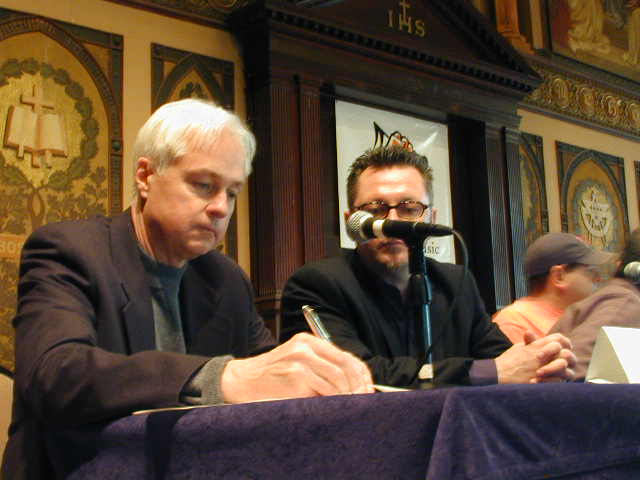
Outgoing NEA Chairman Bill Ivey, at a Georgetown University music conference.(Idler photo)
When Bill Ivey, current head of the agency, announced that he would step down in September, many in Washington thought Ivey had been asked to leave -- perhaps in order to make way for a master bureaucrat in the Donald Rumsfield or Colin Powell mold. Such a savvy operator might protect a newly elected President, helping to avoid the type of mishandling of the "culture wars" by John Frohnmayer that led to the defeat of Bush I.
But former acting NEA Chairman Anne Radice did not appear on stage, and the second Bush administration already appears to be involved in its "first culture war," in the words of The New York Times.
According to the Times, the battle centers on the fate of Roy Goodman, heir to the Ex-Lax fortune and Republican state senator from Manhattan's "silk-stocking" district, who served on the National Council for the Arts during Bush I.
When the American Conservative Union sent out a letter opposing his nomination for the NEA post because of his record as "the most liberal Republican senator in the state," the battle was joined.
Goodman responded by letting the Times know that he was "lobbying hard" for the job -- publicizing endorsements from the likes of actor Tony Randall, former Harvard president Neil Rudenstine, and Phillipe de Montebello, director of the Metropolitan Museum of Art.
But by going public, and reminding Washington of the controversies that swirled around Mapplethorpe, Serrano, Annie Sprinkle, Ron Athey, and the "NEA Four," Goodman may have undercut his own position as the favorite.
Critics of the agency note that Goodman served on the National Council for the Arts during the years of controversy -- that it was on Goodman's watch that NEA saw its budget cut and its reputation soiled.
They add that Goodman's struggle was reported in the press along with a laundry list of other possible names for NEA chairman.
Not a good sign for Goodman...
The same day that the Times reported the Goodman story, the Washington Post carried a report that the American Arts Alliance -- a major NEA lobbying group -- requested that the search for chairman be expanded to recruit candidates from the business world.
Also not good news for Goodman.
To add to the confusion, the ArtsWire Current website (bulletin board for the NEA-grant funded universe) soon posted an article headlined: "THE NEXT NEA CHIEF -- WHO WOULD *YOU* RECOMMEND?"
As the NEA chair search heats up, Arts Wire is seeking grass roots suggestions from the arts community. Please send them to [email protected] along with:
one or two sentences describing why you think your suggestion would be a good choice
your name and a sentence about you
As many responses as possible will be compiled for an upcoming issue of Arts Wire Current.
To say the least, with Goodman's nomination for NEA Chairman in trouble, the NEA "community" is not rallying on his behalf.
And if Goodman is out, who is likely to replace him?
Both the Times and the Post mentioned many of the same names.
Some might face as opposition from conservative critics because of their record as NEA Council members, like Goodman, during the "culture wars".
If so, Peter Hero, president of the Community Foundation of Silicon Valley; William Strickland, president of the Manchester Craftsmen's Guild in Pittsburgh; Marta Casals Istomin, president of the Manhattan School of Music; Arizona university professor Colleen Jennings-Roggensack, and George White, former director of the Eugene O'Neill Theatre Center, may very well be out of the running.
Other names might irk conservatives as well. Like Goodman, Tom Bernstein is a businessman from New York. Peter Donnelly, of the Corporate Council for the Arts, comes from Seattle, and John Walsh used to run the J. Paul Getty museum in Los Angeles. Both cities are as liberal and Democratic as New York. Marian Godfrey, from the Pew Charitable Trusts, might also be in for a rough ride. Pew has often been criticized by conservatives for funding liberal political activism. As representatives of the East and West Coasts, they remind Congress of why the agency is in trouble with what in known in Washington alternately as "fly-over country" or "the Real America".
Likewise, Nancy Risque Rohrbach, director of the National Museum of Women in the Arts, and Dean Anderson, formerly of the Smithsonian Institution, might be perceived as too Washington. Glenda Hood, mayor of Orlando, and Henry Moran, director of the Mid-America Arts Alliance, simply don't have the stature in the "culture wars" that might gain them support from conservatives.
That can't be said of Lynne Munson, who helped run the National Endowment for the Humanities under Lynne Cheney. But one problem is, that when Lynne Cheney ran the NEH, it ran out of control, establishing the controversial National History Standards that the Senate later voted against 99-1. Having that controversy pop up again in a confirmation hearing would rekindle the very "culture wars" that Bush would presumably wish to avoid.
Two names mentioned in the papers might have a better chance than any of the above.
Al Felzenberg, now at the Heritage Foundation, was briefly senior deputy chairman of the NEA, until John Frohnmayer fired him in 1990 during the height of the controversy over Mapplethorpe and Serrano. This made Felzenberg a hero to conservatives. With a Ph.D. from Princeton, he has since served as a key committee staffer in Congress, where he worked with both Democrats and Republicans, as well as serving on a joint Brookings-American Enterprise Institute-Heritage Foundation panel on the Presidential transition. If Bush wants a savvy Washington insider, who can gain support from conservatives, Felzenberg might make a logical choice.
Alan Simpson is reportedly interested in the job, as well. And in Washington, one should never underestimate the influence of a former Senator. While he is known among Washingtonians as a liberal Republican who has just been teaching at Harvard, Simpson can still point to his Wyoming roots as evidence that he has not completely lost touch with ordinary citizens. He has been interested in the NEA for many years, and once appeared at an NEA Council meeting to tell Jane Alexander to clean up the agency. By Washington rules, if he really wants the job, it is probably his. In that case, Simpson would be wise to pick Felzenberg as his number two.
Finally, one name that was not mentioned in the Post or the Times might be the dark horse who comes from behind and wins the race -- if he wants the job (a call from The Idler was not returned).
He is Tony Chauveaux, a native of Claude, Texas, who now practices law in Beaumont, population 100,000. Chauveaux is an arts patron -- he paid for an exhibit of the paintings of Robert Jessup -- and chairman of the Texas Commission on the Arts, appointed by George W. Bush. Given the Bush family's stress on personal loyalty and Texas ties, one might tip Chauveaux as a favorite, should he choose to move to Washington. (If Chauveaux does take the post, like Simpson, he would be well advised to make Felzenberg his deputy.)
Chauveaux is chairman of the board of the Institute of Texan Cultures in San Antonio, a member of the executive committee of the board of the Symphony of Southeast Texas, and former president of the Art Museum of Southeast Texas, and Friends of the Arts at Lamar University. Of French descent, he is also of Texas pioneer stock -- Chauveaux donated his ancestral collection of 1880s vintage letters from Francois Chauveaux to the family in St. Etienne, France to Texas Tech University's Southwest history collection.
Chauveaux is truly Texan, and an arts supporter without the baggage -- no controversial NEA grants, no East Coast or West Coast ties -- and to his credit is practically unknown in Washington, although he did attend this year's Arts Advocacy Day on Capitol Hill. He has an undergraduate degree in journalism from (where else?) the University of Texas.
An arts booster, Chauveaux has travelled across Texas to promote the his agency with folksy charm -- in the tradition of Bill Ivey, formerly head of Nashville's Country Music Hall of Fame.
During a visit to Abilene, Texas, he told reporter Helena Rodriguez of the Abilene Reporter-News : "It's amazing to see what Abilene has accomplished in the arts. Compared to Beaumont, y'all are ahead. I just drove by the outdoor sculpture here. In Beaumont, we're just starting to think about an outdoor sculpture."
The horses are off and running.