Click Here To Download
The Idler's Mobile Version

The Idler's Home Page and Table of Contents
The Idler's email list
To advertise in The Idler
Write a letter to the editor

(www.the-idler.com)
Volume III, Number 142


Click here to download chapters from Finish High School At Home by Charlie Clark







LET'S HAVE A UNITED NATIONS DECADE OF DEMOCRACY IN 2001-2010
By Raymond Lloyd
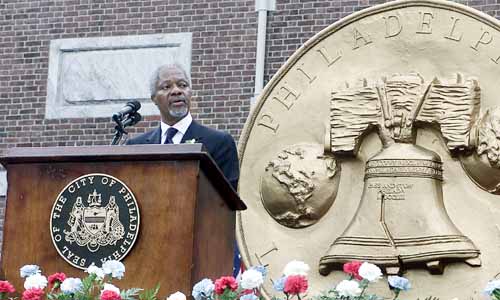
U.N. Secretary General Kofi Annan receiving the Liberty Medal in Philadelphia, July 4th, 2001. (UN Website photo)
In its Political Declaration in Houston on 10 July 1990, the Group of Seven industrialized countries designated the 1990s a Decade of Democracy. In the past ten years, among the world's 192 sovereign states, the number of electoral democracies has risen from 70 to 120, as appraised by the New York-based, 1941-founded Freedom House, whose Freedom in the World yearbook has provided an evaluation of Political Rights and Civil Liberties for all states and territories in each year since 1972.
The time has come to designate the 2000s a "United Nations Decade of Democracy", in order to consolidate and accelerate progress. In my proposal for a World Democracy Decade 1990-2000, published in the July/August 1989 magazine of Freedom House, I suggested that the number of persons living in political freedom could be raised from 39 to 50 % of the world's population, and those in partial freedom from 20 to 25%. This is what had happened by January 2001, followed by my more modest targets for January 2011:
Survey Date - Free Peoples - Partly Free - Not Free - World Population
January 1989 - 2.0 b (38.9%) - 1.0 b (20.0%) - 2.1 b (41.1%) - 5.1 billion
January 2001 - 2.5 b (40.7%) - 1.4 b (23.8%) - 2.2 b (35.5%) - 6.1 billion
January 2011 (target) - 3.2 b (44.5%) - 1.8 b (25.0%) - 2.2 b (30.5%) - 7.2 billion (est)
In my 1989 article, I listed 25 countries which might make the transition to democracy: I was wrong about seven of them: Algeria, Burma, Egypt, Singapore, Sudan, Tunisia and Yemen. All seven are situated in the most persistently authoritarian regions of the world, Asia and the Middle East. If change is to come, it may be by citizens in the key dictatorships of each region, China and Saudi Arabia, claiming their political rights and civil liberties. It is possible to foresee this in China, thanks to the spread of ideas through private enterprise and the internet: it was the West's publication of Chinese faxes which helped keep the 1989 student movement going so long. It will happen in the religious-policed Saudi Arabia only when the industrialized West becomes less dependent on oil, the main maleficiaries of which are sequestered Saudi women and girls.
New Associations of the Democracies
Democracy in the 2000s will also move forward independently of sovereign nation states, not least as many of the small new entities which came into being (and into the United Nations) in the past forty years begin to appreci-ate that the political accoutrements of sovereignty impose too high a price on economic and social development. Countries may not give up their independence - politicians and diplomats are far too keen to hold on to office and status - but regionalism will grow in populous democracies, in Britain and France as surely as in Spain and Germany, and many of the poorer states will give up some economic independence, as in the planned monetary union of anglo-phone and francophone West Africa.
Also, many countries may be helped to consolidate their democracy in new political associations, as the Council of Europe has done for its continent with 43 out of Europe's 48 geographical members, and as the Organiza-tion of American States now forestalls military takeovers in the western hemisphere. Thus it is possible to foresee a Council of Asia, comprising the current 23 electoral democracies among 39 Asian countries, or a Council of Africa, comprising the 21 democracies among the 53 sovereign African entities, the latter a body very different from the African Union now being funded by the Libyan dictatorship. It is also possible to see an Atlantic Rim community, similar to those of the Pacific Rim and Indian Ocean, except that the Atlantic Rim would be based on a common cul-ture and democracy, as well as on trade. And finally it would be desirable to see the Group of Eight itself expanded to include other major democracies, such as Brazil and India, somewhat as those two industrialized countries are already among the ten permanent members of the Governing Body of the Geneva-based International Labour Office.
In June 2000 the first Conference of the Democracies was held in Warsaw. The 107-member conference included 16wouldbe democracies, of which only 3 have since made the transition - Mexico, Peru and Senegal. The conference did not include Ghana, Honduras, Taiwan and 23 smaller democracies, but some of these may be repre-sented in future biennial conferences, such as those planned for 2002 in Korea and for 2004 in Mali. In my 1989 article, I wrote that a Decade of Democracy could be proclaimed only by the democracies themselves, not by the then dictatorship-ridden United Nations. Now that some two-thirds of the UN's 189 members are electoral democracies, and for the next five years the UN has in Kofi Annan a Secretary General who has gone out of his way to stress the importance of democracy and human rights, then a United Nations Decade of Democracy could well be proclaimed by a General Assembly resolution in the session beginning in September 2001. Even earlier, as in Houston in 1990, the Decade could be designated by G8 leaders at their July summit in Genoa.
Empowerment of the World's Most Vulnerable Peoples
The world's first democracy was in Athens, instituted in 508-507 BC, when Cleisthenes made civic rights and responsibilities dependent, not on the clan, but on membership of the polis. Yet even that democracy excluded slaves, minorities and women, the first and second being freed or enfranchised only in the 19th century and women allowed the vote only in the past hundred years.
According to the London-based Anti-Slavery International, the world's oldest non-governmental organization, there are some 27 000 000 persons living in modern forms of slavery. With the approaching bicentennials of the ending of the transatlantic slave trade - by Denmark in 2002 and Britain in 2007 - it would be desirable if new initia-tives are taken to free these new slaves.
December 2001 also marks the 20th anniversary - again in Denmark - of the world's first Centre for the Rehabilitation of Torture Victims, centres which are now established in 70 countries: it would be good if the 2000s saw new initiatives to eradicate cruel and degrading treatment of our fellow human beings in the fifty or so countries whose regimes still torture their civilian opponents.
In the 1990s Decade of Democracy the two worst crimes against humanity were genocides of minorities, of some 800 000 Tutsi by the Hutu of Rwanda in 1994, and of some 7 000 Moslems by the Serbs in Srebenica in 1995. In both cases the G7 democracies did little to stop the slaughter and, in the case of Rwanda, the US and Britain suc-ceeded in keeping the word genocide out of Security Council resolutions, with the consequent legal obligation under the Genocide Convention to take steps to stop it.
Genocides will surely recur in the 2000s, if not of the Hazaras in Afghanistan, the Tibetans or Uighurs in China, the Kurds in Iraq, the Chechens in Russia or the Dinkas in Sudan, then of other minorities threatened elsewhere.
In 1994 in his book Death by Government, the historian Rudolph J Rummel calculated that, in the 20th century up to 1987, some 169 million persons had been murdered by their governments, that is, in addition to the 38.5 million battle-dead from international and civil wars.
Sadly these "democides" continued in the 1990s, notably in the 2 million persons starved to death by the totalitarian regime of North Korea, despite the army stocks of food which satellite photos showed to be high. Droughts and other disasters will recur in dictatorships in the 2000s: it will only be action by the rich democracies which prevent such droughts being turned into famine and democides. Thus, just as the world needs a new Democide Convention, so it would be good if citizen groups got together to create Genocide and Democide Watch institutes, analogous to the Amnesty and Human Rights bodies now active in many democracies.
Parity Democracy
In my analysis of 192 states (B), I claim that three countries - Finland, New Zealand and Sweden - have attained parity democracy, where women and men share equally in the responsibilities of government and administration, parliament and political parties, the judiciary, and the media. Parity democracy is both an end in itself, and a means to a world where every girl, as well as every boy, from Afghanistan to ex-Zaire, receives adequate nutrition, secondary education, and the expectation of gainful employment and an independent income.
Hopefully all nine countries in the second category, and several others down the list, will reach a similarly blissful state in the 2000s, but various kinds of affirmative action may be needed, such as the new parity law in France, and the proposed legislation in Britain to allow all-women election shortlists. Also a greater effort has to be made to nominate able women to appointive office, more than the average 12 percent in national governments - 593 out of 5026 in my bimonthly list 60 of 16 May 2001 - and more than the 16 out of 91 in the United Nations. And as symbols at the very top, women should be allowed to become constitutional monarchs, either as women, or in precedence over younger brothers, as recently legislated for in Belgium, Netherlands, Norway and Sweden.
Calendars of Democracy
For every year in the 1990s I put out a calendar of a hundred major anniversaries which could be used as target dates for consolidating or enhancing democracy. My list of 1700 anniversaries now run as far as 2015. In 2001 they include the 2000th anniversary of the Nativity on 25 December, as an opportunity for Christendom to do good for the millions of babies still born in stable-like conditions throughout the world, to the 2500th anniversary in September 2010 of the Marathon, the first victory run for freedom.
Political Integrity the Foundation of Democracy
The achievement of worldwide democracy, whether it comes in 2010, 2100 or 3000, will not lead to the elimination of political corruption, let alone public evil. Indeed, in the new century, international evil is likely to increase, as wouldbe leaders seize on justifiable grievances, such as the hunger, disease and poverty still suffered by a billion and more of the world's people, to propel themselves into power, and then use lies, theft, torture and murder, of minorities, outsiders and opponents, to maintain themselves in power. Such destructive evil will threaten the democracies, or their oil, water and other supplies, as long as the grievances are justified.
The democracies themselves are not faultless. It is a sad fact that more male crooks and public liars have come as leaders to G7/8 meetings than have women. Personal integrity is the basis of public morality, and of account-able democracy.
It may now be twenty years since a major politician in a G7 democracy resigned for reasons of principle, Lord Carrington as British Foreign Secretary in April 1982 in acknowledgement of a failed Falklands policy, and Hildegard Hamm-Bruecher of the German Foreign Ministry in September 1982 in opposition to her Free Democrats maintaining office in the switch from Social Democrat to Christian Democrat governments.
The more usual examples have been the Clintons and Mitterands lying to, or concealing facts from their publics, and staying on in office. Happily most democracies have term limits to curtail such abuses, but their lack of courage and integrity enable dictators to rationalize evil elsewhere.
Yet it is not the lies or shenanigans of Clinton which will be remembered, nor the fact that not one of his cabinet felt embarrassed enough to resign, but the US failure to intervene in the genocides of Rwanda and Srebenica. Thus whether or not a new Decade of Democracy is formally proclaimed, we can at least work to ensure that the 2000s become a decade of political integrity in the democracies, which will benefit all humankind.
Raymond Lloyd lives in London, where he is Honorary Secretary of the Council for Parity Democracy, and Editor of The Parity Democrat.