Click Here To Download
The Idler's Mobile Version

The Idler's Home Page and Table of Contents
The Idler's email list
To advertise in The Idler
Write a letter to the editor

(www.the-idler.com)
Volume III, Number 14






THE STRANGE SAGA OF STEPHEN OF CLOYES
by Charlie Clark
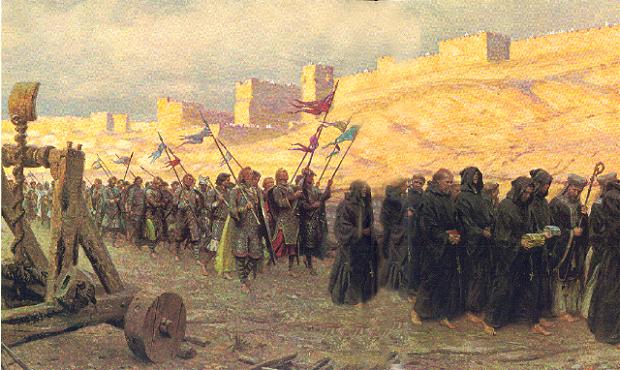
It's every parent's nightmare. Lovingly nurtured children abandon their homes to follow some kook pied piper on a mission to save the world. Are we talking counterculture in the 1960s? A cult invading America during the 1970s? No, this story unfolded in Europe in the year 1212. And the children on this crusade were following the mainstream religion of their day.
Documentation is scanty from this period, but it is fair to assert that the ``brains'' behind the Children's Crusade was one Stephen of Cloyes, a plucky shepherd boy from a French village a few miles west of Orleans. Events unfolded soon after his 12th birthday in 1212, when Stephen was tending his flock. The boy experienced a vision. Jesus Christ appearing in the form of an indigent pilgrim, addressed him with the enigmatic statement: ``For the last time have we heard of defeat.'' It was a call to action that would alter many lives.
What comes down through history as the Children's Crusade was in fact a juvenile version of an endeavor long pursued by the period's adult establishment -- the church, the government and the military. In the eleventh century, the central dogmatists of Christendom felt threatened by the presence of infidels in their monocultural society.
It was bad enough to have to track down and torture heretics such as the Albigensians of Southern France. It was well-nigh intolerable that the Lord's City of Jerusalem was occupied by forces of darkness from Islam.
Beginning in 1095, a declaration from Pope Urban II launched a series of official crusades. Squadrons of knights, clergy and volunteers from the grandest families of France, Germany, England and Flanders traveled to the Holy Land in hopes of rescuing Christ's Holy Sepulcher. The going got rough. In July 1187 at the Battle of Hattin, the Muslim leader Saladin secured control of Jerusalem and slaughtered Europe's largest army. The following 90 years would bring multiple European crusades_some by knights seeking territory, others by humbler citizens making ready for the end of the world. All failed spectacularly.
The Crusades were attempted at a time of great change in Europe's economy. Feudalism_which for the average citizen had always been a mix of job security and slavery_was giving way to entrepreneurial agricultural trading. Across the countryside, thousands of redundant peasants were being tossed off the farms and barred from what had long been public forests. Left to fend for themselves, they were ripe for a new explanation of their role on earth. And for many, the urgency of escaping poverty coupled with a new skepticism toward fat and happy religious elders. The clerics who'd come up with those bright ideas for the Crusades no longer came across as particularly competent.
Such a mindset encouraged a movement of what today is called millenialism. ``The usual desire of the poor to improve the material conditions of their lives transfused with phantasies of a world reborn into innocence through a final, apocalyptic massacre,'' writes historian Norman Cohn in his famous study of the mind of the Middle Ages. ``The evil ones_variously identified with the Jews, the clergy or the rich_were to be exterminated; after which the Saints_i.e. the poor in question_would set up their kingdom, a realm without suffering or sin.''
From this hellish stew emerged numerous ``prophets,'' among them charismatic young touts who recruited volunteers to rebuild the burned Cathedral at Chartres. The new leaders no longer needed to be rich, well-connected, or even above the age of consent. The gate of heaven was now open to the meekest of children.
Much of this would have been known to young Stephen on the day he had his vision. So he sprang into action. Rounding up a few young peers, he journeyed north of Paris, to the Abbey of St. Denis, the sacred burial site of French royalty where King Philip II was holding court. He told his Highness that he possessed a letter from Christ the Lord instructing him to lead a crusade. The King, after consulting scholars at the University of Paris, humored the young prophet but ordered him to return to his family. In defiance, Stephen set up shop outside the abbey and began preaching. To all who would meet him that June in the town of Vendome he promised a divinely inspired journey across France. Wowing them with miracles of healing, he vowed they would see him make like Moses and part the Mediterranean Sea. Then he would lead them to liberate the Holy Land. ``Hereafter,'' Stephen boasted, ``shall children show mailed warriors and proud barons how invincible are youths when God leads them!''
Though the Church officially frowned on the project, word spread quickly as Stephen sent out deputies as young as 8 and 10 to call more children to the cause. Summertime was normally reserved for the chores of preparing for the harvest, but some 30,000 young folks_some sources say it grew to 100,000_eventually broke from their families and joined the irresistible Stephen. From Brittany, from Aquitaine, from Provence, they made what seemed a level-headed decision to enlist. None of the travelers were armed, and few had ever ventured outside their home villages. ``Long enough have you, knights and warriors, so boastful and so honored, been making your fruitless attempts to rescue the tomb of Christ!'' Stephen preached. ``God can wait no longer! He is tired of your vain puny efforts! Stand back and let us, whom you despise, carry out his commission! He who calls can ensure the victory, and we will show you what children can do!''
Contemporary accounts describe crowds following Stephen while carrying homemade wooden crosses, candles, aromatic censers, and the blood-red, three-pronged Crusader's banner called the Oriflamme. As they paraded through towns holding hands and singing hymns, they were joined by priests, older pilgrims and women suckling babies. When curious shopkeepers asked where they were going, the pilgrims chanted, ``To God!''
It is easy to imagine the parents who tried to intercept their departing loved ones. ``Father, ever since I can remember, you have told me the glory and honour of chivalry, and of King Richard and the knights with whom you fought side by side in the Holy Land,'' a youth told his crestfallen father. ``And though it tears my heart to leave you all, yet needs must I be brave and valiant as you yourself have been. Tempt me not, for I follow my destiny; and when it has worked that deliverance of the Holy Places for which you too gave much of your life, I shall return more than ever your son and, I trust; worthy of your training.''
If Stephen was humbled by the phenomenal impact he was exerting on young lives, he made no show of it. On the contrary, while most of the pilgrims traveled on foot, the leader rode in a special cart outfitted with a crimson and gold canopy to keep him in the shade. Wealthier boys who had brought horses rode as his entourage. And at the nightly campgrounds, Stephen slept in the fanciest red-and-white tent, outfitted with a throne from which he received visitors. Wearing a gold crown, he took to bestowing holy knighthoods, declaring: ``With this sword I dub thee knight of the Holy Cross! Rise and take thy place among my bodyguard.''
All along the route toward the port of Marseilles, Stephen was received as a saint, handing out locks of hair and items of his clothing for worshipers to venerate.
The 12-year-old's attitude toward his triumph prompted speculation in one of the most famous accounts of the Children's Crusade, that of 19th-century American clergyman George Zabriskie Gray. ``Elevated in a few weeks,'' Gray writes, ``from being an obscure shepherd boy in Cloyes for whom none cared, and accustomed to regard the nobles who despised his condition as unattainably above him, to a station where he received the admiration of thousands, was regarded as a saint, and received adulatory obedience, he would have been more than human if he had not learned to be vain, indulge in display, and to exact extreme reverence.''
So swell-headed did Stephen become, he is said to have issued a haughty proclamation when his parade passed the ancient Roman town of Arles: ``These ruins show the end of mere power,'' he said. ``Imperial Rome has passed and left but a name. Our work shall stand as long as Christ guards his church and therefore shall never pass away.''
Yet even with this feast of power, Stephen could not claim to be the sole force behind the children's crusade. That very same year in Cologne, Germany, there emerged an exact counterpart, a 12-year-old named Nicholas who was either imitating Stephen, or, as some argue, had actually beat him to the idea. In the Rhineland, he took up a metal cross and assembled some 20,000 German youth. They followed him on a 700-mile route toward Jerusalem that would take them through the Alpes to various ports in Italy.
When Pope Innocent got wind of the German movement, he is reported to have sent emissaries to halt it, commenting remorsefully, ``These children are reproaching us, for they are hastening to recover the Holy Land while we slumber.''
The civilian army marched behind Nicholas, lugging crosses, staffs and baggage, covering an astonishing 35 kilometers a day. Exotic tales were told of how their advance was spearheaded by magical frogs, birds and even fish. ``We shall pass the seas, and we shall find the Holy Land,'' they enthused to the villagers who gave them food.
But what fate had in store for the German crusaders was not kind. Besides long days hiking on rocky roads and fording treacherous rivers, the children had to subsist mostly on wild berries. Many drowned or fell to disease. Others were eaten by animals or assaulted by robbers. ``Thus deceived and confused, they began to return,'' reports one account, ``and those who had earlier been wont to traverse the lands in hordes and throngs, always singing of the heavens, now returned one at a time, silently, barefoot and hungry, fools in everyone's eyes, for a number of girls had lost the flower of their virginity.''
Once in Italy, the German procession splintered. A contigent of 7,000 made it to Genoa in late August 1212, where a local Senate overcame initial suspicions and offered them citizenship. Though a few accepted (today, prominent Genovese families claim them as their ancestors), most spurned the offer. ``Tomorrow you shall see how God cares for his Army!'' they said. ``Who would remain here, when there lies a part in the sea, between emerald walls, to the land where glory awaits us?!''
The children who remained fanned out to Rome, Brindisi, Venice and Marseilles, where they all grew discouraged at prospects for parting the sea. The Pope was demanding their return to Germany, and the Bishop of Brindisi forbade them from boarding ships. Some (including Nicholas) went ahead and signed onto the ships of Moorish slave traders, and were never heard from again. Others were so terrified they fled through the dockside allies and, eventually, filed home.
Down through the ages comes at least some proof that the children's families were not amused by this adolescent ``phase:'' When the outcome was reported back to Germany, a posse of parents is said to have set upon the father of Nicholas and hanged him.
Some accounts report that German Nicholas met up with French Stephen en route to Marseilles, raising suspicions that centuries of retelling have blended the stories of the two national movements.
What is clear is that the children from France fared as disastrously as their German compatriots. A famine and drought during that summer made townspeople wary of feeding the droves of crusaders that descended on French towns such as Tours and Lyons. Having little notion of geography, they'd arrive in each city and ask whether it was Jerusalem. In the month it took to walk the 300 miles, many children starved or gave up, denouncing Stephen as they wandered away.
Those who remained threatened mutiny. This was after they'd reached Marseilles, sat glumly on the beach for three days and realized that the sea would not be parting.
The mayor was called in to adjudicate. He had to balance the townspeople's fears that their own children would get caught up in the mob against the exhaustion that was evident among the young crusaders. It was decided that some of the youth, girls in particular, would remain in Marseilles and be taken on as apprentices. Those still carrying the torch for the Holy Land were placed with two unscrupulous merchants, known as Hugh the Iron and William the Pig. They offered the children seven ships and a free ride to Jerusalem, knowing well what profits lay ahead for themselves and what fate was waiting the children.
For 18 years, Europe received no word of the child crusaders. (The grownup crusades, take note, continued with nary a second thought.) Then, in 1230 a priest returned to France from the Middle East. He told of how he'd accompanied the children on the ships and could report on their fates.
Within days of debarking, it turned out, two of the ships ran into a storm and were wrecked off the island of Sardinia. Dozens of children's bodies washed ashore on the tiny island of San Pietro. (Pope Gregory IX later built a memorial church on the island called the Church of New Innocents.)
The five other ships made it to Arab market towns of Bougie (now Bejaia, Algeria) and Alexandria, Egypt. Hundreds of Europe's children were sold to the Saracens as slaves_the Arab Caliph himself purchased 400. Still others were transshipped to Baghdad, where a sorry lot of 18 were drowned or shot with arrows as Christian martyrs who refused to convert to Islam. ``Was it for this that we have taken the Cross and enlisted in the Army of Christ?'' one victim is said to have protested. ``Has God's arm been shortened that it cannot save?''
The fate of the boy-king Stephen, though unresolved in the primary accounts, was bound to be supplied by some later writer: It is said he was the first of the young to be stripped and sold in the Arab market. He went for a trifling sum. And he sobbed like, well, like a child, drawing scorn both from Arabs and his erstwhile followers.
Over all, the damage from the Children's Crusade was the death or disappearance of at least a third of the 100,000 participants, causing heartbreak for perhaps 60,000 of Europe's families.
Is it fair to blame Stephen, given the example set by the adult crusades? Don't modern societies forgive youth for crimes committed before they reach the age of majority? ``The Children's Crusade was a collective rather than an individual mistake,'' says Frederick Russell, a professor of history at Rutgers University in Newark. And like many human dramas from times passed, the tale has been embroidered over the years by writers seeking to draw moral or religious lessons. ``As occurred with the Robin Hood legend, many different stories were later folded in to make it a better story,'' Russell says.
Modern scholars have even questioned the premise of the Children's Crusade, using linguistic and social science evidence to theorize that most of the participants may not have been children, but rather the poor of society, whose meekness as expressed in religious terms is made comparable to that of children.
But such doubts don't tarnish the story's power. ``To the sea of fools led the path of the children,'' went a verse from one of the hundreds of poems, plays, histories and novels that have been inspired by the Children's Crusade. As recently as the 20th century, the topic was invoked by playwright Bertold Brecht and author Kurt Vonnegut Jr., whose World War II novel Slaughterhouse-Five is subtitled ``The Children's Crusade: A Duty-Dance with Death.''
The most detailed, if a bit fanciful, account of the events, originally published in 1870 by George Zabriskie Gray, was reissued a century later when the social and political upheavals of the 1960s had suggested parallels to the story's big themes. As writer Thomas Powers notes in his forward to the 1972 edition, the ancient words of Pope Innocent expressing remorse about the Children's Crusade ``were often echoed by Americans during the early 1960s when students went South to fight for civil rights, and later in the decade when they actively opposed the war in Vietnam. The sit-ins, the freedom rides, the voter registration projects, the teach-ins on the war, the demonstrations, the draft resistance, even the [Eugene] McCarthy [presidential] campaign of 1968, were all infused with the moral intensity of a crusade and to a large degree were conceived and undertaken by the young.''
Charlie Clark is the author of Finish High School At Home and a frequent contributor to The Idler. This story is taken from his new book-in-progress, GOATS: People Who Messed Up Famously And How They Coped.


