Click Here To Download
The Idler's Mobile Version

The Idler's Home Page and Table of Contents
The Idler's email list
To advertise in The Idler
Write a letter to the editor

(www.the-idler.com)
Volume III, Number 133


Click here to download chapters from Finish High School At Home by Charlie Clark







IPHIGENIA IN TAURIS COMES TO WASHINGTON
By Alexander C. Kafka
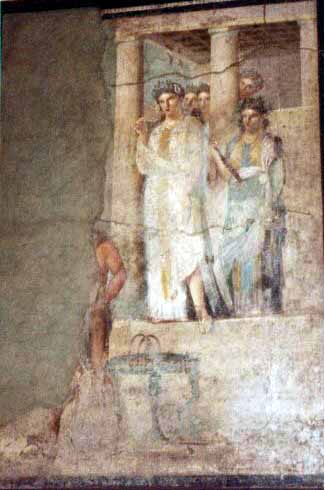
Iphigenia in Tauris, from murals found in Pompeii.
There are no second acts in American lives.
Greek lives, however, are another matter entirely.
Consider the case of Iphigenia, as told by Euripides, that most irreverent of the three great Greek tragedians. She's back, and this time she's mad.
Last we saw Iphigenia, she had been lured to Aulis by her father, Agamemnon, king of Argos, under the pretense that she was to marry the dashing Achilles. That was a ruse Agamemnon had cooked up because the gods had instructed him to sacrifice his daughter to appease Artemis, who had becalmed the seas and prevented Agamemnon's fleet from sailing to Troy to rescue Helen from Paris.
As it turns out, we learn in Iphigenia in Tauris, the whimsical Artemis spirited Iphigenia away at the last minute before the sacrifice. Although the Greeks were fooled into believing the ill-fated girl dead, she was actually brought to Thrace to serve Artemis at the temple in Tauris. It so happens that Iphigenia's job description there includes presiding over human sacrifices. And who is brought to her for that purpose, captured by the local heavy Thoas and his men, but two Greek sailors?
When Iphigenia learns that the sailors are from her home, Argos, she interrogates them in some detail. After a bit of comedic confusion, she learns that the men are her little brother, Orestes, and his cousin, comrade, and best friend, Pylades. That's the good news. The bad news is that Iphigenia's apparent sacrifice led their mother, Clytemnestra, to slay Agamemnon. (Well, there was also that little matter of Clytemnestra's new paramour, Aegisthus, but let's not go there.) Anyway, in retribution, Orestes and their sister Elektra, have now slain their mother. Add the plan to murder their Aunt Helen, and to abduct Helen's innocent daughter, and we're talking serious hot water. It's the kind of jam only Apollo can get them out of, with instructions to steal a prized statue from Artemis's temple, and with a few very ticked off Furies on Orestes's tail, too. Needless to say, Iphigenia and Orestes have a lot of catching up to do, but most of it will have to wait until after they attempt their daring escape from Tauris.
How to handle this peculiar melange of classic tragedy, road saga, and heist thriller--a cup of Aeschylus seasoned with just a dash of Sam Peckinpah? That's the conundrum faced by SCENA Theatre's Robert McNamara & Co., staging the play as the third installment of their Euripides trilogy, which has included last year's Elektra and the ongoing Orestes. In tone, clarity, and momentum, this Iphigenia, though only 90 minutes long, is a tall order, one that calls for some narrative ingenuity and risk-taking, and SCENA delivers with elan, keeping both the play's poignancy and its absurdity intact.
Ellen Boggs is spirited and tormented in the title role. Her Iphigenia serves Artemis loyally, but it's the bitter, disoriented allegiance of a servant since immaturity, who has known nothing else. Indeed, though her body has become a woman's, Iphigenia's mind appears to be stuck, in trauma and disillusionment and homesickness, in a sort of frantic, eternal girlhood.
Remember, the goddess she serves is peculiarly obsessed with purity, but in a tellingly bloody way. For evidence, if you need any beyond the whole human-sacrifice schtick, pull that old file on the hunter Actaeon, who chanced to see Artemis naked at her bath. She turned him into a stag and had him chased down and torn to bits by his own dogs. Talk about passive-aggressive! Some of this, shall we say, ambivalence toward purity, has rubbed off on the volatile Iphigenia, who would like to think there is logic to such a world and to her limbo place in it: commanding slaughters, but without getting her hands dirty. "Gods, wicked? I won't think that!" she declares without much conviction. On hearing of the captured sailors, she feels longing beneath her wrathful blood-thirst, not just for home, but for ordinary humanity. She cries, plaintively, "Greeks...flesh and blood." To her Chorus of Women helpers, she defines where her ocean of rage and sorrow leaves off at the sands of ruthlessness: "It's simple, ladies. Our tears are for ourselves. We have none to spare." Boggs's Iphigenia is a fascinating whirl of determination and delirium.
Christopher Henley is an Orestes who won't be to everyone's taste, but was to mine. Henley makes it a character role--which is chancy but somehow clicks, given the script's ironies. He and Pylades (David Lamont Wilson, solidly gung-ho and gallant in a thankless, small role) are costumed by Konstantin Tikhonov in blood-spattered white suits and tennis shoes, which highlight not only the violence but the metropolitanism of their origins, as well as their youth. They look as if they came off the set of Bright Lights, Big City via American Psycho, but, if initially a bit jarring, that's not unapt. Their tattered preppiness speaks to their "good family" origins, and seeing Furies everywhere isn't, after all, a far cry from a bad trip during an overzealous night of clubbing. Jerked around by the gods, adrift personally as well as geographically, they're the proverbial crazy kids, rebels with an abundance of causes and, in Apollo, a pretty nutty father figure.
It's that James Dean-ish sexy surliness that Henley kind of goofs on, hands in pockets, at once game-faced and ready for the next kick in the teeth. OK, the pinch of Anthony Perkins thrown in, especially around each mention of his m-m-mother, might be a bit over the top. But if you had a mother like Clytemnestra, you'd stammer, too, and on the whole, Henley's Orestes is arresting.
Iphigenia's gripping Chorus of Women is essential, not peripheral, to the work, particularly as conceived by McNamara. These five beings, five voices, act as the unpredictable emotional tentacles of one. They not only resonate with Iphigenia's angry helplessness, but chant and dance and lounge, in an eerily vacant-staring way, to the presiding mood of whatever tale we are hearing from any character. Yet they're seductive and scary and judgmental, too, as they warily eye the hotheaded, cocky Orestes and flirt with his handsome friend. The Women are also, in their most traditional capacity, commentators at large, both admiring and pitying that lowly, striving beast called man. "No mortal pain kills hope," they say. "Some succeed. Some don't. All hope." Onstage, they are five interchangeable ghosty-beasts in one. They do such a good job, however, that their real-life counterparts surely deserve individuation: Melanie Tatum, Alice Anne English, Christine Herzog, Madeline Muravchik, and Mariel T. Butler.
Jim Zidar, as the somewhat inept thug Thoas, gets some refreshing laughs in his couple of brief appearances. He has the grudging petulance of a big ol' bushy-bearded child as he bows to the wishes of Iphigenia and Athena (Svetlana Korobav), who makes a late appearance like some jaded, robed royal fresh off a private beach at Monte Carlo.
David Crandall's sound is used all the more effectively for being used rarely. He doubles as composer, and his original score, heavy on bass and peppered with percussion, helps vivify key plot points and flows wonderfully with the Chorus's pathos-filled song-chants.
Euripides and the talented SCENA players leave us with a strangely invigorating sense of precariousness and humility. "Nobility is ours," says the Chorus, commenting on Agamemnon and Clytemnestra's dazzling family gone to seed--a clan that was spoiled, then spoiled, by the gods. Heading out into the slightly seedy warehouse sidelines of our hubristically named Crystal City, we hear the echoes of the Chorus's warning: "What blesses us, curses us."
Alexander C. Kafka is a contributing writer for Washington City Paper, where this review first appeared. Reprinted by permission.