Click Here To Download
The Idler's Mobile Version

The Idler's Home Page and Table of Contents
The Idler's email list
To advertise in The Idler
Write a letter to the editor

(www.the-idler.com)
Volume III, Number 118


Click here to download chapters from Finish High School At Home by Charlie Clark






CHAPTERS:
LEO STRAUSS AND THE AMERICAN RIGHT
By Shadia B. Drury
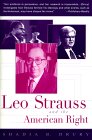
Chapter Four:American Applications of Straussian Philosophy
In the year of the bicentennial of the American Constitution, Gordon S. Wood wondered why the Straussians dominated nearly all of the academic conferences devoted to the study of the American founding.
Part of the answer is that American Straussians are generally conservative, and for conservatives, history is the truest guide to the correct political policies. This is not to say that they are historicists. On the contrary, Straussian conservatives differ from classic or conventional conservatives precisely because they deny that history is the source of truth. Unlike traditional conservatives, they know that every tradition has an origin in the art and inventiveness of great men. Traditions are therefore not as mystical as traditional conservatives generally believe. But this is no reason not to privilege the ancestral, which in this case is the American founding.
There is also another answer to Wood's question, and that has to do with the guilt involved in being conservative in America. There is an assumption, which is not without foundation, that being conservative is somehow un-American.
And if that is so, then nothing could do more to diminish the guilt of being conservative than a scholarly literature intended to show the conservatism of the American Founding Fathers. If conservative policies and ideas can be traced to the Founding Fathers, then being American and being conservative can no longer be regarded as mutually exclusive.
Armed with Strauss's distinction between the wise ancients and the vulgar moderns, Strauss's students set out to discover vestiges of ancient wisdom in their own heritage. Some of them believed that the American founding had its roots in the great tradition of the ancients as defined by Strauss.
Others surmised that America had small vestiges of ancient wisdom, but they have for the most part been overpowered by her enchantment with modernity. Yet others thought that the American founding was so hopelessly mired in modernity that America was almost beyond redemption. These diverse assessments of the American founding have been the source of much of the internecine debates between Strauss's American students. But however much they disagree about the fundamental nature of the American heritage, they are all united in thinking that America is on the verge of some crisis that will devastate her, and maybe even the world, and that the impending doom can be allayed only if she is made to accept, willy-nilly, a kernel of ancient wisdom that would halt the deadly march of liberalism.
In this chapter, I will identify at least three different American reactions to Strauss's political thought. Although these reactions are distinct, they are not mutually exclusive, and may overlap. I will define the three different reactions to Strauss with the words: denial, despair, and pragmatism. The first reaction is a denial that America is modern; a denial that is predicated on a reinterpretation of the American founding as an ancient polity rooted in the great tradition in general, and the classical ideas of the Greeks and the Romans in particular. Harry V. Jaffa is the leading representative of this view. The second reaction begins with an awareness that America is the embodiment of modernity and that her triumph is the death knell of classical wisdom. On this view, the principles on which America is founded are hopelessly modern and tragically flawed. This reaction is understandably filled with despair and foreboding. The gloom of Allan Bloom's The Closing of the American Mind is particularly representative of this view. The third reaction acknowledges the truth of Bloom's vision, but refuses to despair. Instead, it takes a pragmatic approach and sets out to make the most of a bad situation. Willmoore Kendall is the best example of this approach, although it can be argued that Joseph Cropsey, Martin Diamond, and Thomas Pangle provide variations on this theme. This pragmatic approach lays the foundations of neoconservatism discussed in the next chapter.
HARRY JAFFA: AMERICA'S ANCIENT LINEAGE
Many of Strauss's students and admirers are blind to the depth of Strauss's antipathy to America. They cannot believe that Strauss was not an admirer of American freedom, nor a lover of American equality. They cannot imagine that a refugee of Nazi Germany would be critical of a society in which the civil rights of every citizen are guaranteed by the Constitution. This is a natural reaction. After all, Nazi Germany was a hellish place for Jews such as Strauss precisely because Jews had no rights. But in America, everyone has rights that are recognizable and enforceable by law. Suposedly, what happened in Germany cannot happen in America, where the rights of citizens are enshrined in a Constitution that Americans fought and died for.
This is the reaction of Harry Jaffa. In his view, America is everything that Strauss could possibly have hoped for. America is the Zion that will light up all the world. She is a nation founded on eternal and immutable principles of right; her history is a testimony to the triumph of classical wisdom. Strauss's indictment of modernity is therefore not an indictment of America, because the latter has its roots in ancient wisdom. Strauss's critique of modernity must be understood merely as a warning to America, who had better remain true to her roots, if she does not wish to court disaster. What are these ancient roots? And how can they be discovered?
In Crisis of the House Divided, Jaffa argues that the Lincoln-Douglas debates are the American version of what is at issue between Socrates and Thrasymachus in Plato's Republic, Lincoln's position was Socratic--he believed that popular government must depend on a standard of right and wrong independent of mere opinion. In contrast, Douglas was an advocate of popular sovereignty unhampered by independent principles of right; for him as for Thrasymachus, justice was the interest of the stronger, and in a democracy, the majority is the strongest. The triumph of Lincoln over Douglas is therefore the triumph of Socrates over Thrasymachus, freedom over slavery, natural right over majority rule, immutable principles over relativism and nihilism.
Jaffa is quite oblivious to the fact that Strauss regards Thrasymachus and not Socrates as the true spokesman for Plato.
For Strauss, Thrasymachus is the one telling the truth. The harsh and savage truth, which is that there is no such thing as natural right or justice, and that what we call justice is but a set of rules made by those in power to serve their own interests. Strauss believes that Socrates never did succeed in refuting Thrasymachus, but only in silencing him.
Apparently, Socrates tells him (off-stage) that his views are true but too dangerous for public dissemination. If fact, the whole Socratic notion that justice is natural, accessible to reason, and independent of human convention (the fundamental assumption of the doctrines of natural law and natural rights) is itself a Socratic noble lie intended to promote social order and harmony. For Strauss, Socrates is the dissembler, while Thrasymachus is the truth-teller. Jaffa mistakes Socrates's noble lies for the truth. Jaffa takes Strauss at face value, as many others have done.
He assumes that Strauss understands the classics in the conventional fashion, and that the classical philosophers are moral objectivists, and that Plato is not Nietzsche in disguise. But even if we begin from the conventional account of the classics, it does not follow that the American founding extends back from Jefferson and Locke to Aristotle and Plato. I will show later that there is good reason to doubt that there is any line that extends from Aristotle directly to Locke. Suffice it to say that Jaffa's own insistence on equality flies in the face of Aristotelian ideas.
EQUALITY AND THE DECLARATION
For all his talk about the classics, Jaffa is first and foremost a Lockean.
Like Locke, he believes that consent is the foundation of government; but like Locke, he insists on a natural law and a natural right that antedate all government, including government by consent. In other words, Jaffa follows Locke in championing limited constitutional government. This is why Jaffa is opposed to the populist and majoritarian tendencies of modern American conservatives. In contrast to Willmoore Kendall and others, Jaffa affirms a set of absolute and inviolable principles that sets limits on what majorities can decide. For Jaffa, the Declaration of Independence is an expression of the proper relation of natural right and government by consent. Accordingly, Jaffa idealizes Jefferson, and glosses over the contradictory nature of this slave-holding, freedom-loving Founder.
Like Jefferson, Jaffa thinks of America as an unprecedented human experiment and not as a repetition of the old world. Like Jefferson, his political philosophy is based on nature rather than tradition, natural rights and not the rights of Englishmen. And like Jefferson, he is opposed to those who regard the Constitution as a national shrine fit only to be worshiped and otherwise left untouched. For Jaffa, the Constitution can only be understood as a temporary compromise by its authors. But once the times are favorable, then the full measure of the Declaration must be made manifest in the Constitution. Abraham Lincoln is Jaffa's hero precisely because he set America on the road to the actualization of her true principles.
Lincoln realized that slavery was a cancer in the American nation that contradicted her very being. Southern efforts to extend slavery into the territories had to be stopped.
Clearly Jaffa regards the American Declaration of Independence as the definitive document in America's founding.
This is a most unusual position among American conservatives who are inclined to dismiss the radical and egalitarian Declaration in favor of the conservative and aristocratic Constitution. The Declaration is a revolutionary document that appeals to God and nature, and not to venerable traditions; it breaks with British Parliament and the British heritage, and it resolve to a make a new start, to build a society based on the self-evident truths that all men are created equal and endowed by their creator with the inalienable rights to life, liberty, and the pursuit of happiness. Nothing is more antithetical to conservative taste than the resolution to start anew, to break with the past, and to assert the equality of men. In contrast to the Declaration, the Constitution is a product of compromise that accepts inequality, even slavery.
Jaffa is a maverick among conservatives in general, and Straussians in particular; for he insists on the equality enshrined in the Declaration. Strauss and his followers balk at the idea that all men are created equal. As Jaffa points out, his fellow Straussians and conservatives are inclined to agree with John C. Calhoun that only two people were ever created--Adam and Eve--and one was subordinate to the other; the rest of humanity was not created at all, but born, and not born equal.
But Jaffa relies on Locke to make his case, and he makes it eloquently. The equality in question is not an equality of talents, wealth, wisdom, or physical strength. The point is that whatever inequalities there may be among men, they cannot justify making some the beasts of burden for others. It is simply not the case that some men are born to rule and others to be subjects. Nothing in the nature of things justifies this state of affairs. And because being subject is not the natural human condition, the existence of government itself requires the consent of the governed.
This is the Lockean argument that leads to the conclusion (which Jaffa shares) that government by popular consent is the only legitimate form of government.
THE CONSERVATIVE BETRAYAL OF AMERICA
Jaffa castigates his fellow conservatives for being historicists and relativists without principles. He denounces their unprincipled attachment to the past. He tells them that they are no better than liberals and leftists, and that they share the latter's sordid view of the American founding. Like their liberal and leftists opponents, the conservatives regard America's past as rooted in racism, slavery, inequality, and injustice. The only difference is that the leftists reject the past while the conservatives embrace it.
Jaffa's distraught polemics against his fellow Straussians and conservatives are connected to what he rightly sees as their betrayal of the American Revolution.
He criticizes conservatives such as Russell Kirk, Irving Kristol, Jeanne Kirkpatrick, Martin Diamond, Walter Berns, and Willmoore Kendall for rejecting natural right in favor of rights rooted in history and tradition. He reveals the extent to which the idea of equality in the Declaration is anathema to those who long for social hierarchy and who are nostalgic for the slavery of the South. He accuses American conservatives of being propagandists for the Confederacy, and ignoring James Madison, Thomas Jefferson, and Abraham Lincoln in favor of John C. Calhoun and Stephen Douglas. No one proves better than Jaffa the truth of John Stuart Mill's claim that conservatism is the stupid party. When conservatives speak of a "better guide than reason," they are referring to the superstitions and prejudices of the past, no matter how unjust and decrepit.
Nor is Jaffa exaggerating. Conservative and fellow Straussian Willmooore Kendall is a case in point. Kendall vilifies Lincoln as the traitor who betrayed the great tradition and derailed the American founding.
He regards Lincoln as the spiritual father of the New Deal, the expanded presidency, and the welfare state. Kendall surmises that there is a direct line that leads from Lincoln to the radical demands for equality of contemporary liberals to totalitarianism! Natural right is anathema to him. Kendall is an apologist for the Confederacy and longs for the good old days of Southern slavery. He is also a defender of Senator Joseph McCarthy and his Communist witch-hunt. Kendall is convinced that liberal elites have distorted the true principles of the great tradition, but the latter can still be found in the "hips of the people." Nor is Kendall an insignificant figure; he was the teacher of William F. Buckley, who is no doubt the best-known conservative in America.
And Kendall's star continues to shine, for he is much adored at the University of Dallas where T-shirts can still be found that read: KENDALL FOR GOD.
In light of Kendall's beliefs, it may seem puzzling that Jaffa insists on thinking of himself as a conservative rather than a liberal. Part of the answer is that Jaffa's liberalism does not extend beyond the seventeenth century. Jaffa is a Lockean liberal--an advocate of constitutional government and civil rights. But he is not sympathetic with the rest of the liberal revolution. Jaffa has no sympathy with the economic freedom championed by Adam Smith and his modern libertarian and neoconservative followers. Nor is Jaffa in favor of personal freedom or freedom of life-style as represented by John Stuart Mill. He is opposed to the liberal distinction between the public and the private realms. He does not recognize a domain of absolute freedom in the private realm. He believes, much like Mill's critics, that the distinction leads to private debauchery that in the long run undermines the polity because the latter depends on the virtue of its citizens.
The battle between Jaffa and his fellow conservatives and fellow Straussians focuses on issues in American history, with each justifying their claims by appealing to the past. Jaffa focuses on the Declaration, while other conservatives focus of the Constitution. But Jaffa does not wish to ignore the Constitution altogether, and he joins fellow conservatives in advocating that the Constitution be interpreted according to the "original intent" of its authors. In Jaffa's view, the "original intent" of the authors of the Constitution is nothing short of the full realization of the ideals of the Declaration. This idea is very important to Justice Clarence Thomas, whose writings are influenced by Harry Jaffa.
ORIGINAL INTENT
The battle over the original intent of the authors of the Constitution is first and foremost a debate between liberals and conservatives. Liberals argue that the Constitution is a "living document" that has different meanings in different times and circumstances. Chief Justice Earl Warren and Justice William J. Brennan are representatives of this view. In contrast, conservative jurists such as Judge Robert Bork, Chief Justice William H. Rehnquist, and Attorney General Meese are all advocates of original intent. They regard the Constitution as a sacred document containing time-honored principles that should be preserved. They believe that the courts must interpret the law in light of the historical Constitution and its original meaning, rather that relying on a Constitution of their dreams, or a "living" Constitution that changes with the times. In other words, judges must uphold the law, not their own personal and political preferences. Otherwise, we will end up with judge-made law, which means that judges will usurp the legislative power of Congress.
Conservatives complain that liberal judges have little regard for precedent. They are inclined to ask: Is this right? But the conservative advocates of original intent insist that it is not the place of judges to determine the rightness of law. Instead, they must ask: Is it legal? Or, is it constitutional? Or, was it deemed right by the original framers of the Constitution? Whether the Supreme Court judges approve of the law or not is irrelevant. The idea is not to keep the Constitution in tune with the times, but the times in tune with the Constitution. Of course, the Constitution can be changed, not by judges, but by Congress or the legislative branch of government.
The doctrine of original intent insists that judges stick to the letter of the law and not get too creative in their interpretations. But to say that the judge must stick to the original intent of the law does not resolve the difficulties involved. Judges have to apply laws in situations that could not have been anticipated by the original makers of the law. Besides, the Constitution of the United States does not have a single author with a single intention. It has a multiplicity of authors with diverse intentions, and is in the final analysis a product of compromise. The doctrine of original intent is intellectually fraught with difficulties.
Chief Justice Roger B. Taney, who presided over the famous decision in the Dred Scott case (argued in the Supreme Court 1856-57) can be regarded as the most eloquent representative of the doctrine of original intent. Judge Taney argued that the Constitution regarded slaves as property and that the right to property in a slave was to be protected in the same way as the right to any other article of merchandise. And since the Constitution had not been amended, he as judge was not in a position to invent something that was not there. He surmised that as a judge, he had to abide by the letter of the law where this "unfortunate race" was involved. The decision in the Dred Scott case brought the conflict between the North and the South over the extension of slavery into the western territories to a head, and this in turn precipitated the Civil War.
Jaffa disagrees with Justice Taney's decision, saying that he was wrong to deny that the descendants of African slaves are not included in the word "citizen" as used in the Constitution. But instead of abandoning the doctrine of original intent, Jaffa insists that it must be reinterpreted. He insists that the intent of the framers is that the Constitution must be understood in light of the Declaration. And since Taney's interpretation of the law is contrary to the Declaration, then it is contrary to the doctrine of original intent properly understood. Jaffa's reinterpretation of original intent is questionable, and it is not surprising that many conservatives reject it.
But Justice Clarence Thomas shares Jaffa's view of original intent.
The doctrine of original intent is positivistic in its tenor--it says that law is valid and must be upheld whether it is just or not, whether judges approve of it or not. But Jaffa is an advocate of natural law and natural right and these are concepts that are not always compatible with the conservative reverence for law. It seems to me that an advocate of natural law cannot wed his views with original intent without creating a strange and contradictory hybrid. Jaffa uses the doctrine of original intent to bridge the gap between what is right and what is legal. In essence, his position is that what is legal is right--at least deep deep down in the hearts and minds and intentions of the authors of the law, if not in the letter of the law itself. But this idea undermines the conservative and positivistic character of original intent.
Jaffa's version of original intent explains the importance of prudence and statesmanship in his thought. Prudent judges must interpret the law in the most charitable light, the light of the natural law (Justice Roger B. Taney did not display this sort of nobility in the Dred Scott case).
The same is true of great statesmen such as Lincoln; he knew what was right and he did his utmost to move his people and their laws closer to the philosophic ideal of right. Jaffa also thinks that the same standard applies to lower officials such as Oliver North who was at the heart of the Iran-Contra affair. North was involved in a covert operation to sell arms to Iran and use the profits to provide military aid to the Contras who were conducting a guerrilla war against the Sandinista government in Nicaragua. The operation was illegal because it was contrary to legislation enacted by Congress. The executive branch was opposed to the legislation and may have turned a blind eye to the operation. The extent of the involvement of President Ronald Reagan and Vice-President George Bush was never clearly determined. Jaffa regards Oliver North as a hero and condemns the president for not having supported him vigorously and openly. Jaffa's position is puzzling because condoning Machiavellian tactics in the administrative branch goes contrary to his own insistence on government by consent. Of course, Jaffa believes that the people don't always know what is right or what is good for them, and this is why leadership is of the essence. However, there is a difference between leading people openly through persuasion, and using devious methods to circumvent the law, supposedly for the people's own good. This is the difference between great statesmen and Machiavellian scoundrels.
Jaffa clearly believes that devious and illegal methods are justified when those in power are convinced of the rightness of their ends. In this way, Jaffa combines the anarchic risks of the natural law doctrine and its high-minded moral appeal with more than a dash of political Machiavellianism. In responding to my claim that Strauss's conception of natural right was consequentialist and Machiavellian, Jaffa revealed his own sympathies to Machiavelli.
But Jaffa does not think that devious and duplicitous tactics are Machiavellian when they are used by those on the side of the good, the right, and the national interest. The trouble is that if great statesmen use the same tactics as tyrants, then it becomes difficult to distinguish them. Jaffa thinks that this is a politically naive point of view. And I would grant him that the greatest statesman cannot afford a policy of total honesty if he hopes to care for the welfare of his people. But by the same token, there must be sacrifices that he is willing to make for the sake of doing what is right. The great statesman must set limits on what he is prepared to do to pursue the most felicific course of action. It is precisely the absence of this moderate spirit that is disturbing about the famous dictum that Jaffa coined for Senator Barry Goldwater's campaign for the presidency in 1964: "Extremism in defense of liberty is no vice. Moderation in pursuit of justice is no virtue."
Jaffa can be understood as a quintessential modern from the Straussian point of view. For Strauss, modernity contains tyrannical proclivities that are global, precisely because it is founded in a universal and rationally justifiable set of absolute and inviolable moral principles. When this faith is healthy, it invites global tyranny and totalitarianism; when it falters, it ushers in nihilism and despair. So, whether healthy or not, modernity is undesirable. From this point of view, Jaffa's modernity is robust but disastrous. It leads him to confuse the good with American interests around the globe.
Although I am sympathetic to Jaffa's liberal rationalism, I think that Strauss and other postmodern writers have good reason for thinking that rationalism often has despotic tendencies.
CRITIQUE OF JAFFA
In concluding, I would like to return to Jaffa's insistence that America is heir to classical ideals. It seems to me that there is a profound and fundamental difference between the American and classical traditions that Jaffa overlooks, largely because of his Straussian education. Strauss's Manichaean dichotomy between the wise ancients and the vulgar moderns obscures the significant divide between the pagan and the Christian traditions. Locke and Jefferson belong to the Christian rather than the pagan tradition. The doctrines of natural law and natural rights are not classical in origin. They have their source in the Christian belief in the inviolability of individuals because the latter are the property of God, made in His image. This means that no amount of social benefits or advantages to the society as a whole can justify the violation of the life or liberty of individuals. This emphasis on the sanctity of individual life explains the prohibitions on infanticide and abortion. But pagans like Aristotle thought that infanticide and abortion were legitimate means of controlling the size of the population.
Aristotle's rationale was that the state exists to promote human happiness that was understood as the life in which the highest human faculties are cultivated. There is a clear sense in which individuals are responsible for their own happiness, because it is up to them to take the initiative to cultivate themselves. Nevertheless, it is also the case that they need certain external goods that would provide them with the opportunity for self-cultivation. The function of the state is to provide the conditions under which this optimum self-development of individuals is possible. Wealth, leisure, friendship, and even an opportunity to exercise one's rational and deliberative faculties in the political arena are among the conditions of the good life. The state is justified in doing whatever is necessary to make the good life possible. It is this consequential reasoning that led Aristotle to justify slavery as a necessary means to the leisure needed for the good life, and to regard infanticide and abortion as equally necessary and justifiable.
Another reason that the American Founders are not heirs to the classics has to do with the question of equality. The classical thinkers were not egalitarians. They did not believe that human beings were born equal.
They thought that people had radically different potentialities and this meant that they were not entitled to the same privileges and the same consideration, or even formal equality before the law. Jaffa is quite mistaken in thinking that there is a line that extends directly from Aristotle to Locke. After all, Aristotle defended slavery, while Locke argued for equal rights because he thought that whatever differences there were among people, they were all the property of God and cannot be abused or destroyed without offending Him.
There is absolutely nothing Aristotelian about the American founding. Aristotle is a eudiamonistic and consequential thinker. To use John Rawls's expression, he believes that the good is prior to the right; in other words, he posits a certain good, then he declares that the right is what best promotes the good in view. In contrast to Aristotle, the rights of the Declaration (which are enshrined in the amendments to the Constitution) are fundamental. They are prior to the pursuit of any given good.
Another important difference between American liberal assumptions and the classics has to do with the pursuit of happiness. Contrary to the assumptions of the classics, American liberalism as enshrined in the Declaration regards the pursuit of happiness as plural rather than singular.
The function of the state is not to promote a particular understanding of the good, but to protect individual rights and freedoms so that citizens can pursue their own visions of the good life without interference as long as they do not violate the rights of others to the same.
This liberal aspect of the American pursuit of happiness is not endorsed by Jaffa. Jaffa shares with conservatives and fellow Straussians from Willmoore Kendall to Allan Bloom the view that America is too liberal and pluralistic and that what it needs is a single orthodoxy that governs the public and private lives of its citizens.
There is yet another reason that the American Founders are not first and foremost heirs to the classics, and that is the question of virtue. As Jaffa makes clear, the Founders were lovers of liberty; but he also thinks that they were equally lovers of virtue. And it is their love of virtue that brings them closer to the classics, because the latter were not partial to liberty. I believe that Jaffa is right in thinking that the Founders were lovers of liberty as much as lovers of virtue. This is not surprising since freedom and virtue are both genuine goods of equal worth that enhance human life. However, the tragedy of political life is that it is impossible to choose both of these goods in full measure. A society must choose which one will be fundamental; it must order them hierarchically. If we value virtue above all else, then we must be willing to forgo a great deal of the freedoms we now take for granted. If we choose freedom, as liberal societies do, then we must be willing to put up with a certain degree of vice. It is impossible to have both perfect freedom and perfect virtue at the same time. Liberals have always defended private vice, not because they are drawn to it, but because they are compelled to defend a domain of liberty that is free from government interference, even when this liberty is badly used. Liberals know that the cost of liberty is a certain tolerance of vice. And it may well be that their love of liberty is so immoderate that they are willing to accept more vice than a society can withstand and still thrive. The question that liberals are reluctant to ask is: at what point does private vice infect public order and decency? But even if they are reluctant to ask that question, liberals are cognizant of the fact that liberal society is premised on a certain degree of self-restraint. The question is: has this self-restraint been sufficiently eroded as to make a free society no longer viable? And if this is the case, then we should not be surprised to lose some or all of our cherished freedoms; because we are likely to get the government we deserve.
There is little indication that the Founders were very clear on these issues. In fact, they were often attracted to the most foolhardy aspects of liberal doctrine. I am referring to the intoxicating idea that the proliferation of private vice contributes to the maximization of public benefits. Private vices such as greed and the love of wealth unwittingly contribute to the commonwealth by increasing productivity. Adam Smith popularized the doctrine with his concept of the "invisible hand" that insures that everything works out for the common good, even though individuals pursue their own interests with little regard to the welfare of others. The idea is as enticing as the advertisements that promise a sleek and fit physique without diet or exercise. It implies that we can have excellence without effort. This view was satirized by Bernard Mandeville in his poem Fable of the Bees that was subtitled "private vices, public benefits." Mandeville laughed at a society in which every part is full of vice, yet the whole mass a paradise!
This is the sort of doctrine that one finds in the writings of James Madison, side by side with overtures to virtue. Madison echoes Kant's view that if men were angels, then government would be unnecessary.
The implication is that well-crafted institutions where interest checks interest would make good government possible even in a nation of devils. But this seductive doctrine is totally antithetical to the sobriety of ancient philosophers who taught a hard truth about politics--namely, that our government is only as good as ourselves and that without self-restraint we cannot hope to have justice. Plato taught that the state was a microcosm of the individual and that the character of the state will always resemble the dominant character of the citizens, especially those in power.
The doctrine of the separation of powers that has played such a significant role in American politics is a procedural technique by which power will check power. This device may limit the abuse of power, but it cannot secure justice unless it is endowed (as it often is) with magical charms. Institutions alone cannot guarantee justice. Corrupt individuals will always find ways to circumvent the system; they will manage to discover loopholes in the law. This is why Plato banned lawyers from his ideal regime. He thought that a society that depended on law alone and not on the virtue of its citizens would be perpetually making laws to fill the loopholes discovered in the previous ones. He compared the efforts to secure justice in such a litigious society with the hopeless enterprise of cutting off a hydra's head (twelve more grow in its place). To the extent that America's Founders believed that liberty and justice can be secured by an ingenious Constitution, by the separation of powers, or by any other legal and institutional devices, they have fallen prey to an intoxicating doctrine that is no part of the sobriety of the ancients.
For all these reasons, Jaffa's claim that the American Founders were heirs of the classics is highly questionable.
ALLAN BLOOM: AMERICA'S INCURABLE MODERNITY
Allan Bloom's The Closing of the American Mind is the most successful popularization and application of Strauss's ideas to America. Bloom's view of the American founding is diametrically opposed to the view expressed by Harry Jaffa. Bloom portrays America as a polity grounded in the ill-conceived ideas of modernity, ideas that are engulfing the globe and shattering the glorious heritage of Western civilization.
According to Bloom, America's Founding Fathers were the heirs of early modern philosophers such as Hobbes and Locke. These moderns were not privy to the sublime insights of the classics or their recent heirs--Rousseau and Nietzsche. Instead, they looked at man in his brutishness: untamed, uncultivated, and self-centered. And, incredible as it may seem, the early moderns set out to create a society made up of these selfish creatures. The result was a society of individuals whose natural tendencies for self-seeking and self-satisfaction were not suppressed by culture, but simply rechanneled into commerce. In this way, man's natural egoism assumed a form that was not altogether destructive of social life. The result was a bourgeois society that is paradigmatic of American life.
Bloom portrays American society as a collection of solitary individuals with nothing to live or die for. American society offers man a sterile vehicle for self-preservation, self-aggrandizement, and the pursuit of wealth. Such a society cannot become the object of love and devotion. It cannot elicit the sort of passion that is equal to the strength and violence of sexual passion. This is the meaning of Bloom's notorious complaint that there is no mention of sex in the American founding.
"Why should there be?" reviewers like Harry Jaffa have scoffed.
Bloom's apparently outrageous remark is meant to indicate the absence of a culture whose charms can transfigure sexual energy into love of motherland.
As a result, Bloom believes that America fails to provide a culture that can be embraced, loved, and appropriated by its citizens. She offers them only an opportunity to devote themselves to the satisfaction of their brutish nature. Far from teaching them to have contempt for themselves and their brutishness, it teaches them smugness and self-satisfaction.
America provides her people with nothing splendid and sublime to bow before. All this is due to the fact that her roots are hopelessly mired in modernity. And this leads her to believe that a society can be built on truth, philosophy, and enlightened self-interest. But the wise know that society needs myths, religion, and self-sacrifice, otherwise it is little more than an animal farm.
AMERICAN LIBERALISM Bloom heaps abuse on American liberalism and its open society. He complains that America mistakes her supreme vice, the greatest threat to her well-being, and the source of all her troubles, for her supreme virtue. Bloom makes three distinct objections to openness. First, he provides what appears to be a typical conservative indictment of liberalism. This criticism amounts to saying that a healthy society is one in which citizens are united by a single orthodoxy or a set of shared values that are believed to be superior to those of every other culture. In contrast to this unitary and cohesive model, American liberalism is open to a plurality of values, life-styles, and cultures, and this supposedly makes America little more than a collection of isolated, alienated, and disoriented individuals lost in a morass of cultural relativism and meaninglessness.
It would be a mistake to suppose that Bloom objects to openness tout court. On the contrary, Bloom regards openness to be appropriate for philosophy, but not for society. Philosophy must be open to the truth that transcends convention. Like Strauss, Bloom thinks that the truth discovered by philosophy is relativistic, nay even nihilistic because philosophy can provide no rational justification for the morality necessary for convention, any convention. Philosophical openness is appropriate for the few who can live in the absence of dogmas and conventions, but it is not appropriate for society. Society needs its dogmas. For Bloom, as for Strauss, society cannot be modeled on philosophy without courting disaster. An open society encourages citizens to think that all cultures are equal, and that their own culture has no special status in the world, or mission in history. This leads to relativism and its concomitant results-- indifference, nihilism, and political annihilation.
In response to this objection, it is important to point out that for all its devotion to openness, liberalism is not itself nihilistic or relativistic. The liberal devotion to openness does not have its source in skepticism or relativism. Liberalism is not born out of the belief that there is no such thing as truth, or that everyone has their own truth. On the contrary, the liberal devotion to freedom of thought, speech, and discussion is rooted in the liberal love of truth, and the hope that the truth will best be served by open discussion and debate. John Stuart Mill argued eloquently for freedom of thought and speech on the ground that no one has a monopoly on truth. To assume that the conventional opinions are true, and that dissenting opinions should be silenced, is to rob mankind of the opportunity to exchange error for truth.
It was on account of truth that liberals put their faith in openness. But Bloom has no faith in the salutary effects of truth. And this is the real source of his objection to openness. Anticipating Straussian objections, Mill argued that in an age "destitute of faith, but terrified at skepticism," men will insist on the protection of public orthodoxies not because they are true, but because they are useful to society. But the usefulness of an opinion is itself a matter of debate.
One of the pervasive problems with Bloom's critique of American liberalism is that it confuses liberal reality with liberal ideals. In criticizing American liberal society, Bloom is under the mistaken impression that he is also criticizing liberal theories, ideas, and ideals. This confusion has its source in the assumption that American liberal society is the actualization of liberal ideals, or the logical and inescapable consequence of these ideas. Listlessness, indifference, promiscuity, and nihilism are assumed to be phenomena that belong only to liberal societies. Liberalism is assumed to be bereft of all moral fiber; only conservatives have principles. But in truth, many of Bloom's criticisms of American liberalism are made by liberals such as Ronald Dworkin. Dworkin uses liberal arguments to oppose rampant commercialism and its attendant pornographic excesses.
He feels that it does not provide the neutral public space that liberal society needs to make freedom in the private realm possible. He worries about how those with traditional attitudes to sexuality can live freely and pass their convictions and traditions to their children in an atmosphere so charged with sexual libertinism. It is therefore not the case that American liberal society is the manifestation of liberal principles and ideals. Bloom's second objection to openness is that it contributes to the weakness of society by allowing it to embrace within itself a multiplicity of cultures and ways of life. In so doing, openness prevents the development of a "collective consciousness."
Bloom points out that in America, majorities have always been suspect, and as a result, American politics is dominated by minorities, or what the Founders called "factions." Bloom remarks that the Founders were wise enough to be wary of factions.
By the same token, it must be added that the American Founders were not so wary of factions as to try to eliminate them altogether. On the contrary, Madison thought that it is impossible to eliminate factions without also destroying freedom.
He therefore tried to create a system that would mitigate the effects of factions, without actually prohibiting them. To eliminate factions is to give priority to collective consciousness over individual freedom, and to abandon Locke in favor of Rousseau--and this is precisely the position Bloom takes.
Bloom is suspicious of factions because he follows Strauss in thinking that Weimar is the prototype of liberalism. He therefore transposes the Weimar experience onto the American setting. As a result, his book is full of vague and formless premonitions of disaster. One of the most pervasive themes of his book is the uncanny coincidence of American popular culture with that of Weimar and Nazi Germany. For Bloom, America is the ghost of Nazi Germany. He would dearly love to save America from the catastrophes of Europe, but America's love affair with her own liberal modernity fills him with unmitigated gloom.
For Bloom, liberalism sets the stage on which the conflict between irreconcilable factions takes place. These conflicts are bound to erupt into violent confrontations, which could end only with the dominance of the triumphant faction. This is what happened in Weimar, and it will very likely happen in America. In order to convince his readers of the aptness of the comparison between America and Weimar, Bloom spends a great deal of energy documenting the subliminal similarities between America and Weimar. Americans are unconsciously using the same words ("hang loose" is really a translation of Heidegger's Gelassenheit), the same music (Louis Armstrong's "Mack the Knife" was Marlene Dietrich's song), the same social science (values, charisma, and gestalt are all German in origin).
It is worth noting that Bloom's second criticism contradicts the first. The description of America as threatened by the possibility of violent conflict between groups contradicts his claim that openness reduces America to a collection of atomized, isolated, unconnected individuals. It is possible to argue, as Hannah Arendt does, that the isolation and atomization of individuals makes them vulnerable to becoming a "mass" blindly led by self-proclaimed supermen.
But Bloom cannot use this argument against liberalism precisely because his conception of social health is intimately connected to the idea of a mass blindly led by a philosopher-superman. This is the source of Bloom's admiration for Rousseau, whose democratic ideas are shot through with the towering image of the great lawgiver--the architect of the will of the people. If openness really makes people into atomized, isolated, passive monads who are easily led and manipulated by demagogues, then Bloom should praise openness as a necessary stage on the way to a truly united, cohesive, and meaningful social order.
Bloom's third objection to openness is that it is a fiction and a sham--it is impossible for a society to be open. In reality, American openness is a fraud that camouflages her imperialistic inclinations. When Americans set out to learn about other cultures, they find that they are closed, each thinking that it is the best. For example, Herodotus reports that the Persians thought of themselves as the best, and the nations bordering them as second best, and the nations bordering the nations bordering them as third best, and so on.
The Persians considered themselves as the model of civilized humanity, and judged everyone in terms of their proximity to themselves. Americans are supposedly repelled by this closedness, which they reject in favor of their own openness. In other words, Americans reject every other culture in favor of their own. This is the import of Bloom's claim that the great opening is really a closing and a "disguised form of a new imperialism."
Bloom implies that Americans are just as overbearing as the Persians were. In short, American society is, in spite of itself, a closed society, and to the extent that it is determined to divest every other society of its closedness, American society becomes imperialistic. Unwittingly, Americans behave much like the Persians (whom Bloom considers strong and healthy). But even if Bloom is right in thinking that America's openness is hypocritical, it does not follow from his own criteria that this hypocrisy makes her weak and vulnerable.
Bloom's claim that America is weak and in danger of dissolution is not consistent with his observations and assumptions. Openness is the form that American culture assumes; and it operates like other successful cultures in history--overbearing, self-righteous, and imperialistic. It may be worth recalling that after the Gulf War of 1991, American bumper stickers read: "we're number one and don't you forget it." It seems to me that American boorishness is not to be outdone--not even by the Persians. Far from being, atomistic, nihilistic, and indifferent, Americans often seem menacingly patriotic. There may be all sorts of things wrong with America, but on Bloom's criteria she must be deemed very healthy indeed.
Bloom's criticism of American openness is contradictory. Either America is open, and hence weak and vulnerable, or she is closed, and hence strong and imperialistic. Bloom begins by objecting to openness because it threatens America with "decomposition," and ends by denouncing openness as a new form of imperialism.
I contend that it is not America's weakness to which he objects but her strength. Bloom is fully aware of the ease with which America is quickly remaking the world in her own image, and is worried that her brand of imperialism might prove irresistible. But he does not admire her strength.
The explanation has its source in the fact that Bloom finds American culture repellent.
Nothing exclusively American counts as culture. He is blind to American art forms such as jazz and blues. He is not capable of appreciating, as Nietzsche would, the triumph involved in turning the pain of slavery into art. His objection to American liberalism has everything to do with its strength and its seductive appeal, not its weakness.
In summary, Bloom's objections to American liberalism are threefold. First, liberalism fosters atomized, nihilistic individuals. Second, liberalism endangers America by making her into a stage on which the conflict among cohesive groups takes place. Third, liberalism is hypocritical because it is just as imperialistic and bombastic as any closed society. These criticisms are paradigmatic of the futility of the Straussian critique of American liberalism. Like Strauss, Bloom cannot endorse either pluralism or the unity of the American melting pot. Pluralism is divisive and reminiscent of Weimar; while the all-American melting pot robs Europeans of their identities in favor of the meaningless individuality of liberal society. Bloom longs for the clannish brotherhoods that existed before the melting pot had a chance to do any damage. In short, the liberal creed and its love of freedom cannot be the foundation of a new community; true community has its source in blood, soil, and religion.
It is clear that Bloom's Straussian philosophy cannot provide America with a meaningful critique of her liberal tradition. Straussian conservatism can neither ennoble nor inspire American liberalism, it can only reject it. Strauss has taught his students to despise America's liberal heritage, not just because it can fail, but because it might succeed.
EDUCATION
When William J. Bennett, former secretary of education and chairman of the National Endowment for the Humanities, published a report on the state of the humanities in higher education, it sparked a controversy that has not abated.
Bennett's report was damning; it maintained that students graduate from colleges and universities ignorant of the great works of Western civilization; as a result, they live as aliens in their own culture. Higher education has failed these students because it has not enriched their lives as it was meant to do. The source of the problem is the universities themselves. In particular, the professors have retreated behind the cloak of expertise, professionalism, jargon, and pedantry. Bennett reprimands the academics for losing their nerve, and drowning in the quagmire of relativism. Bennett is right, but that's not the whole story.
Bennett implies that there is a single, coherent set of ideals and principles contained in the great books of Western civilization, and that it is the function of the university to inculcate these values. Based on this belief, Bennett was grouped with Allan Bloom and Saul Bellows as conservatives and dubbed by their opponents as the three killer Bs.
The most ardent opponents to this conservative view of education are the fashionable postmoderns in the academy. But in my view, the Straussian outlook on education is not that different from the postmodern position. On the postmodern view, all ideals are but excuses for domination. All claims to knowledge are but disguised manifestations of the will to power. The canonical works of the Western tradition are nothing more than subtle and seductive tools by which the West inculcates its values and insures its supremacy. In the eyes of the postmodernists and deconstructionists who follow Michel Foucault and Jacques Derrida, the values of the West are the values of domination--the colonial domination of the Western over the non-Western world, of whites over all other races, and of men over women. Postmodernists reject the pedagogical emphasis on the great works of Western civilization because the latter is imperialistic and oppressive, and its art and literature are simply ornaments intended to justify or camouflage its "white mythology."
To undermine this subjugation, literature penned by the subjugated, the downtrodden, and the colonized must take the place of books penned by the dead white males of the Western tradition. Postmoderns do not pretend that these new books will replace the old regime of power with a new regime of truth; they will simply replace one regime of power with another. In this struggle for power, the humanities are the architectonic activity--the makers of civilization, and the shapers of minds and souls.
The trouble with this view is that it leaves us completely at sea. It replaces the search for truth with the quest for domination. It dismisses all ideals as lies and subterfuges. But in truth, ideals always look like lies to those who are disenchanted with the realities of their own civilization. And it is also the case that every civilization falls short of its ideals. There is always a gap between the realities of a civilization and its ideals; the size of the gap is a measure of a civilization's success or failure. It is indeed the case that Western civilization has not lived up to its ideals. But there is no better way to shame a civilization than to compare its actions with its own ideals and principles. Asking it to abandon those principles altogether can only augment its crimes and pave the way for its complete demise. The debate between the conservative and the leftist views of education is often mistaken for a debate between radical relativists and moral objectivists in search of timeless truths.
But it is important to recognize that Bloom does not condemn the universities for failing to inculcate the truth. On the contrary, he regards the truth as too dangerous to be spread liberally by universities intended for mass education. His point is that the universities, because of their commitment to openness, have failed American society on two counts. They have failed to educate either the many or the few. First, they have failed to impart to the many what Strauss calls noble lies or salutary myths; the myth of openness is destructive, not salutary, because it fails to cement individuals into a single whole with a single identity.
Second, the universities have failed to provide the few with what Bloom regards as an education in the real sense: a capacity to transcend the myths of the cave and see the truth. To do this, philosophy must dismantle culture, and Bloom warns that this is a "dangerous business."
Philosophy breaks the spell of culture. It liberates man from the charms by which culture holds him captive. It is therefore a threat to civil society. American universities are heirs of the modern belief that philosophy is not dangerous to political life and that it can be unleashed on the many without cost. Bloom has no intention of replacing philosophy with indoctrination into the myths of culture. He would simply like to reserve philosophy for the few. But how can this be done in universities designed for mass education?
Strauss comes to the rescue. The great books of Western civilization contain a dual teaching as Strauss tirelessly illustrates. They can therefore be adapted to the needs of education in a mass society. They can teach the many to weep and worship while fashioning the supermen who will be the architects of the lores and legends of society. In this way, philosophy, understood as the brutish return to nature, is preserved without wreaking havoc on sacred culture. Bloom's central objection to American culture and American universities is that they spread nihilism about too liberally.
In the past, the debate between the right and the left proceeded on objectivist premises. At the heart of the debate was a discourse on justice, or what a just and good political order requires. But in the contemporary version of the debate, the two antagonists agree that justice and truth are fictions intended to conceal the arbitrariness of traditions and their attending customs, powers, and conventions. The left sets out to uncover the fiction, while the right upholds it. Since there are no legitimate grounds for authority, the left defends the new order simply on the grounds that it is the turn of the downtrodden to wield power, while the right tries to hold on to the power it has against the intrusion of the rabble. Both parties to the dispute share the postmodern preoccupation with power and the postmodern belief that knowledge is power. The debate is intractable because it begins from the same premises. Indeed, it is not an intellectual debate at all, but a political conflict about who should be given the liberty or privilege of shaping reality.
Contrary to the assumptions of the postmoderns on both the right and the left, the greatest books produced by the West are not a homogeneous lot with a uniform set of values. They are neither morally abhorrent (as the left maintains) nor are they flawless founts of wisdom to be disseminated with uncritical reverence (as the right assumes). The great books are neither evil incarnate nor goodness personified. They are not a pernicious quest for domination. Nor are they a value-free and apolitical account of a single, objective truth. They are a dispute and a conversation about the right and the good--a conversation that is the heart and soul of the Western tradition.
The university has always been political, and a liberal arts education is a political education because it is an education in the best political alternatives that have been proposed or thought by the writers and thinkers of the West. Plato, Locke, and Marx are not apolitical writers. Their works are not value-free, nor do they pretend to be. The writers of the Western tradition, even if they are all male and white (there are exceptions) do not speak with the same voice, which is to say that their sex and their race do not altogether determine their thoughts.
At the heart of Bloom's conception of higher education is the Straussian assumption that a tradition is like a house of cards; it cannot afford to be too closely scrutinized. This is why philosophy must retreat or be kept secret. Traditional conservatives have always distrusted reason. But it was only individual, isolated, ahistorical reason that they distrusted. They still believed that their traditions were grounded in the wisdom of the ages, or the reason of humanity. This is why they warned against sweeping away the past and replacing it with newfangled ideas and institutions. No matter how reasonable the latter may seem, conservatives caution that their rationality has not been fully established because they have not withstood the test of time. In contrast to traditional conservatives, Bloom, like Strauss, regards traditions as the rationally groundless inventions of philosophers, sages, and prophets who pretend that their inventions have their source in divine inspiration. Supposedly, Moses, Jesus, Mohammed, and Buddha were creative geniuses who invented Judaism, Christianity, Islam, and Buddhism. These traditions are founded neither in reason, God, nor nature. What makes a people what it is, what lifts it out of the brutishness of nature, is the adoption of a way of life that involves sacrifice and hardship.
It matters little what that hardship is for. It is no wonder that so arbitrary a burden cannot withstand rational scrutiny.
It may well be that Strauss and Bloom are wrong. Far from destroying a tradition, rational discourse serves to strengthen it. A tradition that is unexamined, a tradition whose rational justifications have been forgotten, a traditional that is never challenged, is bound to atrophy into what John Stuart Mill called the "dull and torpid assent" that is generally accorded to dead dogma, and what A. N. Whitehead called "mental dry rot."
More recently, Alasdair MacIntyre, who is not himself a liberal, has brilliantly defended this conception of tradition.
MacIntyre has pointed to the difference between tradition and taboo. The latter is a totally irrational adherence to practices, customs, and ways of life--practices that when challenged or questioned collapse instantly. Such was the situation of the Hawaiians under Kamehameha II.
Europeans wondered why it was deemed so indecent for men and women to eat in each other's presence, in a society that was so casual about sexual intercourse. When asked to give an account of their customs, the Hawaiians were stumped. The geographic isolation made them unfamiliar with this sort of challenge; they were not accustomed to giving an account of their beliefs and practices. And once challenged, they collapsed almost instantly, since they had no vitality and were not part of the inner life of the people. What is disconcerting in the current debate between the right and the left is that it is a debate between postmoderns who share the same view of the West. Allan Bloom does not deny that culture imposes its dominion through art, myth, illusion, and subterfuge. His point is that it is the function of the humanities to sustain the myths, to inculcate the illusions, and to maintain the dominance of the West. It seems to me that a culture is in trouble when its critics and its defenders describe it in the same terms--as domination camouflaged by sugarcoated lies.
AFFIRMATIVE ACTION
Bloom's criticism of affirmative action is wildly hypocritical. His argument relies heavily on liberal ideals and sentiments. He objects to affirmative action on the ground that it undermines the primacy of merit and considerations of excellence that ought to govern university admissions. Preferential treatment for disadvantaged groups accomplishes nothing more than humiliating the very groups whose social position it is intended to improve. The reason is that everyone suspects that they have been admitted without having the credentials to make the grade, even when this is not the case.
The trouble with Bloom's argument is that it is disingenuous. No sooner does he finish extolling merit and excellence as the supreme criteria of admissions, he begins to wax nostalgic over the good old days when "aristocratic sentiments" prevailed, and when differentiations based on family and wealth were the rule. Unfortunately, Harvard, Yale and Princeton have
abandoned preference for the children of their alumni and the exclusion of outsiders, especially Jews. Academic records and tests became the criteria for selection. New kinds of preference--particularly for blacks--replaced the old ones, which were class preserving, whereas these are class destroying. Now the student bodies of all the major universities are pretty much alike, drawing from the best applicants, with "good" meaning good at the academic disciplines. There is hardly a Harvard man or a Yale man anymore.
Even Harvard and Yale, the "last resorts of aristocratic sentiments," have "lost their focus" and succumbed to democratizing pressures.
Clearly, Bloom approves of special treatment for the sons and daughters of Harvard and Yale graduates, but not for the sons and daughters of former slaves. He insists on academic excellence when it comes to admitting the latter but not the former. Because his devotion to excellence is suspect, his argument against affirmative action is hypocritical and manipulative in the extreme--it appeals to our liberal and meritocratic values but only to protect privileges based on birth, not merit or excellence.
LOVE, SEX, AND FEMINISM
His objections to Freud notwithstanding, Bloom's discussions of love and sex, as well as his indictment of feminism are premised on Freudian assumptions about sexuality that he partly inherits from Leo Strauss. Simply stated, these assumptions are as follows: Men are primarily interested in sex, and women are primarily keen on offspring. Women are therefore mothers by nature, but men are fathers only by convention. It is the function of civilization to transform natural men into fathers and husbands. Women are necessary accomplices in this process. By withholding their sexuality, women are the key to the existence of the family and to the process of sublimation.
Sublimation is the process by which frustrated sexual energy is redirected to other interests and pursuits. Like Freud, Bloom regards culture and the arts as the products of sublimation.
Although Freud welcomed the success that civilization has achieved in taming mankind and redirecting sexual energy into art and science, he warned civilization against being so encouraged by its success as to embark on even greater conquests over the instincts. He believed that the triumphs of civilization were won at the expense of the instincts and that there were limits to the oppression that the instincts can withstand without either becoming neurotic or rebelling against their intolerable burden.
Either case would be disastrous for the future of civilization. In light of his assessment of the situation, Freud would have welcomed outlets for the beleaguered instinct--birth control, rock and roll, free love, and feminism, for example. But Bloom's attitude is the very reverse. Bloom is a champion of civilization and its repressions.
Despite his reliance on Freud, Bloom departs from him in a significant way. Bloom is a romantic at heart. And he is most endearing when he speaks of the beguilements of love and the illusion of perfection it creates. He laments that the relations between the sexes have been demystified, and that the world has been robbed of love, romance, and enchantment. The rot began with the unerotic Freud. Bloom does not reject Freud's account of sublimation; he objects to the fact that the Freudian account implies that the pleasures of art and culture are second-best in comparison to the raw sexuality of nature. Bloom argues that Freud cannot answer the question: why sublimate instead of doing what comes naturally?
Of course, Freud devoted much energy to answering this question; but his answer usually took a social rather than an individualistic turn. Simply stated, he believed that the appetites when left to their own resources run afoul of reality, and make survival, peace and social order impossible. But Bloom is asking the question that Glaucon asked Socrates: why should, I (or any other individual) sublimate if I have the chance, in the context of the relative peace and order that society provides, to seek the greater satisfactions that nature affords? Freud's answer to that question is not all that clear. There is a hint of the Platonic answer that the appetites are self-destructive, and that they need to be restrained for their own good. If we eat all the time, then we will be unable to enjoy the pleasure of eating since that pleasure depends on being hungry.
What is true for food is true for drink and sex. But unfortunately, Freud does not state this explicitly, and is therefore vulnerable to Bloom (and Glaucon's) objection.
In contrast to Freud, Bloom thinks that raw or natural sexuality is uninteresting and unerotic.
Repression is necessary to make natural sexuality erotic and sublime. What interests Bloom is what society does to sex. Eros is born out of the repressions and distortions of society. The latter account for what is sublime about sublimation. Failing to appreciate the wonders of repression, Freud supposedly failed to understand the sublime in sublimation. The result is a hopelessly unerotic account of sexuality. Freud's unerotic approach to sex is then carried to new heights by social scientists and their polling madness. Bloom rightly heaps abuse on the pseudoscience of the Kinsey report, with its clinical, unerotic, and totally banal approach to love.
Bloom is convinced that the world has conspired to trivialize and demystify sexuality, and to sever it from its romantic moorings. Sexuality has therefore been reduced to its animal function.
Bloom considers his students living proof of the death of eros. He describes them as "prodigies of reason" who need not fear Othello's fate.
Gone is the "divine madness," gone is love and longing, gone is the "steamy sexuality" of Madame Bovary and Anna Karenina, gone are the "illusions of perfection" that love devises.
Bloom makes a gallant effort to revive romanticism, but to no avail. As one of his students asked incredulously, "Do you expect me to play the guitar under some girl's window?"
Bloom is repelled by the casual approach to sexuality that his students display--it's included, along with sharing the rent and the dishes, and at the end of their university years, they part company with a handshake. As one of Bloom's female students remarked, "It's no big deal."
For Bloom, this remark depicts the magnitude of the problem. If women are no longer willing to be accomplices of culture, in the transfiguration of natural man into father and citizen, then all is lost. If women give their sexual favors freely to men, then what incentive is left for marriage and family? Why should men pay dearly for what is now offered with no strings attached?
Although not freedom-loving in its inspiration, Bloom regards feminism to be parasitic on the de-eroticization of sexuality that was accomplished by Freud, the sexual revolution, and the social scientists. Bloom links this de-eroticization of sex with the dissolution of the family, which he believes to be at the heart of the feminist project. And insofar as the family is a microcosm of civilization, the fate of the latter is linked to the fate of the former.
According to Bloom, the decline of the family began with Locke's democratization of that institution, and ended with the feminist emasculation of men. Locke obliterated the authority of the father as the symbol of the divine on earth. And, in the absence of this fiction to nourish men's pride, male machismo seems to have evaporated.
Machismo is a sublimation of the aggressive and warlike instincts of men; it is the way that women and culture harness the ambitious and assertive nature of men and transfigure them into passionate attachment, loyalty, and protectiveness of "their own"--their own wives, children, and country. Of course, the feminists have not vanquished machismo singlehandedly; they simply completed a project that is at least as old as Hobbes.
In Bloom's view, the new order softens, emasculates, and feminizes men--its goal is to make them sensitive, caring, and nurturing. Whereas the old order worked with nature, the new order subverts it. Bloom therefore declares feminism highly unnatural.
It does not occur to Bloom to consider whether the feminist disenchantment with machismo is connected to the latter's decay in our time. In our world, machismo has become little more than false pride, egotistical self-absorption, and an excuse for violence and aggression. Bloom compares the sexual revolution to the French Revolution, and feminism to the reign of terror that followed.
His point is that the sexual revolution was grounded in the demand for freedom, which is natural, whereas feminism is grounded in the demand for equality, which is artificial or socially contrived. The feminist world order demands the equality of the sexes; it demands that men and women have the same opportunities and employment prospects; it hopes for a world in which men and women are pilots, doctors, and bus drivers first, and men and women second. Bloom thinks that this sort of equality presupposes the subversion of eros.
Some objections are in order. First, Bloom assumes that women are mothers by nature, but that men have no natural desire for offspring, they must be swindled. Bloom's opinion reinforces the message of the beer commercials: real men are irresponsible sexual vagabonds. If Bloom is right about men, and if women are tired of playing tricks, then the family is a relic of history. But if Bloom is wrong, and both sexes have a keen interest in having and rearing their offspring, then the family is bound to have a rebirth. Seen in this light, the family is an arrangement for mutual advantage, intended to satisfy powerful natural instincts. The nature of these arrangements will inevitably depend on the historical and geographical conditions in which men and women live and rear their young. This is not to say, as feminists often imply, that only sameness of condition and function would qualify as justice between the sexes. It is also not to say, as feminists do, that the old divisions of labor between the sexes were relations of domination, or exploitation of women by men. The old arrangements were fair and practicable under the circumstances in which men and women lived. But modern conditions have created new circumstances that make the old arrangements inadequate. It is up to those who are critical of the traditional division of labor between the sexes to suggest a new order. But it is important not to assume at the outset that justice between the sexes requires sameness of condition or function, but merely an equitable distribution of benefits and burdens.
Second, Bloom objects to the feminist project on the grounds that it is both oppressive and unnatural. But by his own account, culture is not an extension of nature; it involves some imposition, control, or sublimation. Somehow, the unnaturalness of feminism gets on Bloom's nerves. But in fairness, it must be admitted that if it is possible to transform sexual vagabonds into fathers and husbands, as Bloom maintains, then other transformations of men are also within reach. And in that light, the feminist project is not all that far-fetched. Its goal is to change the division of labor between the sexes, so that women need not be confined to their biological roles. This is certainly not unreasonable in an overpopulated planet. It means that occupations that were previously a male preserve must be made open to women, and that men must get used to the idea of working side by side with women in the office, at the factory, and on the assembly line. This will not be easy for men or women who are used to a greater segregation of the sexes, but it does not seem to be unnatural. As with every social change, there will be benefits as well as costs. Bloom is blind to the benefits, and painfully aware of the costs.
Third, there is no doubt that feminism comes into conflict with Bloom's romantic sensibilities, and that is the source of his antipathy to it. But however alluring Bloom's romantic sensibilities may be, they cannot withstand rational scrutiny. The decline of the family is certainly not the result of the death of eros and the demise of romanticism. On the contrary, the prevalence of romantic notions and expectations is closely linked to the rise in divorce rates. Marriage has its source in a view of love that is diametrically opposed to that of romanticism. The romantic cannot not pledge to love in sickness and in health, because love is something he falls into; it is not something he has any control over, and it is not subject to his will. Romantic love is a state of ecstasy, brought on by frustrated longings; it is a condition that cannot survive the pleasure of consummation, because it is a desire for the unattainable. Only in its bastardized twentieth century incarnations, such as Harlequin Romances, does romantic love end in marriage. In its classic expression, romantic love ends in death. Johann Wolfgang von Goethe's The Sorrows of Young Werther (1774) and Emily Brontâ's Wuthering Heights (1847) are examples.
Bloom's nostalgia for the glories of an enchanted past are as dangerous and as misguided as the dreams of Gustave Flaubert's Emma Bovary. Bloom reads the novel from Emma's point of view.
He regards her husband Charles and his friend M. Homais, as the personifications of the bourgeoisie--contemptible, self-satisfied imbeciles. But Bloom is full of empathy for Emma who cannot bear her bourgeois existence; she despises her husband, her neighbors, and her surroundings. She dreams of an enchanted world of great and glorious men who do not exist. And in comparison to her fantasy world, she finds her life so unbearable that she commits suicide. Bloom regards Emma's suicide as her "triumph" and her "only free act." He implies that sensitive women who are forced to live in this hideous modern world, a world bereft of glorious men, will naturally feel suicidal.
Bloom's reading of the novel is highly questionable. There is a higher and more objective perspective in the novel that Bloom rejects. Far from presenting Emma's perspective as the final insight into the nature of reality, Flaubert portrays Emma as a middle-class coquette whose world is constructed by myths, illusions, and romantic novels. When invited to an upper-class party, she is dazzled by the marquis and the marquise because she confuses "sensual luxury with true joy, elegance of manners with delicacy of sentiments."
She is equally enchanted with the old man sitting in the corner with gravy dribbling from his sagging lips because she discovers that he was the old Duc de Laverdiäre who was believed to have been the lover of Marie Antoinette.
Imagine living at court and sleeping in the bed of a queen! Far from endorsing Emma's view of the world, Flaubert unravels it. He allows us to understand that those who expect life to mirror romantic fairy tales will not have the courage to face reality. Emma is self-centered, self-absorbed, capricious, and cruel; she is incapable of loving the husband who adores her, or the father who cherishes her. Flaubert tells us that Emma "was not in the least kind-hearted, nor readily aware of the feelings of others."
She reads her romantic novels at the dinner table while her husband eats and talks to her. And she repays his devotion and continence with adultery. Her quest for romantic excitement fills her with torment, lust, rage, and hatred.
Emma is a selfish, frivolous, incontinent coward. But Bloom portrays her as a sensitive soul who preferred death to the banalities of bourgeois existence.
Bloom is sympathetic to Emma because he shares her romantic sensibilities. But this romantic longing is a dangerous and deadly fantasy. Emma is the paradigm of the romantic because her expectations of love are so extravagant. The romantic expects love to be her salvation; she expects it to deliver her from feelings of isolation, to rescue her from the drabness and tedium of existence; she expects it to bestow life with significance, ecstasy, and intensity. Flaubert described the romantic sensibility brilliantly when he says of Emma that she believed love "had to come suddenly, with a great clap of thunder and a lightning flash, a tempest from heaven that falls upon your life, like a devastation, scatters your ideals like leaves and hurls your very soul into the abyss."
Such romantic expectations invite helplessness; they sever love from the will, and make one unable to face reality, affirm life, or love another. Emma's romantic fantasies make her incapable of loving her husband. Dull as he may have been, he was honest and continent; and there is no telling what transformations he might have undergone had he been truly loved. Emma was constantly in search of the man who will transfigure her existence; and as each lover proved disappointing, she became desperate. Far from making love glorious, romanticism blinds us to its sweetness. Consummation, satisfaction, and conjugal bliss are altogether foreign to the romantic.
What is charming about Bloom is that he is something of a sorcerer's apprentice: he falls prey to his own spell. Strauss is to Bloom what the master sorcerer is to the apprentice in the old Egyptian tale. According to Goethe's version of the story, the old master tells his disciple only what he thinks is safe for him to know.
But he does not teach him how he can dress a broom and turn it into a living servant. But the apprentice overhears the magic words, and when the master is out, he tries it. Sure enough, the broom comes to life, and obeys the command to fetch a pail of water. But the apprentice does not remember the magic words that would make the broom inanimate again. So the broom keeps fetching more and more water until the place is flooded. In despair, the apprentice takes an ax and smashes the broom to pieces; but every piece becomes yet another servant fetching water. Happily, the master sorcerer returns in time to save his apprentice from a watery grave. But no such luck for Allan Bloom. He knew that romantic love was one of those spells that, with the help of philosophers, culture devises. But Bloom has fallen prey to his own tricks.
In conclusion, Bloom's critique of America is a rejection of liberal society tout court; he rejects American pluralism as much as the American melting pot. His disdain for distinctive American art forms, such as blues and jazz, is a failure to recognize the triumph involved in turning the pain of slavery into art. His conception of higher education is little more than indoctrination in the myths that camouflage dominance. His critique of affirmative action is hypocritical in the extreme. His conception of the family as a sugar-coated outlet for male aggression is ripe for feminist invective. And his scorn for feminism is rooted in his hopeless romanticism. In short, Bloom's Straussian education fills him with repugnance for everything American. It makes him nostalgic for a European past, its grandeur, its art, its passions, and even its repressions. Like Emma, he lives in a dreamworld, loathing the real world around him.
WILLMOORE KENDALL: THE POPULIST CURE
The third appropriation of Leo Strauss's ideas in America can be described as pragmatic, practical, and political. It combines the positions of Jaffa and Bloom. It accepts Jaffa's claim that America's foundations have an ancient lineage and are therefore not altogether modern, as well as Bloom's assertion that America's troubles have their source in her liberal modernity. But in this view, what is critical is the recognition that America's troubles are not totally incurable. They can best be addressed by curbing the excesses of her modernity. The key to nursing America back to health is to undermine her liberal modernity and bring to the fore vestiges of ancient wisdom that are deeply hidden and long forgotten. Unwilling to wallow in the gloomy prognostications of Allan Bloom, practical-minded Straussians adopt an all-American approach and take the bull by the horns.
To control the damage that liberalism wreaks on social life, America must be brought to her senses; she must be convinced that her love affair with liberalism must come to an end; she must recognize liberalism as the enemy. She must understand that the only vestige of good sense left in America is her people. The people alone can be relied on to recognize liberalism as the enemy and to unseat the liberal elite that rules them. Populism is the cure for America's liberal malaise. The idea is to use American democracy to subvert American liberalism. The strategy has its foundation in Carl Schmitt's important distinction between liberalism and democracy. This is not a secret or sinister plot. It is a strategy that is embraced in good faith out of love for America. The trouble is that the cure might turn out to be worse than the disease.
No matter how politically or practically inclined, Straussian conservatives realize that politics alone will not do. There is much academic work to be done. It is up to political philosophers and historians to provide a theoretical basis for the political strategy at hand. Their role is to show that the populist project is not a betrayal of America's roots or her heritage, and that antiliberal, anti-individualist, and antisecularist ideas have always been a part of America's heritage, even if they have never been part of her official documents. The conservative spirit may not have inspired many American leaders, and as a result, it has been politically overshadowed by the more flamboyant spirit of liberalism.
Straussian conservatives have provided several versions of this argument. The most radical version belongs to Willmoore Kendall. Kendall articulates Strauss and Bloom's objections to American liberalism in the clearest terms. In a famous essay on John Stuart Mill, "The Open Society and Its Fallacies," Kendall argues that Mill's proposals are of unprecedented novelty.
Mill was the first philosopher in history to recommend a society without a public orthodoxy. If liberal society has any orthodoxy at all, it is skepticism. However, Kendall recognizes that liberal skepticism does not have its roots in nihilism, but in the love of truth and devotion to its pursuit. Liberalism is the organization of society on the model of a debating club, where freedom of speech and the pursuit of truth are the highest goods.
Nevertheless, liberalism rests on a total misunderstanding of the nature of society.
For Kendall as for Strauss and Bloom, society is by its nature closed. The liberal worship of truth, while not uncommendable in itself, is antipolitical. The love of truth requires a posture of "openness." The latter is a virtue suitable to philosophy, but it is contrary to the nature, health, and survival of political societies. Political societies must necessarily be closed in the sense of being unwilling to entertain opinions or values that differ from their own. What is important for society is not truth, but the unity of feeling and sentiment that only a public orthodoxy can create.
Kendall is not an enemy of the pursuit of truth. Like Strauss and Bloom, he thinks that the pursuit of truth is for the few; and that it would be a very good thing for society to provide that select minority with the funds, leisure, and resources it needs for the pursuit of truth. It would also be a real boon if that select minority were to influence the society at large.
But no society can survive in the face of freedom of thought and speech.
Kendall scorns Mill's liberal sympathies for Socrates. Liberals regard Socrates as a sage who was ruthlessly persecuted by a mob of small-minded Athenians. In contrast, Kendall shares Strauss's view that Socrates got the punishment he deserved; for he should have known that the marketplace is no place for philosophy. All his talk had the effect of undermining the regime; and the Athenians were quite justified in condemning him in self-defense.
Society has every right to exercise its power to silence.
Anyone who challenges the public orthodoxy should find barriers. Socrates must have recognized the error of his ways when he submitted to the law, even though he had a chance to escape. Plato learned the lesson well, and retreated from the public arena and into the academy.
The Straussian assault on liberalism has its source in the assumption that freedom of thought and discussion may indeed allow the truth to emerge; but the truth is destructive of society because the latter cannot sustain itself in the face of the realization that there is no God, no rational foundation for morality, and no natural good other than pleasure. In the face of atheism, nihilism, and hedonism, social life is impossible. The Straussian objection to liberalism is rooted in a Nietzschean conviction that the true, the good, and the beautiful are at odds. But instead of following Nietzsche and disregarding the true in favor of the beautiful and noble, Straussians continue to hanker after the sordid truth. So understood, philosophy is a self-indulgent vice on the part of those who delude themselves into thinking that they are superior to the ordinary run of humanity. And this explains why philosophy must remain secret--not just to preserve the city, but to protect the philosophers.
Like Strauss and Bloom, Kendall complains that a liberal society is weak and vulnerable to dissolution because it courts the truth. But unlike them, he denies that America is liberal. A liberal society would be one in which neither Communists, anarchists, nor defenders of polygamy can be silenced. But this is not true in America. A liberal society would not be savvy enough to use the doctrine of the clear and present danger as Americans have done in their effort to defend themselves against the Communist threat. Nor would a liberal society display America's grassroots support for Senator Joseph McCarthy, whom Kendall naturally defends.
Kendall is convinced that in her heart of hearts, America is not and has never been a liberal society, and that American history has been a grand swindle perpetrated by a liberal elite that has hoodwinked the people.
Abraham Lincoln's liberation of the slaves was a classic blunder. Lincoln was the first in a long line of liberal leaders who have created institutions and laws that reflect their own liberal modernity, and not the true sentiments of the people. The only reasonable political strategy is to unseat this pernicious and misguided liberal elite and to replace it with a conservative elite that understands what the people really need and want.
Kendall relies on the classic friend-enemy dichotomy. The enemies are "barbarians" or Communists who threaten America from without, and "heretics" or Communist sympathizers and liberals who undermine America from within.
The internal enemy is by far the most dangerous. Kendall is convinced that the liberal enemy may have won many battles, but it has not won the war. Liberals have succeeded in emancipating the slaves, in expanding the suffrage, and adding the post-Civil War equality amendments. But there is a great deal more that they have not succeeded in accomplishing. Kendall thinks that the liberal agenda includes equalizing incomes through the reform of income tax laws; closing the loopholes in the income tax act to prevent the rich from getting richer; and equalizing education through bussing. Kendall is convinced that liberals want every American child picked up in a yellow bus, whisked to a remote school, fed a free lunch, doctored, hospitalized, and educated for liberal democracy. Kendall interprets this as teaching people to eke out a living by soaking the rich and playing the angles. He fears that the end result will be a society of delinquent Socialists.
Kendall rejoices that all these plans have not succeeded, and tax loopholes have not disappeared so that it is still possible in the United States, as it is not in Britain, to get "smacking rich" and to will it all to your grandchildren.
In contrast to Bloom, Kendall is neither gloomy nor depressed, he has a practical cure for America's liberal malaise. The solution rests in the people who are alone the repository of America's ancient lineage. The key is to turn the people against liberalism. For Kendall, a new populism in the service of conservative principles is of the essence. However, Kendall is not totally blind to the vagaries of the people. Despite his populist sympathies, Kendall is ambivalent toward the people. Although they are the repository of tradition, they may be manipulated by demagogues (a word reserved for liberals). The key to keeping the people honest is the elites. The latter must shape the will of the people. Kendall's populism is a Straussian populism that is peppered with a strong elitist element.
Democracy has traditionally rested on a strong faith in the common people, their decency, their rationality, and their common sense. But in American politics, the behavioral movement brought in a new and unprecedented democratic theory. Instead of putting its faith in the rationality of the people, it declared their irrationality. In fact, it repudiated the whole idea of the will of the people on the grounds that it was unintelligible--there is no such thing as the will of the people, since the people are a diverse collection of conflicting irrational interests and desires.
But this did not lead behaviorists to despair of democracy. Instead, they offered a new definition of democracy that was less utopian and more compatible with American political reality. They defined a democracy as a society in which elites compete for power.
Despite his castigation of the behavioral movement in political science, Strauss welcomes its emphasis on the "irrationality of the masses and the necessity of elites."
But he rightly criticizes the behaviorists for continuing to cling to democracy even though they are convinced of the irrationality of the people.
The behaviorists assume that since all values are equally irrational, there are no grounds on which to choose among them. Their solution to this meta-ethical dilemma is democracy. Democracy resolves the problem by allowing the will of the most numerous, or the most adept at the struggle for power, to triumph. Strauss repudiates this equality of all wills in favor of the superior will of the wise, who should rule over the unwise. The inequality of opinions leads Strauss to the antidemocratic conclusion that freedom of speech as well as elections based on universal suffrage are equally unwarranted.
Despite his antidemocratic elitism, Strauss chooses democracy as the lesser evil when compared to liberalism. The worst of all possible worlds is the coupling of liberalism and democracy--hence the "crisis of liberal democracy."
The problem is that liberalism is permissive and democracy is egalitarian. The coupling of the two allows a society to extend to all its citizens privileges that are only appropriate for the very few. The result is rampant and uncontrollable vice that undermines the discipline, self-sacrifice, and self-abnegation on which social life depends.
If the crisis of liberal democracy is to be averted, democracy must be used to defeat liberalism. The elite must turn the people against their own liberal institutions. This may not be as difficult as it may seem. For as Kendall has pointed out, the people are by no means as liberal as the regime. Joseph Cropsey makes a similar point when he distinguishes between the "parchment regime" and the "ungovernable" part of the American polity.
The parchment regime is articulated in America's official documents--the Declaration, the Constitution, Lincoln's Second Inaugural Address, judicial decisions, and others. But the unspoken, unofficial, and ungovernable part of the American heritage, the part of the tradition that is in the hearts or hips of the people, is at odds with the parchment regime. The idea is that Americans are not as liberal or as modern as the official documents that define their regime would lead one to believe. There is something to be said for this view. There is a sense in which Americans have always been reluctant liberals. America's earliest settlers were Puritans who were escaping religious persecution in Europe. Their puritan heritage led them to accept liberalism as a necessity for securing their religious freedom. But there is a permissive quality in liberalism that ill-suits the puritan mentality. It would therefore not be difficult to convince a puritan-minded people that liberalism has outlived its usefulness and must be discarded because it is responsible for the death of God, the nihilistic indifference of the youth, and the moral decay of America. This is indeed what the leaders of the religious right in America have succeeded in convincing their devout followers. And while it is the case that liberal permissiveness must bear its share of the blame for America's vices, it must also get the credit for America's freedom. In my view, the tragic reality of life is that it is as impossible to have a free society without vice as it is to have a virtuous society without coercion and oppression. If the religious right has its way, and America makes virtue its supreme value, then it must be ready to lose most, if not all, of its hard-won freedoms.
In conclusion, Kendall does not confine himself to lamenting the triumph of modernity and the loss of the great tradition. He resolves to do something about it. He believes that it is possible to save America from herself. The idea is to drive a wedge between liberalism and democracy, and to use the popular will to defeat American liberalism. This is not to say that either Strauss or his American followers are democrats. The only democracy they could endure is a representative democracy in which the few rule over the many. Strauss's students generally praise republicanism, not democracy.
They appeal to the Founding Fathers: they appeal to Madison's fear of the tyranny of the majority, and to Jefferson's talk of the rule of the natural aristocracy.
What they like about republicanism is that it is aristocracy in a democratic guise.
For the Straussians, the practical political problem is how to get the people to choose the natural aristocracy who should govern. Like Kendall, they believe that the task at hand is to unseat the liberal elite and replace it with a conservative elite that is more favorably disposed to the advice of the wise. In this way, America can recapture her ancient lineage and in so doing, escape the deadly effects of her modernity.
The populist approach to the crisis of liberal democracy has its risks. Strauss himself warned of the vagaries of the people. But the elite must be wily. And because Strauss has such contempt for the masses, he encourages tactics that are antithetical to those of rational persuasion and mutual respect. In my view, manipulation and deceit are likely to result in political failure. These Machiavellian tactics are bound to be found out, and then the people's trust and faith in the elites will be severely damaged. In this way, the populist cure for America's liberal modernity may backfire. But for now, the populist cure to America's troubles has become a dominant motif of the American right.
As we shall see in the next chapter, Straussian ideas provide American neoconservatism with all its dominant themes: the internal enemy, the weakness of liberalism, the iniquity of liberal elites, the need for a public orthodoxy, and the populist cure for America's liberal modernity.
Shadia B. Drury is a political theorist at the University of Calgary and author of Leo Strauss and the American Right, from which this chapter is excerpted by permission of the publisher, and The Political Ideas of Leo Strauss. She wrote Alexandre Kojeve: The Roots of Postmodern Politics, and is currently working on a book that examines different conceptions of tradition, and what the contemporary disparaging of all traditions (i.e. their deconstruction) means for social life.