Click Here To Download
The Idler's Mobile Version

The Idler's Home Page and Table of Contents
The Idler's email list
To advertise in The Idler
Write a letter to the editor

(www.the-idler.com)
Volume III, Number 115

Click here to download chapters from Finish High School At Home by Charlie Clark







SEVEN DEADLY DWARVES: A REVIEW
By Alexander C. Kafka
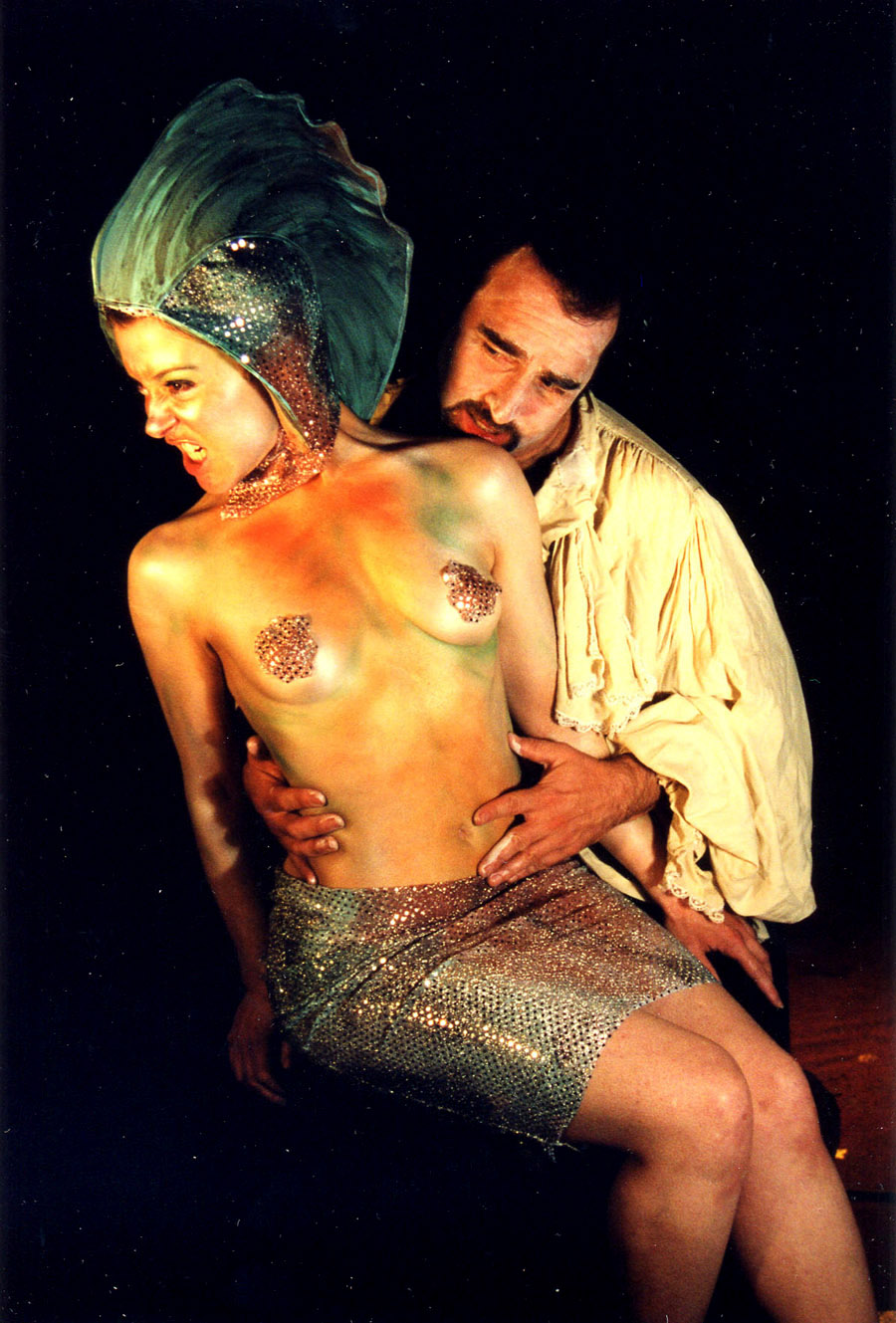
Armande (Scott Sophos) tries to hook Carmina (Beth Gilson) in Anton Dudley's Carmina Piranha. (Photo by Molly-Rose Arnstein from the Cherry Red Productions website.)
In this period of intellectual high-wire acts at the theater, when Michael Frayn and Tom Stoppard and David Auburn have us untangling nuclear physics, arcane classics, and obscure mathematics to get at the roots of the human condition, there’s an allure to a troupe that is smitten by smut, "[d]edicated to plays that appeal to the body first, then the mind." I went to Cherry Red Productions’ latest, Seven Deadly Dwarves, anticipating a refreshingly anarchic and raunchy change of pace. I liked the exquisite corpseness of the show’s origins--some playwrights hanging out at Cherry Red chief Ian Allen’s apartment, noting serendipitously that Snow White has seven dwarves, while Satan promotes seven deadly sins, then drawing dwarves and sins out of a hat.
But I left Metro Cafe after the show feeling kind of battered and sad. As nasty as they want to be, these equal opportunity offenders, now at the close of their sixth season, continue to give the First Amendment a vigorous aerobic workout. I’m all for that and would climb the ramparts, should it come to that, to protect their right to do it. I just wish I hadn’t had to sit through it.
There’s something to be said for theater that rockets so far past the lines of good taste that one’s forced to take a distance view of taste’s whole topography. But shock theater has two major hazards: (1) it’s hard, in this day and age, to genuinely shock audiences without being downright injurious, and (2) such fare veers, usually, into self-congratulation and smugness. Its implied promise is that it will strip our eyes from social illusions and offer us something more solid, if rawer and uglier, in return. But if the stripping is done sloppily, or even done well but to no payoff, it’s not invigorating, the way you hope it will be, but simply corrosive.
Dwarves, in the twisted intensity of its cabaret commentary, rams smack into both of these obstacles and is totaled in the process. It attempts to make us gasp at the use of dildos, fake bodily fluids, body-odor jokes, nudity, nihlism, fetishes, and a graphic abortion skit, the last of which skips the local stops at gross-out humor and expresses right over to cruelty. The last 75 years have seen Salvador Dali, Luis Bunuel, John Waters, Monty Python, Charles Busch, the Farrelly Brothers, Tom Green, and scores of self-revealing performance artists. If you turn up the German gothic rock loud enough and distract us with those garbage bags to protect us from flying fluids, maybe you can convince us, for 30 seconds, that you’ve come up with something none of those folks have.
What’s regrettable isn’t that Cherry Red’s sizable crew of writers, directors, players, musicians, and techies isn’t talented. What’s sad is that they are. There are hints of boldness and incisiveness that really could transcend theatrical and social pieties in a pretty satisfying way, and a smart, disrespectful mind really is a terrible thing to waste.
There’s some promising Rabelaisian girth, for instance, in the premise of Roberto Aguirre-Sacasa’s Morning Becomes Olestra, and the title alone deserves a salute. The Python players’ retching fat man in the restaurant, about to bite into that one last, "wafer-thin mint" may be the close uncle of Harold Hogsworth (Stefan Aleksander), but give a detestable lug a suitcase-sized lunch, and send him off to his job as a night watchman at a donut factory, and you have our full, primitive attention. Like so much in Dwarves, though, the act turns out to be a trip to nowhere, fueled only by gas jokes, and even campy theater can't get but so far on fumes. The SNL folks were sharper, with Will Farrell touting that appliance that turns flatulence into high-minded allusions to the Charlie Rose show.
Another misfire: Emily Rems’s The Most Foul Tragedy of Nico and Narcotic, which could have been an intriguing, if creepy, essay on self-delusions. Two prostitutes bill themselves as psychedelic songstress Nico (Fiona Blackshaw in a weirdly riveting riff on heroin chic) and Princess Di (Beth Gilson, in a turn that manages to be both demure and debauched). The island cadences of a third (Camille Gurnell) belie less-exotic origins. And a pimp named Narcotic (the versatile Flordelino Lagundino), who has a Ballard-like fascination with celebrity car-crash deaths, is so hip to the street that he ends up mating with it. But again, these intriguing misfits—-caricatures of caricatures, to the point that they’re something more than caricature—-have, dramatically, no way out, and the piece’s meanness overpowers whatever might have been its meaning.
Or, speaking of foul, take the evening’s finale, Ian Allen’s Doc Gets It in the End. We can relate to the fury of the young yuppy woman (Gilson) forced to sit around endlessly in a doctor’s waiting room. And we can certainly relate to her fellow patients, forced to listen in on her bitchy cell-phone calls. OK. Ratchet it up a bit, Ian, and clue us in to the fact that she’s actually waiting for an abortion and yet doesn’t want to be late for her afternoon spinning class. That’s sick, but heck, we’re not at the Folger, and we’ll give you a voucher for insightful repellence, an earthy whiff of the bourgeoisie’s discreet charm. What comes after, however, doesn’t push boundaries, it just makes us worry about the segment’s creators. It shows us nothing. It tells us nothing. It makes us wish we’d made other plans.
Of course, some of the skits don’t take themselves so seriously, and neither should we. Anton Dudley’s Carmina Piranha is a one-note joke about the lethal effects of a certain opera on a certain pet fish. Plusses: We see Gilson’s half-clad figure and get to laugh at opera—-both pleasant experiences. Minuses: a few stale fish-smell jokes. The tally ends up pretty much even—-this brainless sketch is, at worst, a victimless crime. Similarly, Allergic Erection, by Chris Griffin, is essentially a one-page treatment for a prosaic porn movie, complete with Boy Scout kerchief. Oh yeah, and Mark Osele shows us his popo--a departure from the theatrical mainstream? If you think so, you haven’t been to the theater for a while.
And let’s give credit where credit is due. Claudia Alick’s Boxing Ennui, a surreal hip-hop nightmare about what gets us off, and what offs us, is deeply disturbing, but in a novel way that cuts through to truths about loneliness, lust, and our McLuhanish disconnections with disembodied others. Phone Woman Gurnell, in an aggressively frisky, hopped-up mode, works a suicide help line. The first kink in the line, of course, is that on it, she helps people plan their suicide. The second kink is that the whole thing is role play. The third kink, we discover as she services a despondent client (Aleksander), is that it isn’t. Giving the proceedings a freakishly funny and frightening resonance is Lagundino as an off-kilter mime.
Careful Now, by Paul Donnelly...well, I’m on the fence about this one. Its send-up of a home-merchandising party is crafty. The hostess, Stacie (Lindsay Allen), has some nicely offbeat lines suggesting that her college years, and those since, were less than wholesome. And Blackshaw, as Donna de Ville, the saleswoman, is perkily demented, kind of a blond Karen Black on acid, as she pitches what turns out to be a make-up effects kit that captures attention by making clients look horribly victimized. A dark premise, sure, but then, that’s what we came for, isn’t it? Donnelly pushes the envelope hard, but doesn’t quite tear it, when the sole black person at the party (Gurnell) objects--not because the Careful Now product catalog is nauseating, but because it targets a white market since blacks have been victimized for so long anyway. But did Donnelly really need the Kaposi’s Sarcoma line to get his point across? That’s where he lost me.
Cherry Red’s association of creatives are indeed creative, and brave, too. But they also seem a little lazy--unwilling to really follow through on their interestingly irreverent instincts. Seven Deadly Dwarves just begs viewers either to succumb to its slack trendiness or reveal the sterile expanse of their conventionality. And the only thing worse than a defensively supportive critique is a moralizing one. Maybe having your sensibilities trampled just to remind you that you have them has a cathartic effect. But if that’s not what you’re looking for--indeed, if you never looked for it, or haven’t since freshman year of college—-there are a lot of good plays in town right now, well worth seeing.
Alexander C. Kafka is a contributing writer for Washington City Paper, where a shorter version of this review first appeared. Reprinted by permission.


