Click Here To Download
The Idler's Mobile Version

The Idler's Home Page and Table of Contents
The Idler's email list
To advertise in The Idler
Write a letter to the editor

(www.the-idler.com)
Volume III, Number 113


Click here to download chapters from Finish High School At Home by Charlie Clark







IS ANDREW SULLIVAN'S PRIVATE LIFE "NONE OF YOUR BUSINESS?": An Interview With David Ehrenstein
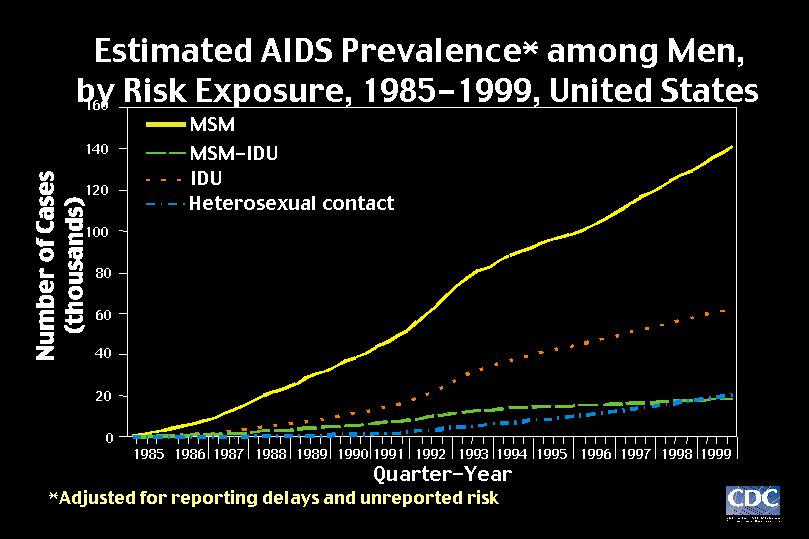
HIV prevalence data from the Centers for Disease Control website.
Controversy swirls, on the internet and the press, surrounding accusations that writer Andrew Sullivan, author of Virtually Normal: An Argument About Homosexuality, had advertised in internet chatrooms for unprotected sex with HIV-positive men. On his personal website, Andrew Sullivan.com, he charges critics with "sexual McCarthyism" and declares that his private life is "none of your business." Letter-writers to Romenesko's MediaNews continue heated debate on the issue. So, The Idler asked David Ehrenstein, author of Open Secret: Gay Hollywood 1928-2000, and a vocal critic of Sullivan's, to explain why he thinks public discussion of Sullivan's private activities is justified.
IDLER: How did you become involved in the Andrew Sullivan controversy?
DAVID EHRENSTEIN: I became aware of the Andrew Sullivan story when someone posted anonymously about it in the"Gossip" forum of a chatroom called Datalounge.
Ordinarily it's a setting for a lot of mindless and silly chit-chat about celebrities, but this was something else entirely. So I began asking around to see if anyone else knew about and immediately e-mailed several newspaper people to find out if they had heard about this.
IDLER: Did you try to contact Sullivan?
EHRENSTEIN:I also e-mailed Sullivan for a reaction, getting only dead silence on his part.
IDLER: Did you get any reaction from your newspaper contacts?
EHRENSTEIN: Then, Lloyd Grove of the Wahington Post called me up, and he was apoplectic.
He was reading off the stuff on the website, Sullivan asking for "Hot milky loads in my ass, in my mouth."
Grove said it sounded absurd.
IDLER: How did you respond to him?
EHRENSTEIN: I pointed out that sex was absurd.
He wanted to know if I believed it -- as he said he didn't.
I told him that I found it hard to believe that Bill Clinton would play hide-the-salami with an intern in the midst of humngous investigation of every aspect of his life.
IDLER: So how did the controversy get reported, if newspaper people wouldn't believe accusations against Sullivan?
EHRENSTEIN: Finally the other shoe dropped, and Sullivan admitted that the whole thing was true.
IDLER: Why do you think he did that?
EHRENSTEIN: The latest is that this story first surfaced, or was about to surface, in the British tabloids. Whoever found out about that, posted the news in Datalounge.. I'm sure it was posted elsewhere too.
And thereby hangs the tale.
IDLER: Why did you think rumors about Sullivan's private life might be relevant to the general reading public?
EHRENSTEIN: There is a very immediate connection between Sullivan's sex life and his writing.
He wrote and article titled "When the Crisis is Over" for the New York Times a few years back.
It was taken by all and sundry in the media to mean that the AIDS crisis was indeed over.
IDLER: What do you think is the responsibility of the New York Times for not checking that story prior to publication?
EHRENSTEIN: Plenty!
My mind keeps going back to poor Jeff Schmalz -- deeply closeted and terrorized by Abe Rosenthal every day of his working life, until he collapsed on the floor of the editing room with a grand mal seizure.
My how times have changed at the Times!
IDLER: How do you think drawing attention to Sullivan's behavior will help stop the spread of AIDS?
EHRENSTEIN: The significance of the letters in Romenesko is that the real issues at the heart of this entire affair are becoming clear.
Sullivan's behavior is monstrously irresponsible, and his trying to cast himself as "Poor, pititful HIV+me just trying to meet other HIV+ guys," won't wash.
There are all sorts of informational set-ups for HIV+'s to contact one another on the internet. But what does Sullivan choose? Bareback City.com.
IDLER: Sullivan claims he was having anonymous sex only with HIV-positive partners, shouldn't that end the discussion?
EHRENSTEIN: The argument that it doesn't matter because Sullivan was already HIV+'s and looking for other HIV+'s to have sex with (problematic in itself, as his AOL messages were far from picky on that score) doesn't hold water, because re-infection creating new and tougher strains of HIV is not only possible -- it's actually happening.
IDLER: And the AIDS crisis is not over?
EHRENSTEIN: The truth of the matter is it's not only far from over, it may be getting worse.
Having invasive sex -- with fluid exchange, without condoms -- can quite literally kill you.
The documentation of this is exploding in stories over the past week.
But I guess we all shouldn't be concerned that Andrew Sullivan has turned his body into a fetid swamp, because "it's his choice." Right?
He says he "prefers" HIV+'s on the AOL sites. This is where it all gets murky.
The bottom line is, if he were be practising safe sex, none of this would be at issue.
IDLER: Sullivan says the issue is his right to privacy.
EHRENSTEIN: The issue is HIV infection.
The rates are skyrocketing among a new generation that appears to regard the "cocktail" as the cure.
And one reason for this is "The AIDS Crisis is Over" pieces by Sullivan, and his defender Dan Savage.
You know as well as I do, that when an article in the New York Times says that the AIDS crisis is over, as far as the rest of the media is concerned, it's over.
Well it's not.
David Ehrenstein is the author of Open Secret: Gay Hollywood 1928-2000 and The Scorcese Picture: The Art and Life of Martin Scorcese.


