Click Here To Download
The Idler's Mobile Version

The Idler's Home Page and Table of Contents
The Idler's email list
To advertise in The Idler
Write a letter to the editor

(www.the-idler.com)
Volume III, Number 102


Click here to download chapters from Finish High School At Home by Charlie Clark






MY ENCOUNTER WITH CHIEF JUSTICE REHNQUIST
By Charlie Clark
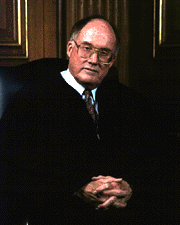
The Chief Justice of the United States appeared last month in a room packed with an intimidating number of Northern Virginia Democrats.
I'm here to testify that one and all behaved with impeccable civility.
The April 27 occasion at the Army-Navy Country Club was the 46th anniversary banquet of the august Arlington Historical Society, of which I am a loyal, if lazy, member. In keeping with the society's scrupulously nonpartisan nature, Chief Justice William Rehnquist was invited (as a prominent Arlingtonian who has written three history books) to deliver remarks commemorating the 200th anniversary of Arlington's founding.
But put the event in context. It has been only four months since Rehnquist and his four allies in the Supreme Court's starboard majority stepped into the historic Florida election mess with a stunning ruling that halted state-authorized vote recounting, and handed the presidency to fellow conservative George W. Bush.
When Rehnquist spoke to the University of Arizona law school in Tucson in early February, he was met by 250 protesters who carried placards reading ``Impeach Rehnquist" and ``How can you sleep at night?"
When his ideological teammate, Justice Antonin Scalia, spoke at Marquette University in Milwaukee in mid-March, he drew 100 less-than-polite protesters.
And last month, Justice Sandra Day O'Connor was forced, while attending the prestigious Jefferson lecture at the Kennedy Center (she had a better seat than I had), to listen as noted playwright Arthur Miller acerbically accused the justices of merely ``pretending" to be the Supreme Court while pursuing their self-dealing decision in Bush vs. Gore.
So imagine the temptation, with Rehnquist seated at a nearby table amid the bonhomie of a local banquet, for such deep-dyed Democrats as Rep. James P. Moran, state Sens. Mary Margaret Whipple and Patricia S. Ticer, state Dels. James F. Almand and Karen L. Darner, and Arlington County Board Chairman Jay Fisette, among others.
Who knows how many toyed with the notion of giving the famous man a piece of their minds?
In my own fantasy, I down a whisky sour and describe to the Chief Justicethe stomach-churning moment on that December Saturday when I logged onto America Online and saw the headline announcing that his court had stopped the Florida counting. I ask how he and colleagues could insist that Bush vs. Gore was a federal case when they had for years declined to intervene in so many compelling state cases. I ask him to reconcile the Catch-22 in the court's declaration that Al Gore had run out of time when it was the court's own injunction that had eaten up his time. And I ask how he plans to deal with the coming bevy of cases being brought in reaction to the high court's novel and expansive interpretation of the Constitution's Equal Protection Clause.
But let's stick with reality.
Rehnquist's talk to the record crowd of 270, which he began after some preliminaries from leaders of varying political persuasions, was witty and erudite. He quipped that he had long been in the habit of prefacing his speeches with jokes portraying lawyers as ``greedy and parasitic." He ceased doing that, Rehnquist said, ``because the lawyers didn't like it, and the non-lawyers didn't realize these were jokes."
He then showed off the tidbits of Arlington history he had boned up on in the course of 17 years as a county resident. Rehnquist declared himself a skeptic about the assertion that Arlington is celebrating its 200th year. If you study a map from 1801, he noted, you end up paraphrasing Gertrude Stein and saying, ``There was no there there, then." Still, he added, if we dwell on the fact that Arlington wasn't technically created until 1920, we wouldn't be enjoying a wonderful banquet honoring its 81st year.
Rehnquist noted the irony in the fact that when the Custis and Lee families sued the federal government in the early 1880s for having confiscated Arlington House during the Civil War, the Supreme Court, by that familiar 5-4 vote, rejected the government's claim of ``sovereign immunity." He recapped the history of the bridges connecting Arlington to the District of Columbia, and praised the county for its good schools and libraries, low taxation and wealth of single-family real estate.
Rehnquist received a (mostly unanimous) standing ovation.
Then, without mingling or taking questions, he linked up with his security men and departed. The predominantly Democratic crowd was the picture of respect for Rehnquist's privacy.
They naturally minded their manners, and needed no lecturing on civility from that mandateless Texan whom Rehnquist helped install in the White House.
Charlie Clark is author of Finish High School At Home and a frequent contributor to The Idler.


