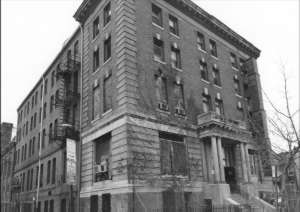
Twelfth Street YMCA Building before a recent renovation, 1816 12th Street NW Washington DC
The photograph above shows the
old "Twelfth Street Y" building now renovated and
home to The Thurgood Marshall Center For Service And Heritage.
The interior was completely redesigned and the façade
restored to its former appearance, including the period G. W. Cabaniss served as a Director.
The Twelfth Street YMCA building is the former home of the first full service YMCA for African Americans in the nation. It was designed in the Italian Renaissance style by one of the nation's first African-American architects, W. Sidney Pittman, son-in-law of Booker T. Washington and was built largely by African-American artisans.
The association was co-founded by Anthony Bowen in 1853 two years after the first white YMCA was established in Boston. The 12th Street Y was one of the most important local institutions of the 20th century. It was designed y architect W. Sidney Pittman and opened in 1912.
The cornerstone was laid by President Theodore Roosevelt. The building incorporates five stories and 72 rooms and a swimming pool. It was financed through contributions from white philanthropists John D. Rockefeller and Julius Rosenwald. Black Washingtonians also spearheaded a capital campaign raising more than $30,000 toward its completion. Among the 12th Street YMCA's homes before moving here were 1609 11th Street, NW, and The True Reformer Hall, 1200 U Street, NW.
As a full-service YMCA, the 12th Street facility worked to improve the mental, physical, and religious lives of boys and young men. Beyond that, the Y became an important resource for individuals and families, providing shelter, activities, meeting space, a library, and classes. It became a meeting space for some of the early civil rights and legislative work that transformed the country in the middle of the 20th century.
Anthony Bowen is the early figure most identified with the YMCA. Bowen was born enslaved in 1809 in nearby Prince George's County. He moved to Southwest Washington in 1826, where in addition to establishing the YMCA, he helped found St. Paul AME Church, established a Sunday Evening School for children and adults, and met and sheltered freedom-seekers as part of the Underground Railroad.
The building was listed on the DC Inventory of Historic Sites in 1975 and on the National Register of Historic Places in 1983.
Sources: Kathryn S. Smith and Marya McQuirter, A Guide to the Historical Resources of Shaw (Washington: The Thurgood Marshall Center for Service and Heritage, 1996).
|