Most shoulder injuries are probably caused from the serve.
The serve generally has two motions. One motion is to get to
a trophy position. (Not some trophies though.) This position
is where the tossing arm is up, and the racket arm is bent and
the hand is close to the shoulder, with the racket pointing
straight up. The second motion is where the arm moves
up to hit the ball. I think the cause is usually
that the arm is not bent enough when starting from the
trophy position. Another cause is that the elbow does not
rise early enough. If the arm is straight, then the
shoulder muscles must work very hard to move the
whole arm lever.
Body Problems
Shoulder injuries can be caused when the chest muscles
are much stronger than the back muscles. The chest
and throwing muscles can cause the shoulder ball to
move back slightly out of the socket. Stronger back
muscles and rotator cuff can prevent this from happening.
Cure
The cure is first to rest and let the injury heal.
Then strenghen the back and rotator cuff. To strengthen
the rotator cuff, lie on your side. Keep your
elbow by your side, and start with your arm bent
at a 90 degree angle with your forearm pointing forward
from your body. Then rotate slowly so that your forearm points
up towards the ceiling. If you take 10 seconds or more
to lift, you will really feel the burn even with light
weights.
To strengthen the shoulder muscles, lift weights
by rowing, straight arm lifts, and lat pulls. The straight
arm lifts can be done best by using cable machines.
Tennis elbow can be caused by one of two basic motions.
Both are generally caused by incorrect wrist or arm motions or
excessive use of the wrist and are made worse when the
tendon is tight at the time that the racket hits the ball.
The tendon involved in tennis elbow runs to the outer bony
point on the elbow. One example motion is when the palm is
facing down, and the palm is pulled back so that the fingers
are pointed up. The other motion is when the palm is facing
down, and the wrist is rotated so that the palm is facing
up.
Tennis elbow is usually caused by an incorrect backhand.
This can often be caused when the wrist is used to compensate
on shots, and is made worse if the arm angle is wrong and
the ball is hit late. Another
possibility is that the wrist is being used to try to generate
topspin instead of using the shoulder. Using a two handed backhand
may help. It may be that the arm is pointed too much to the side at the
time of impact, which puts more stress on the elbow. If the
arm is pointed more to the front (where the ball is coming from),
there will be less stress.
Body Problems
Tennis elbow is when the tendon builds up scar
tissue from continued playing. With continued misuse, the scar tissue may
not heal. It is best to fix things as soon as possible. Worst
case is that surgury must be done to remove the scar tissue.
Cure
As always, it is best to rest until you can do some curing
excersizes. See Tendon Massage
and Tendon Stress for other information.
Stretch
Stretching involves folding the wrist towards the
body and pulling with the other hand so the palm points toward
the body. It can be either done with the fingers on the injured arm
pointed up or with the fingers pointed down. There seems to
be more stress when the fingers are pointed down. Stretching
should be done for five minutes while shaking out your wrist
periodically. A tendon with scar damage is not as flexible,
and a properly stretched tendon can reduce future damage.
Strengthen or Align
Take a one pound weight and slowly curl your wrist upward
with the palm facing down.
Once again one motion can take seconds to execute. Repeat
for five minutes. The purpose of this excersize is to align
or strengthen the tendon and muscles.
Ice Massage
Use an ice cube and hold it with a towel, and expose one
end so that it can be used to massage the elbow. Massage
for up to five minutes, but continue to move or remove periodically
so that it doesn't cause frostbite. The purpose of ice massage
is to reduce the swelling, and increase blood flow.
If any of these are done before proper healing, or are done too
strenuously, further healing will be prevented. So reduce whatever
is too strenuous.
Golfer's elbow can be caused by one of two basic motions.
Both are generally caused by incorrect wrist or arm motions
or excessive use of the wrist and are made worse when the tendon
is tight at the time that the racket hits the ball.
The tendon involved in Golfer's elbow runs to the inner bony
point on the elbow. One example motion is when the hand is
initially palm down with a straight wrist, and then the wrist
pulls the hand down. The other is a rotation problem, and
an example is when the palm is initially up, and the wrist
is rotated so that the palm faces down.
These problems are generally either the serve or the forehand.
On the serve, it can happen with a spin or other serve where
the wrist snap is generated by the wrist. Normally the serve
wrist snap should be generated by using no muscles for the
wrist, and simply be the momentum of the racket spinning around
because of the arm motion. It may be that the elbow is too far to
the right side of the body (for a right hander) at the time of
impact and that the elbow should be pointed more towards the
direction that the ball will go after the serve or forehand.
On the forehand, this can be caused by trying to put excessive
topspin on certain balls, especially low short balls. Topspin
should be generated by the shoulder and not the wrist.
Body Problems
Golfer's elbow is when the tendon builds up scar
tissue from continued playing. With continued misuse, the scar tissue may
not heal. It is best to fix things as soon as possible. Worst
case is that surgury must be done to remove the scar tissue.
Cure
As always, it is best to rest until you can do some curing
excersizes. See Tendon Massage and
Tendon Stress for other information.
Stretch
Stretching involves folding the wrist back and pulling with
the other hand so the palm points away from the body. It can be
either done with the fingers on the injured arm
pointed up or with the fingers pointed down. There seems to
be more stress when the fingers are pointed down. Stretching
should be done for five minutes while shaking out your wrist
periodically. A tendon with scar damage is not as flexible,
and a properly stretched tendon can reduce future damage.
Strengthen or Align
Take a one pound weight and slowly curl your wrist upward
and palm facing upward.
Once again one motion can take seconds to execute. Repeat
for five minutes. The purpose of this excersize is to align
or strengthen the tendon and muscles.
Ice Massage
Use an ice cube and hold it with a towel, and expose one
end so that it can be used to massage the elbow. Massage
for up to five minutes, but continue to move or remove periodically
so that it doesn't cause frostbite. The purpose of ice massage
is to reduce the swelling, and increase blood flow.
If any of these are done before proper healing, or are done too
strenuously, further healing will be prevented. So reduce whatever
is too strenuous.
Back or side problems can be caused by jerking the
body to compensate for other problems. I had a back
injury that started on my forehand side, and moved
to the middle of the back, and then got
so bad that it affected even walking or sleeping.
The problem was poor racket preparation of the
backhand stroke. I was always late, and had to
compensate by trying to move my body position backwards
with my back.
Back problems can also be caused by too much bending
on the serve. (Sorry to say, especially for older people.)
The solution is simply to pull the racket back early
and make sure the racket is moving well forward at
the time the ball is hit. In fact, try to hit the ball
early. This can fix back problems very quickly.
In some cases, the tennis elbow and golfer's elbow take forever to
heal. One alternative is to try tendon massage. This is known by
many different names. What this involves is extreme pressure
on the tendon and a good amount of pain. It is thought that this
either breaks apart the scar tissue, or moves things around enough
that blood can flow to regions and do the repair. This should only
be done if you know there is no serious damage to the tendon.
Usually it is very difficult to do by yourself, but probably can
be done. I am not sure that I can explain it correctly, but it is
something like the folowing.
Take your thumb and press it onto some point of the tendon.
Keep pressing, and with one smooth motion, both stretch the tendon
by straightening the arm, and bending the wrist in a manner that
stretches the tendon.
Take about 3-5 seconds to straighten the arm.
While straightening the arm, slightly move the thumb towards the
bony point where the tendon attaches to the elbow, all the while
keeping strong pressure on the thumb.
If the pain becomes too great, slightly lessen the thumb
pressure. If there isn't much pain, either that is an area
of the tendon that is not injured, or you are not pressing
hard enough.
Do this at a few spots along the tendon, but don't do
too much the first day. After doing this, the elbow may actually
feel worse the next day, but after another day, the elbow should
start to feel better. It usually takes two days to recover,
and then another session of massage can be performed.
If it is difficult to do yourself (you can't get the healing you
need),
then another person applies the thumb pressure, and you stretch
the tendon by straightening the arm and bending the wrist.
While this can increase the healing speed, the most important
thing is to improve the stroke. If the stroke is not fixed,
the injury will recur.
This section shows an idealized representation of the
stresses on the tendon. There is a lot going on, but this
simplified version can help to understand some of the forces.
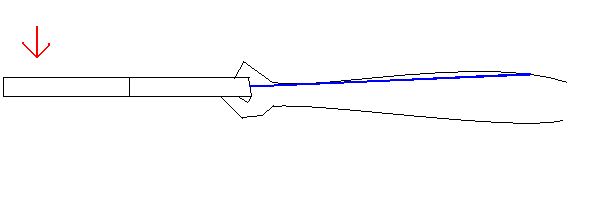
The following drawing shows the stress in the arm for a poor right
handed backhand. The blue line shows the pulling points
at the time of impact. The red arrow shows the direction
of the ball, and the point that the hand and arm gets
pushed backwards, causing the stress.
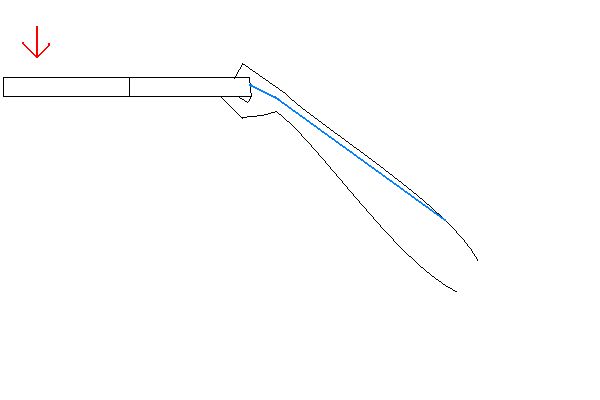
The next drawing shows what happens if the angle of the
arm is changed to roughly 45 degrees. The stress in
blue gets reduced to about 70% of the original stress
depending on assuming that the person puts the same
effort on the tension of the tendon. If the arm angle was increased
to more than 45 degrees, the stress could drop much more
depending on how much force is put into the wrist. The more
the arm is pointing towards the ball at the time of impact,
the more that the stress will be reduced.