Strap on your gloves and goggles, things are about to get a little bit muddy.
In a lot of ways, the racing game has undergone less change than many other console mainstays, including fighting games, platformers and sports titles. The concept is still to simply get from point A to point B, while avoiding obstacles and other vehicles, clipping apexes, and taking the occasional shortcut. Looking to flesh out the soon-to-be glutted genre of racing titles for the PS2, Interplay has released Wild Wild Racing, a buzzy little off-road (but certainly not offbeat) racer with an emphasis on real world, on-and-off road competition. Nice graphics and physics and a number of secondary features make for a satisfying ride, but it's ultimately lacking in the innovative thrills we've come to expect from Sony's highly hyped machine.
The long-term goal is for players to prove themselves a skilled-enough wheelman to drive the Wild Wolf, a custom-built racer that's been developed in secrecy by a team from Japan and the UK. To succeed, the player must complete varying objectives in several environments, including India, Iceland, and Mexico, thereby unlocking new cars and upgrades. What's nice is that ultimate success necessitates completing events from both the Competition and Challenge modes. While the Competition mode is standard stuff, the Challenge mode is thought out quite well -- Quest, Stunt and Skill submodes are available, and range from completing particularly challenging tracks in record time to pushing giant balls across a finish line; and the ubiquitous collecting of letters. Beating the various Time Attack modes also allows for upgrades to the appropriate class vehicle.
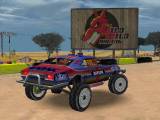
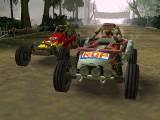
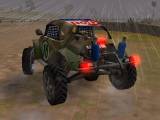
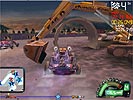
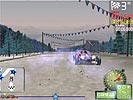
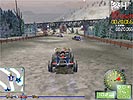
Graphically, Wild Wild Racing is a mixed bag of apples -- mostly sweet, but with a few bad ones here and there. The cars themselves are marvellously detailed, right down to the little exhaust fans that whirr to life whenever the gas pedal's down. As the race goes on, dirt accumulates on the wheels, and the various trees, sawhorses, and other obstacles are marvellously detailed -- although the exhaust from the vehicles is curiously unconvincing. The courses are elaborate and feature some nice points, but end up being ultimately repetitious, even from one environment to the other. This is most likely because the game's designers have clearly opted for a realistic approach with this game. We're not complaining, but in our eyes it's what keeps this game from being a standout title. Unfortunately, while it's worth noting that the split screen suffers from little significant graphical degradation, the emphasis on the muddied, repetitive schemes and layouts of real off-road racing don't really lend themselves to two-player play. Everything looks fine, but it's really difficult to differentiate things in the distance from anything else.
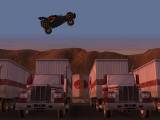
The gameplay offers a number of nice features including kickdown, which is designed for drivers too scared to test their manual-shifting mettle. Basically the equivalent of downshifting, it allows for drivers stuck on steeper hills to get a little extra traction and oomph. It's a small addition, and only occasionally useful, but nicely compensates for those of us who never, ever, let off the gas. Otherwise it's fairly straightforward stuff, albeit a little demanding. While powersliding is encouraged and as satisfying as ever, jumps -- even small ones -- are particularly treacherous, and demand a near-perfect landing to avoid ending up facing in the wrong direction altogether. Of course, different road surfaces impart differing effects on the cars, the most extreme examples being ice and oil -- but patches of either are usually placed conveniently proximal to a patch of dirt or gravel.
Most prominent amongst any significant flaws is the music, the oftentimes-secondary factor in designing games. The tortured growl of engines is prevalent, and provides a satisfactory sense of white-knuckle racing, all of the additional aural effects seem to have been placed and forgotten. Everything is there -- birds, rain, the annoying congratulatory announcer's voice, and some really bland sort of techno-jazz -- but it's not convincing, and doesn't provide players with a true sense of having their car interact with the road. And isn't that what this sport's all about? Developers in general would do well to take a look at such games as Oddworld or Castlevania to see that for videogames, as in television, sound can be equally important as vision when creating a comprehensive alternative reality.
With Wild Wild Racing, Interplay has provided a fine racer. Anyone can see that it's a marked visual improvement over the last generation, anyone can quickly make sense of the controls, and most relevant, anyone can play it. So if most everything is so well done, what then keeps this game from receiving a Direct Hit? We can't honestly say that this game will truly appeal to most diehard gamers, or at least those who haven't already decided that it's on their must-have list. Without a doubt worth a rental, it's a significant indicator of what to expect from the next slew of ultrarealistic races, but not quite a groundbreaker itself.
The Bottom Line: As one of the few "real" racers available for the PS2, it's satisfying on many levels -- if not exactly the most innovative test drive we've taken. |