|
|
From Subtle and Intimate to Powerful and Pubic, Steinway sound evolved the Sound and the Glory
by Bernard Holland
The first pianos spoke quietly. They were born to serve as conversationalists, but the pull of history turned them into orators. No one is more responsible for that escalated voice than Steinway & Sons. Steinway perfected the instrument's iron spine and its capacity for string tension. It gave the piano lung power, breath control, and remarkable enunciation. Loud and clear don't necessarily go together in piano making, but Steinway made them fit.
It had no choice, for by Beethoven's time, at the turn of the 19th century, music had begun its exit from the palace, the noble benefactor, and the elite audience. Sustenance now came from paying customers, as many as could be fitted into ever bigger public halls.
The older instruments were meant for smaller rooms and fewer ears. In the years after Beethoven, Franz Liszt's gargantuan virtuosity literally crushed the delicate pianos put before him. New music called for new instruments, and Steinway answered the summons more fully than others. Founded 140 years ago in New York, Steinway rose from a small factory to a dominant position in music. It invented few of the mechanisms that make the modern piano go, but it assembled and refined them into a product that swept an entire culture.
The varieties and subtleties of early pianos remain endearing and instructive; different keys, for example, actually had a different sound color even on the same keyboard. The modern instrument, helped by a more uniform tuning system, smoothed out the old bumpiness and rolled it into sleek, powerful reliability. Many miss the old intimacy. They have a point.
According to piano restorers Sarah and Irving Faust, the Steinway arrived at its present makeup at the close of the 19th century. What has come since, these notable craftsmen say, is a series of small refinements. Yet the Steinway character continues to change, subtly and not so subtly.
|
|
Pinning down that change is not so easy.
If we forget the piano's lower orders-the mass-produced, machine-made soldiers-we are left with an elite body of individual voices. Good instruments are fitted and assembled by hand, so that the lumber in one, and the way it is handled, will speak a little differently from the lumber in another. Once built, pianos thrive according to how they are conditioned. Think of a trainer working on your body, building a muscle here, removing a bulge there. Often the distinctions between pianos are not good versus bad, but simply one taste against another. Performers have the serial numbers of their favorite Steinways forever memorized in their heads, if not tattooed on their bodies.
The Fausts have lost their hearts to those tum-of-the-century Steinways, which Sarah Faust, a performing pianist, prizes for warmth, firmness, and adaptability to different kinds of music. The later Steinways, from the 1920s and 1930s, tend to be bigger, brighter, more forward-at their worst aggressive salesmen, at their best brilliant public speakers. Sarah Faust mourns the loss of an older Steinway personality, a void in which mellowness has become confused with deadness, and ever-increasing brilliance is the desired end. Both trends reflect, in microcosm, the music industry's relentless competition for the public's attention.
The Steinway factory in Queens, New York, has some fascinating competition in the industry. Garrick Ohlsson plays the Boesendorfer, an Austrian instrument made slowly and patiently in a little factory outside Vienna. It fits the Ohlsson style: a big technique capable of differentiated details. Sarah Faust likes the Boesendorfer's cleamess, too; it's good for making records, she says. But one also loses. A lower threshold of power lets Schubert or Mozart sparkle but tends to muddle the grand Russian style of Rachmaninoff or Prokofiev.
Andre Watts, a powerful pianist, plays the Yamaha. The Yamaha concert grand is a brute, a Godzilla of a piano; it takes power and brilliance to extremes. This is an odd phenomenon given the traditional refinement of Japanese culture, but rest assured that Yamaha's makers, relative newcomers to the high-end field, are working to tone their piano down. Walter Gieseking, the great German colorist, preferred the American Baldwin, but it has always lagged just behind the leaders. Many Steinway players choose the products of the company's German arm in Hamburg, perceiving in them a finer, clearer instrument. The artists who play these pianos are the walking, breathing advertisements that ambitious competitors crave. They do not go unrewarded.
The best Steinways (and there have been some in the postwar era that were not very good) show an assertiveness, indeed an explosiveness, almost American in character. The crafters of these instruments make no bones about their ringing sound, but they are equally proud of how clear and definable that sound can be, and how smoothly it distributes itself from the lowest notes to the highest.
|
|
Sarah Faust says there are old Mason-Hamlin pianos that stand up to the best of the moderns.
It's a familiar name but we don't hear it much anymore. Indeed, 100 years ago piano-makers were everywhere. Every American city had at least one-just as it had at least one brewery to satisfy the local taste for beer. Today the big have swallowed the small. It's a story told in many places: the move from private to public, from small to big, from individual to generic, from fineness to power. Yet looked at in another way, the grand piano plays a curious role as both innovator and anomaly, having one foot in the old ways and the other foot in new ones.
For if piano playing has become a form of modem public speaking, note that it performs its function without microphones, wires, or loudspeakers. This nakedness presents Steinway and its colleagues with a big job: that of addressing the jaded, overloaded 1990s ear using the tools of the 1890s orator, a William Jennings Bryan perhaps, or a Sarah Bemhardt. Like them, the piano has only its own body to draw from. It speaks for itself.
Bernard Holland is the chief music critic at the
New York Times. He studied piano and music at The Paris Conservatory and The Vienna Academy of Music.Repdnted from: Mercedes Momentum Vol. 1, Number 1, 1995
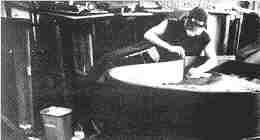
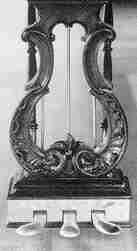
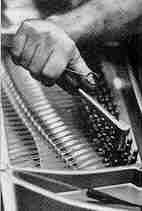
At Faust Pianos in Irvington, Now York, restorers seek to recapture the warm, rich sound of the 1890s Steinway. photographs by Peter Liepke