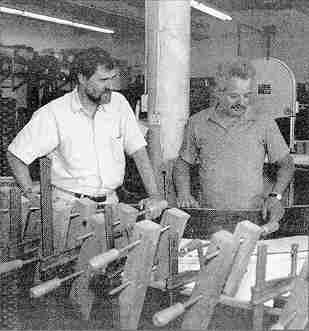
Mr. Faust with Angelo Andino, foreman of the Fausts' piano shop in a former research laboratory in Dobbs Ferry.
|
Mr. Faust with Angelo Andino, foreman of the Fausts' piano shop in a former research laboratory in Dobbs Ferry. |
Where Timeworn Pianos Regain Their Souls and Finish
By J. HERBERT SILVERMAN
Dobbs Ferry [, New York]
Restoring pianos and replacing their "souls" is an art refined to its ultimate by Sara and Irving Faust of neighboring Irvington. Their atelier here is in a former labyrinthian naval research laboratory on the Hudson River once better known for electronic submarine research than esthetic achievement.
The huge World War I bluestone building built as a book bindery in 1919 is now home to Faust Pianos, a piano restoration company that is considered a leader in bringing instruments back to their peak of excellence.
Neighbors in this eclectic enclave, which also once served as a brewery, include music-related companies like Computer Klavier Works (an innovator in electronic player piano retrofits), American Bagpipe Makers, Dobbs Violin Shop and, in contrast, DeCoashes, a quality supplier of spaghetti, fettucine and lasagna to clients like Maud's Tavern in Hastings-on-Hudson and Lotsa Pasta in White Plains.
A century ago, concert grand pianos from makers like Steinway, Knabe and Mason & Hamlin were the preferred instruments of performers as well as families to whom quality of musical life was essential. The great pianos also provided decorators with remarkable objets d'art, highlighted by inlaid woodwork, gleaming brass pedals and Art Deco embellishments, including Fragonard-style cherubs and intricately carved garlands and swags.
A professor and a concert performer form a business.
Faust Pianos was founded by Sara Faust, a concert pianist, 13 years ago, assisted by her husband, then an associate research professor at Vassar in Poughkeepsie. In little over a decade, the Fausts have become major factors in uncovering and restoring once-prized pianos that have deteriorated. Many of those instruments made between 1890 and 1940 have incomparable "harps" (the flat part of the cast-iron frame, which forms the core of the piano). And even after restoration, the pianos can sell for substantially less than contemporary versions.
The Fausts came to piano restoration by diverse paths. Mr. Faust, with a scholarly career, had been a postdoctoral fellow at Rockefeller University specializing in problems of obesity, going on to work at Vassar. Ms. Faust is an accomplished musician who began performing at age 5 and studied at Juilliard. Before turning to piano restoration, Ms. Faust, who has an extraordinary sense of sound, performed on the concert stage. Her father is a carpenter in Manhattan, thus providing a heritage that now stands her in good stead.
The Fausts married and moved from Manhattan to Irvington when two pianos in two rooms was too much for their growing family and a rapidly expanding restoration operation. "We began remodeling an old house in 1989 as a home for ourselves and our pianos," Mr. Faust said. "I decided we were more interested in establishing a piano business than doing research, and Sara agreed. "I now direct the restoration operation - about 150 instruments annually - which is supervised by Angelo Andino, a 23-year Steinway veteran. Sara heads that end of our business, which buys and resells renovated classic pianos, 95 percent Steinways."
|
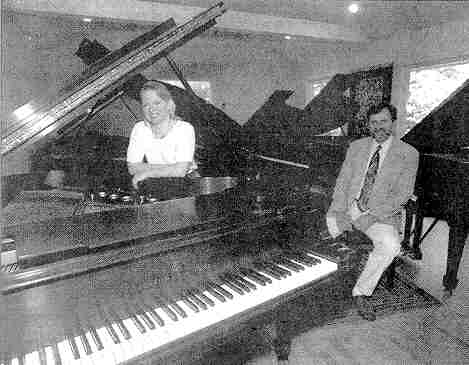
Sara and Irving Faust keep a collection of restored grand pianos in their Irvington home. |
In the last few years, the couple's sales have ranged from a restored Steinway concert grand signed by Arthur Rubinstein, Vladimir Horowitz and members of the Steinway family to an instrument purchased by the Rye Presbyterian Church. "While Steinway still produces fine pianos, we believe the quality of the 75 to 100-year-old instruments is almost impossible to match," Mr. Faust said. "Skilled craftsmen have become harder to find, and those beautiful harps made prior to 1940 are simply no longer produced." His wife concurred, saying, 'There's no Steinway like an old Steinway." Mr. Faust continued: "Many artists believe that pianos built by the founding Steinways were among the best ever manufactured. And the painstaking work that goes into our renovation is well worth the cost, which can range 'from $5,000 to $80,000, in the latter case a gem-like Louis XV-style seven-foot ornate Steinway with a carved art case."
Any time of the year, the Fausts have three instruments a week being worked on by their factory craftsmen. They have also assembled a group of 17 period instruments in their home, which looks as much like a piano museum as a residence and is "carefully humidity controlled and air-conditioned more for the health of our pianos than for our comfort," Ms. Faust said.
Piano restoration at the Faust plant is an exacting task, involving the talents of wood and metal workers, artists and musicians. "Action" and damper specialists along with "stringers" and lyre assembly professionals are essential to the restoration team. The process includes replacing original pinblocks and sounding boards. Furniture hardware is either polished or replated, and master carpenters repair the piano structure along with the furniture veneer. Sounding boards are made from prime kiln-dried Sitka spruce. The metal plate is rebronzed, and elaborate Steinway decals are installed on the boards. The process normally takes about five months.
The company also provides in home tuning services and repairs, but Ms. Faust warns that not all old instruments are worth a large renovation investment. "Once a piano has been restored, it should look and feel as though it were new, and - with maintenance should last a lifetime," she said.
Photographs by Alan Zale for The New York Times
THE NEW YORK TIMES SUNDAY, JULY 23, 1995