
Where's The Steel?
Dan Baldé
( E-mail:
[email protected] )"I hear steel… but don't see one on stage."
"There's three guys with guitars. The steel must be on tape or something!"
"I hear that the pedal steel player is a wild man, he straps the steel around his neck and dances around the stage".
What are we taking about? Well, it's not a standard guitar with a B-bender and it's not just a slide guitar. It's not really a steel. It's something in between: a "Pedal-Slide Guitar". It has a tailpiece with five palm pedals and a hip lever, plus a tuner for a seventh string. The instrument has the equivalent of the A, B & C pedals, plus an F-lever, played standing up, bottleneck style.
I dreamed of playing steel for years, but couldn't afford to order one new or find any around for sale new or used. The local music store didn't sell them or even know what they were. I was a slide player working out of G / A or D / E, always reaching for the missing intervals. Developed over a period of 25 years, I just tinkered with the pedal functions until I was able to reproduce the chord pull and interval combinations that I heard on records and the radio. Talk about "reinventing the wheel!" It would have been a lot easier if I had known something about the pedal steel guitar before I started, but it sure forced me to learn what I was doing with this very unique instrument.
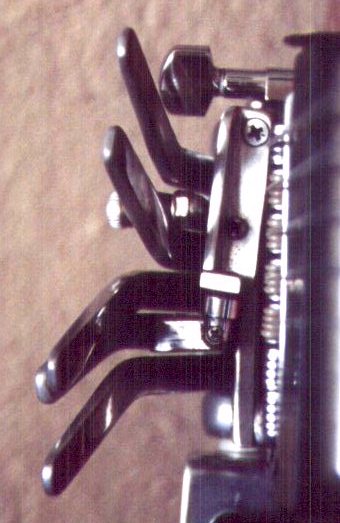

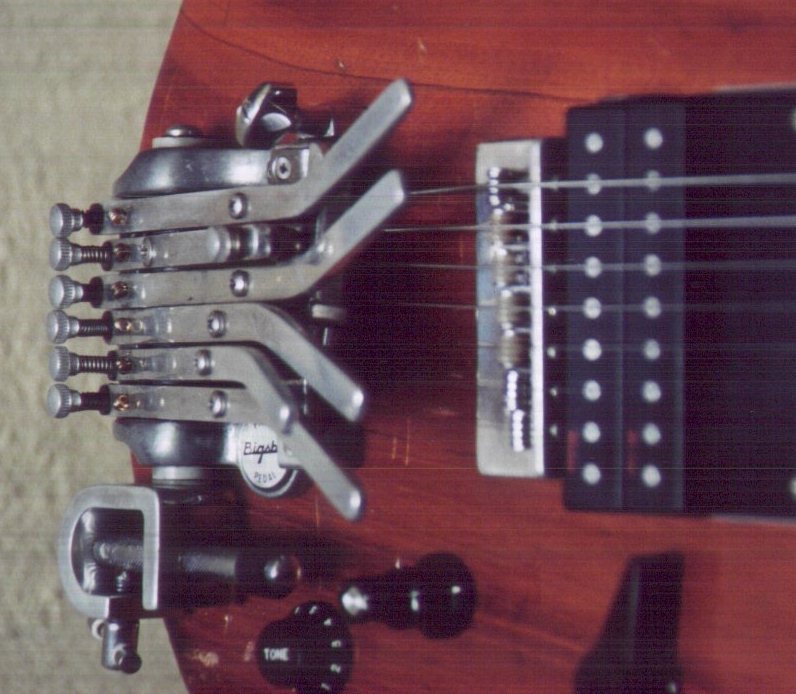
The instrument is built using Bigsby Palm-Pedal and "Whammy Bar" parts along with an odd assortment of found hardware including; a conga cymbal mount, an antenna swivel joint, a 3/8" grounding lug, a truck fender clamp, a mic boom lock and a Halogen floor lamp tubing & clutch. I added a "stop plate" since originally the stop screws hit the nylon rollers. It has the tuner for the seventh string mounted on the tailpiece. The ball end of the low string is looped through a lug mounted under the sixth string tuner at the headstock. A seven slot custom nut was made for the old 70's Kramer aluminum neck guitar that has a zero fret that reduces nut friction, along with a seven string roller bridge. The palm pedals are positioned as far back as possible, fanned out, elevated and staggered in length to provide for the best hand position for picking and depressing. They all can be depressed individually or with neighboring pairs for the A and B pedal functions, only pulling the strings that are played. The hip F' lever is attached to the main shaft, which is connected to the 5th string pedal with a shortened arm. The arm has a tunable 1/2-step linkage to the 2nd string. The 2nd string also has a shortened arm that is only depressed along with the 1st and 3rd pedals for a whole step pull, giving the combined effect of the B and C pedals.
|
E9th |
D9th |
Pedal-Slide |
" D" Slide |
|||||||
|
String/Tuning |
String/Tuning |
String/Tuning |
String/Tuning |
|||||||
|
1 |
F# |
> |
1 |
E |
|
|
|
|
|
|
|
2 |
D# |
> |
2 |
C# |
|
|
|
|
|
|
|
3 |
G# |
> |
3 |
F# |
= |
1 |
F# |
|
|
|
|
4 |
E |
> |
4 |
D |
= |
2 |
D |
= |
1 |
D |
|
5 |
B |
> |
5 |
A |
= |
3 |
A |
= |
2 |
A |
|
6 |
G# |
> |
6 |
F# |
= |
4 |
F# |
= |
3 |
F# |
|
7 |
F# |
> |
7 |
E |
|
|
|
|
|
|
|
8 |
E |
> |
8 |
D |
= |
5 |
D |
= |
4 |
D |
|
9 |
D |
> |
9 |
C |
|
|
|
|
|
|
|
10 |
B |
> |
10 |
A |
= |
6 |
A |
= |
5 |
A |
|
X |
(E) |
< |
X |
(D) |
= |
7 |
D |
= |
6 |
D |
|
How the tuning relates to the standard steel and slide guitar tunings ( The whole tone lower D9th tuning is shown here for reference.) |
||||||||||
Using the D tuning allows for accessing notes that would normally be only available with lowered strings or from the missing strings. It also reduces the string tension and depressing force required to operate the pedals. Additionally, it makes available "open string" chords and harmonics that are in more commonly used keys.
PEDAL-SLIDE COPEDANT CHART
|
Tuning |
PALM - PEDALS |
HIP- LEVER |
"LANDRETH -MANEUVER" |
|||
|
OPEN "D" |
A |
B |
(B) & C |
F |
1, 2, 3 |
|
|
1 |
F# |
|
G |
(G) |
|
F, E, Eb |
|
2 |
D |
|
|
E |
E b |
C#, C, B |
|
3 |
A |
B |
|
B |
|
A b, G, F# |
|
4 |
F# |
|
G |
|
|
F, E, Eb |
|
5 |
D |
|
|
|
E b |
C#, C, B |
|
6 |
A |
B |
|
|
|
|
|
7 |
D |
|
|
|
|
|
|
foot notes: |
usable individually |
together |
together |
@ the 12th fret |
||
Unlike with lap, Dobro or steel, the "bar slant" technique cannot be used easily. However, an equally powerful technique developed by Sonny Landreth called "fretting behind the bar" can be used (See the June '95 issue of Guitar magazine). If a string is pressed down to the fingerboard, it is pushed low enough to clear the "bar" and sound the fretted note clearly. (This only works above the third fret.) By using the "Landreth Maneuver" equivalent notes can be produced normally found on the now "missing" standard pedal steel 1st, 2 nd, 7th & 9th strings and D, E, G & X levers. So, for example, if at the 12th fret we use this maneuver on the first string, two frets back will get the equivalent steel 1st string pitch, or the second string one frett back gets the equivalent steel 2nd string or the "D" lever pitch, et cetera. Most of the notes are available for melodic lines but not all for "full chord" instrumental solo performing. As an accompaniment instrument, it has no problem reproducing most of the "Pop-Steel" parts in today's "New Country" tunes.
Some of the other playing techniques are the same as steel, like bar pockets, picking patterns, pick blocking and left hand blocking. Palm blocking is not possible, so the use of other methods such as "side of thumb" or "side of finger" blocking are necessary. The vibrato is kind of backwards. It can be pleasing to hear stronger vibrato on higher pitches and less on lower pitches, as with lap, Dobro or steel play. The bottleneck hand position & pivot point is opposite, so greater care has to be taken to not pivot but move parallel to the neck on larger chords.
The old Kramer, with its aluminum neck, is very stable, with little "drop", and has a bright tone & great sustain. ( Guitars with a similar necks are currently being manufactured by Vaccaro Guitars ). It is outfitted with a pair of Bill Lawrence "Wilde" 9-pole "J" bass pick-ups at the bridge along with a pair of knock-off Danelectro lipstick tubes. I do not use picks, but can get a very bright tone and snap out of the instrument with the use of the built-in, variable control compressor ( MXR Dyna-comp). I use a Craftsman 3/4" deep-well 3/8" drive-socket ( it's lifetime guaranteed ) instead of the music-market slides, they are either too light or too fragile. And, of course, I use a volume pedal, an old Fender Volume/Tone wired as an expression pedal for control use with a multi-effect unit.
One may ask, "Why go to so much trouble? Just get a steel?" The major reason for me was that over all it was a lot less expensive. I bought it "one piece at a time" as I developed it, learning as I went. The whole mechanism cost me under $300 (OK, so it's about the cost of a Maverick). But this instrument also has some distinctions and advantages over standard pedal steel, in that you can slip into slide or lap styles and play rhythm more easily. You are not confined to sitting, you stand up and can move around, be in a better posture for singing, be more expressive in your stage presentation, be freed up to be a "showman" or even front a band.
I often get asked, "Why don't you patent the thing?"… It would not have the mass sales potential to make money on the licensing of the "idea", it would barely have any profitability in manufacturing with the limited amount of units produced. Bigsby ( now owned by Gretsch Guitar Co.) has the patents on most of it and the rest is public domain. It's a one of a kind for now. Maybe someone else with the mechanical ability will think it's worth putting one together for himself.
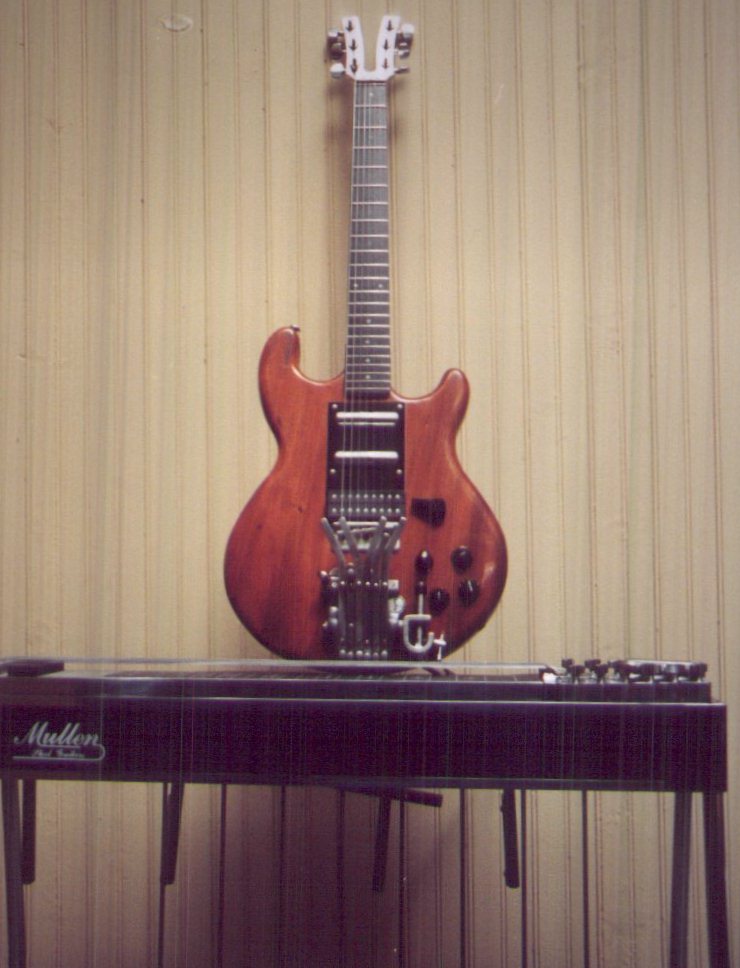
P.S. I also play a 1989 Mullen U-12 8 &5, but I don't play it out too much yet. I haven't been playing it nearly as long as the Pedal-Slide. Check the web site
http://www.db.ms and you can find additional information, like how to post questions and feedback or where you can see and hear it in action. " Catch you steelin' "(Note: The author, Dan Balde is a member of the Pedal Steel Guitar Association.
He is a working musician, based in New Jersey, who gigs on a regular basis in the Northeast.
This article is meant to inform, not to intimidate pedal steel guitarists.)
From The Pedal Steel Newsletter Volume 26 Number 7 August/September 1999